
Blog categories
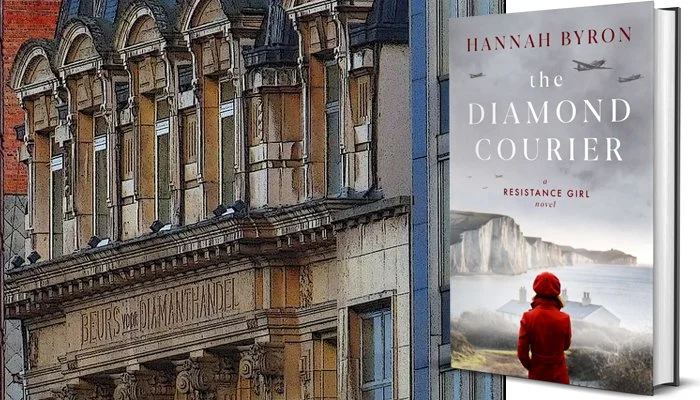
The Story behind The Diamond Courier
While writing The Diamond Courier, I discovered the remarkable wartime history of Antwerp's Jewish diamond industry. What began as historical research became the inspiration for Lili Hamilton's story—a novel rooted in the quiet courage of the men and women who risked everything to smuggle diamonds out of occupied Belgium.
The ornate stone façade of Antwerp Central Station with its grand dome, turrets and arched glass window rising above the station square.
I’ve lived close to Antwerp for most of my life and have always been fascinated by this city at the mouth of the River Scheldt, with its rich history and love of good food. It is a city that has produced painters like Peter Paul Rubens, writers such as Willem Elsschot, and designers including Dries van Noten and Raf Simons.
But Antwerp has another glittering heart: its diamond industry.
The diamond district, also known as the Diamond Quarter (Diamantkwartier) and often called the Square Mile, is an area in the centre of Antwerp. It consists of several square blocks covering no more than about one square mile.
Although much of the gem cutting and polishing historically carried out in Antwerp has moved to countries with lower labour costs, about 84% of the world’s rough diamonds still pass through the district, making it the largest diamond centre in the world. With a workforce of around 30,000 people, it remains one of Antwerp’s most important industries.
The Beurs voor Diamanthandel building in Antwerp's diamond district, its name carved above classical columns.
Within the district is the Antwerp World Diamond Centre and four trading exchanges, including the Diamond Club of Antwerp and the Beurs voor Diamanthandel, both founded by Hasidic diamantaires, as well as the Antwerpsche Diamantkring and the Vrije Diamanthandel.
The neighbourhood has long been dominated by Jewish diamantaires, alongside Jain Indian, Lebanese Maronite Christian and Armenian dealers. Historically, Yiddish was one of the principal languages spoken on the diamond exchange, and no business was conducted on Saturdays.
Behind these elegant buildings, however, lies a complicated wartime legacy: one of brilliance, betrayal, survival and silence.
As I was writing World War II fiction at the time, I wanted one of my novels to explore this difficult chapter of Antwerp’s history. That became The Diamond Courier, the story of a young British woman who is drawn into the dangerous task of smuggling precious diamonds out of occupied Antwerp and bringing them safely to London.
Although Lili Hamilton’s story and her contacts with the Goldmunz family in Antwerp are fictional, many real stories exist of diamonds being hidden and smuggled out of the city to keep them from Nazi hands.
The Black Falcon, a 612.34-carat black carbonado diamond shaped like a falcon's head
While researching The Diamond Courier, I had the honour of corresponding with the Belgian historian Eric Laureys, author of Meesters van het diamant. De Belgische diamantsector tijdens het nazibewind (Masters of the Diamond: The Belgian Diamond Sector during the Nazi Occupation). He generously answered my many questions and even read The Diamond Courier before publication, kindly giving it his approval.
His book offers a rare and meticulously documented look at how the Nazi occupation reshaped Antwerp’s Jewish diamond industry, both through brutal suppression and, more unexpectedly, through moments of calculated tolerance.
The Antwerp Diamond Industry Before the War
By the late 1930s Antwerp was already one of the world’s great diamond centres. More than 25,000 people worked in the trade as cutters, polishers, dealers and brokers. The Jewish community stood at the heart of this world, particularly on the commercial and export side. Many families had come from Eastern Europe and worked alongside Flemish artisans in a close-knit, highly skilled industry.
Tolerance, Then Seizure
When Nazi Germany invaded Belgium in May 1940, the pattern of occupation was anything but uniform. Unlike Amsterdam, where the Jewish diamond industry was seized almost immediately, Antwerp’s Jewish diamantaires were, for a time, allowed to continue working.
Why?
Because the Nazis needed them. Their expertise could not easily be replaced.
That uneasy tolerance began to disappear by mid-1942. The SS established the Deutsche Diamant- und Edelstein Gesellschaft, a centralised agency that forced all sales through Aryanised firms in Brussels. Jews who had not yet fled or been arrested were increasingly barred from the trade. Their workshops were closed. Their assets were looted. And their names disappeared from the books.
Resistance Through Stones
But the story didn’t end there. Some diamantaires defied the system. They hid diamonds, passed them to trusted contacts and joined the underground.
Eric Laureys recounts cases in which diamonds were sewn into coat linings and carried across borders by couriers posing as fashion buyers or students. Many of those couriers were women, calm, alert and brave.
It was while reading these accounts that Lili Hamilton slowly began to take shape in my imagination. I wanted her courage to be rooted in the real acts of ordinary people whose names history has largely forgotten.
The smuggled stones were sold or used to finance escape networks, bribe collaborators and keep Resistance organisations alive. These were quiet acts of defiance, but vital ones.
Aftermath and Reconstruction
After the war Antwerp slowly rebuilt its diamond trade. Some Jewish families returned, shattered and scarred, and attempted to reclaim what they had lost. Many others settled in the newly established state of Israel or in cities such as New York and London, where new diamond centres developed.
Yet Antwerp remained closely tied to the diamond trade, and new firms gradually rose in place of the old, although the shadow of wartime looting and collaboration never completely disappeared.
Laureys’s work does more than expose injustice. It restores dignity to those who resisted, even in the smallest ways: those who hid a pouch of uncut diamonds instead of handing them over, and those who crossed a border knowing they might never come back.
After reading his book, I couldn’t stop thinking about the unnamed men and women who carried diamonds through occupied Europe, unarmed, untrained and utterly brave.
It was then that Lili Hamilton came to life.
Although The Diamond Courier is a work of fiction, it is firmly rooted in the courage of those forgotten men and women whose quiet acts of resistance helped save lives.
This remains one of the lesser-known stories of the Belgian Resistance, and I’m deeply grateful to Eric Laureys for helping illuminate this forgotten chapter of history and for so generously sharing his knowledge while I was writing The Diamond Courier.
Further Reading
· Eric Laureys, Meesters van het diamant (Lannoo, 2005)
· The Plundering of Antwerp’s Jewish Diamond Dealers, 1940–1944 – United States Holocaust Memorial Museum symposium
· Antwerp Diamond Centre archives and post-war restitution files (Royal Library of Belgium)
In Lise de Baissac’s Footsteps in Marseille
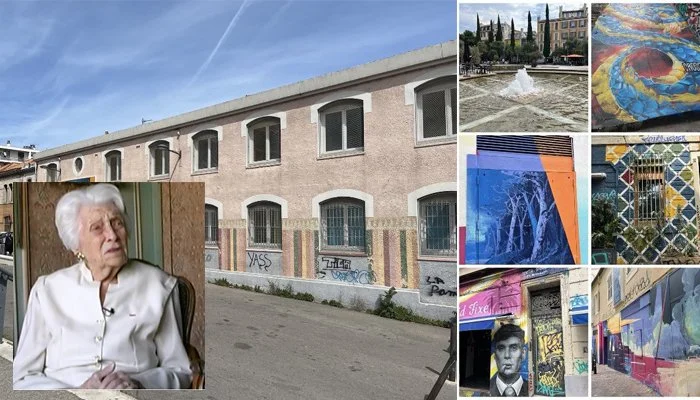
Following in SOE agent Lise de Baissac’s footsteps through Marseille took me from her former home overlooking the Vieux-Port to a street bearing her name that I couldn’t find — and finally to the graffiti-covered streets of Cours Julien, where history unexpectedly met my fiction.
Finding Lise’s apartment on the Quai Rive Neuve
Before travelling to the south of France, I knew that Lise de Baissac had lived in an apartment overlooking the Vieux-Port after the war on the Rive Neuve side, but I hadn't been able to work out exactly in which building she lived. So, sitting in my hotel room overlooking the harbour and having walked up and down in vain, I decided to email Martyn Cox, who had interviewed Lise in her house in the early 2000s, not long before she passed away, to ask whether he happened to remember her address.
Within ten minutes, he replied: 15 Quai de Rive Neuve. Not only that, he sent me photographs to help me recognise the building, and when I looked out of my hotel window I realised, rather wonderfully, that I could actually see Lise's house from my room.
So I immediately set out on my expedition with the address in hand. The building was still there, rather unremarkable between its more imposing neighbours, above the Bar de la Marine, although the first thing I noticed was that the front door was covered in graffiti.
"Oh no, I don't want that for Lise," was my first thought. “How can that be in such respectable surroundings?”
I went into the Bar de la Marine and spoke briefly with two young waiters, who did know that Lise de Baissac had once lived upstairs, although they probably were still in diapers when she died in 2004. The patron may have known more, but he wasn’t in.
From her house I walked a little further down and took the ferry that crosses from one side of the harbour to the other, so I could look back at her house from the water. It was nice to realise I was seeing and enjoying sights she had probably cherished for decades: all the vitality of a busy port city, both on the road and on the water.
A Street without a Sign
There was another trace of Lise I wanted to find because my research had shown me Marseille had named a street after her: Rue Lise de Baissac in Saint-Mauront in the 3rd Arrondissement.
I had been advised not to wander around that particular area alone, so I found a young English-speaking taxi driver and explained what I was looking for. He took me there in his Tesla — my first ride in one, incidentally — and we gradually left the familiar Marseille around the Vieux-Port behind for a very different part of the city, with tower blocks, satellite dishes, washing hanging from balconies and, once again, an extraordinary amount of graffiti.
According to Google Maps, Rue Lise de Baissac should have been alongside an primary school school, and we found the school easily enough, which was closed on Sunday, of course. What we couldn't find was any evidence whatsoever of the street name or sign.
We parked the Tesla and walked around the school and the block several times while I stared at Google Maps and the taxi driver got more confused by the minute. If the street existed as Google Maps showed, there should be a sign, according to his taxi driver mind. I was quite prepared to accept defeat, but not the young Tesla driver.
“Stay close to me,” he warned, and although I was taller than him and he didn’t look particularly muscled, it sounded reassuring. “This is an area where you have to stay very vigilant. Keep your bag close and don’t leave my side.”
We spotted a group of young men loitering outside the closed school entrance and he resolutely walked over to them. I watched him trying to explain who Lise de Baissac had been and why this English historical novelist desperately wanted to photograph a street sign with her name on it, but they were too drugged and disinterested to provide him with anything but a vague stare and a shake of heads. Tesla man gave up as well.
I took a photograph of the school instead, just to be sure.
I’ll never know whether we missed the sign or it simply wasn’t there.
Cours Julien
The third place I wanted to visit in relation to my book had nothing to do with the historical Lise de Baissac. It was about The Colour of Courage.
The contemporary part of my novel takes place in Marseille in 2004, and my modern heroine, Sil Anderson, is a young graffiti artist. I had deliberately brought Sil to Marseille because of its street-art culture, so Cours Julien was an area I very much wanted to see.
I went early in the morning, before the shops and restaurants had opened, and wandered around taking photographs of the murals. Some were wonderful, although there was also a lot of scribbling over some, and I wondered if Cours Julien might actually have become more run-down over the years. Not an artist in sight, but they probably slept in.
I couldn’t suppress the thought that — unbeknownst to me when writing my novel — graffiti seemed to follow Lise throughout my Marseille research. It was on the front door of the house where she’d lived, all around the neighbourhood where I couldn't find the street bearing her name, and now it surrounded me in Cours Julien, where it had become part of the fictional story I had written about her.
Lise, quite the aristocratic lady, probably wouldn’t have approved, but then again she married a painter, Gustave Villameur, so who knows? She might even have enjoyed wandering around Cours Julien herself and remembered that she too had once been young and a bit of a rebel, parachuting into France to fight the Nazis.
The Girl Who Was Almost Audrey
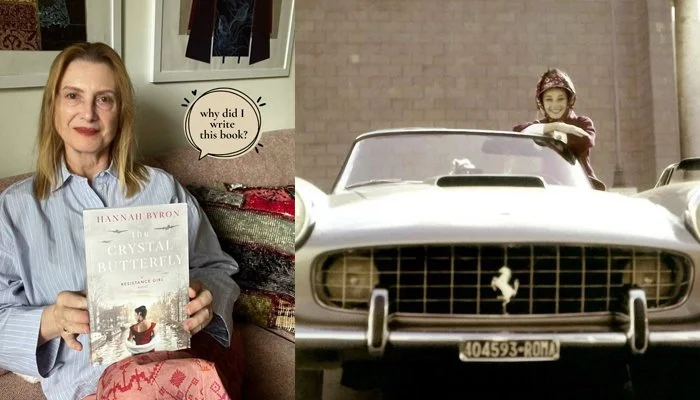
I have loved Audrey Hepburn all my life — long before I knew she had been a ballerina, and a girl in the Dutch resistance. This is the story of how that lifelong love, and one astonishing fact, became The Crystal Butterfly.
Audrey Hepburn and a Ferrari in Rome, Italy in March 1961, during a fashion shoot for Givenchy. Photographer was Pierluigi Praturlon (public domain) Hepburn's husband Mel Ferrer is to the right. Ferrari historians claim this is the s/n 1879GT which was used in a Pink Panther movie as well.
I have loved Audrey Hepburn all my life.
When I was young, the loveliest thing anyone could say to me was that I looked a little like her. I never quite believed it, but I treasured the compliment more than any other — because to be told you resemble Audrey Hepburn is to be told you resemble grace itself. And perhaps the kinship I felt ran a little deeper than a face. Audrey was half-Dutch, with a baroness for a mother — grand blood and hardship braided together. I am no aristocrat, but I know something of that braiding: a whisper of nobility on my father’s side, old family arms and all, and plain working-class Britain on my mother’s. Grand and ordinary, in the same person. She was, quite simply, everything I longed to be.
But it was never the glamour that moved me most. Anyone can admire the gowns and the cheekbones. What held me was something quieter: that Audrey had come through so much in her childhood — hunger, fear, the long years of occupation — and had carried all of it with such lightness afterwards, as though grace were a decision you made every morning rather than a gift you were handed.
The thing I didn’t know
It was only much later that I learned the rest of her story.
As a girl in the Dutch town of Velp, living with her mother and her grandfather through the German occupation, Audrey had played her own small, quiet part in the resistance. And before any of it — before the films, before the fame — she had wanted to be a ballerina. She had trained for it, dreamed of it, danced through the war on too little food and too much fear.
A ballerina, in the Dutch resistance. I couldn’t let it go.
Where Edda van der Valk came from
So Audrey’s Dutch years was the spark for The Crystal Butterfly.
I wanted to write a ballerina who finds her way into the resistance — a girl whose discipline and grace become something harder and braver when her country is taken from her. Her name is Edda van der Valk, and I want to be clear: Edda’s story is entirely her own. It is not Audrey’s life in disguise. But Audrey was always there as I wrote, somewhere at the back of my mind, a presence rather than a template — the reason the book exists at all.
An unexpected honour
While I was writing, I did something I still can hardly believe I dared to do: I got in touch with Robert Matzen.
Robert is the author of Dutch Girl: Audrey Hepburn and World War II, the definitive account of exactly those years in Velp — a book written with the cooperation of Audrey’s youngest son Luca Dotti, and with access to material no one else had seen. He is the person who knows this story better than anyone alive.
And he became one of the very first readers of The Crystal Butterfly.
“Hannah Byron brings the fight against Nazi occupation in World War II vividly to life. The Crystal Butterfly is a page-turner that authentically captures the times and its heroes. I loved this book.” — Robert Matzen, international bestselling author of Season of the Gods and Dutch Girl: Audrey Hepburn and World War II
I have kept that review close ever since.
Walking the real streets
I couldn’t write about Velp and Arnhem from photographs alone. So I went. I walked the streets Audrey walked, stood where she stood, and took my own pictures of the places that shaped both her story and, in its own way, Edda’s.
I wrote all of that up separately — the discoveries, the corners that still remember the war, the small shocks of standing in a real place after imagining it for so long.
Read about my footsteps through Audrey’s Arnhem and Velp here
Adriaantje
There is one more thread, and it is the one I have never quite been able to explain.
Audrey’s grandfather called her Adriaantje — a small, tender Dutch endearment. My own second name is Adriana. And somewhere along the way I quietly took her name for mine, too: I have called myself Hannah Audrey ever since.
I don’t offer this as evidence of anything — only as the truth of how deep some admirations go. Long before I knew about Velp, or the resistance, or the girl who danced through the war, some part of me had already folded Audrey’s name into my own. Perhaps writing Edda was simply the moment it finally rose to the surface.
Where the book began
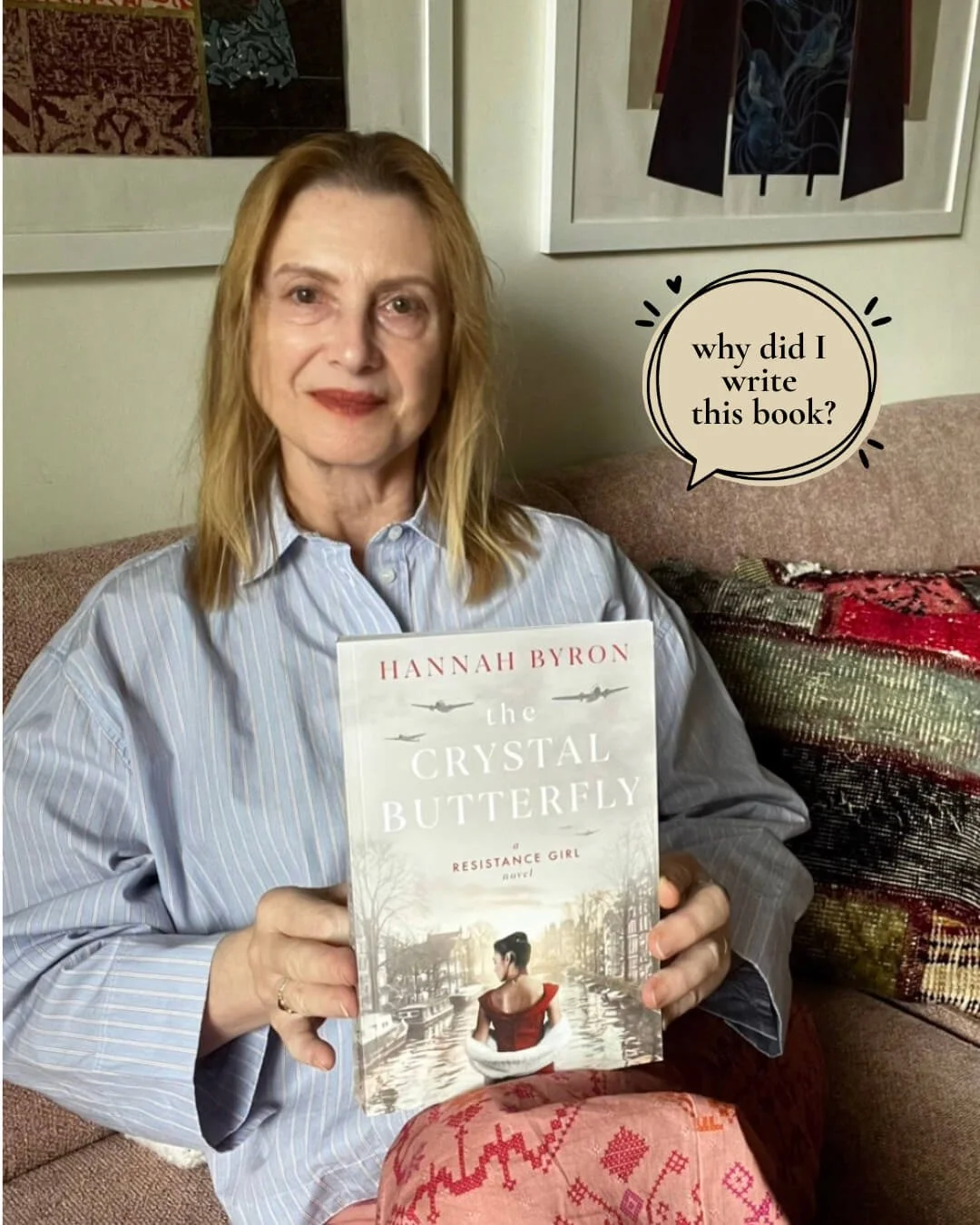
So that is the honest answer to why did I write this book?
Not because I set out to fictionalise Audrey Hepburn. I never would. But because a lifelong love, and one astonishing fact — a ballerina in the resistance — lodged in me and would not leave until I had written my way toward it. The Crystal Butterfly, a Resistance Girl novel, is where that finally led.
When Finding a Grave Became a Mission
Finding Henri Fiocca's grave in Marseille became an unexpected mission. With the help of a kind taxi driver and a determined cemetery clerk, I finally stood before the family tomb of the man who gave his life protecting Nancy Wake. It was the most moving moment of my entire research trip.
While researching my trip to Marseille, I’d found out that the city had named a street after Henri Fiocca, Nancy Wake’s husband, so I wanted to see that with my own eyes and take a picture. Marseille had honoured its late citizen with a street in the 1st Arrondissement, not far from my hotel on the Vieux Port.
There was, however, one place I couldn't find. I knew Henri, after been tortured and killed by the Gestapo in 1943, had been buried on the Cimetière Saint-Pierre, the largest graveyard in Marseille, but for the life of me I couldn’t find the exact tomb on that enormous graveyard.
I wrote to the cemetery office and to the archives, hoping someone might be able to tell me the exact location of the Fiocca family tomb. No one replied, so I decided that once I arrived in Marseille, I'd simply try my luck at the cemetery itself. The website cited an onsite office, open all weekdays. My simple French and I would manage.
I assumed the family concession might no longer exist. Why else had nobody been able to tell me where Henri was buried? Why else couldn’t I find it in this day and age where everything and everyone is traced and recorded? But it was worth the try.
So I set out on the Monday morning, with little hope but plenty of determination. What I imagined would be a straightforward enquiry – sorry Madame, no longer here - turned into the most memorable event of my entire trip.
My “arranged” taxi driver who only spoke French, while I communicated in my broken French — and I set out on what turned out to be a bit of a drive to the north of the city. I was really excited — and when I'm excited, I talk a lot. So I was telling this originally Marseillaise driver of Algerian descent a great deal about why I wanted to go there but what I expected. He seemed half interested, but also clearly thinking: this lady, trying to find people who died in 1943, in this heat, when everybody else is just thinking about ice creams.
When we arrived, we found the office crowded with people waiting and only one lady behind the counter. My heart sank, so I looked at my driver and said, "Maybe we should just turn around — this is going to take ages, and it's going to cost me a lot of money with the meter running." But he replied, "No, no. Let's sit down and wait."
At some point I got restless, breaking my mind how to speed this thing up, so I said to him, "I have a phone number here in one evasive email I got back — maybe you could ring them, because my French isn’t good enough to explain what I want on the phone. If you'd be willing…" And he said, "Yes, of course." He went outside to make the call and told me to listen for a phone ringing in the office.
It didn’t but soon after a blonde woman in her forties came down the stairs, in a rather ridiculous short playsuit — not meant to be sexy or anything, just the fashion, I guess. She came up, a bit hazy, and said, "What do you want?" I explained, and she said, "Okay, okay," and wrote it down on a Post-it, ready to drift over to another waiting person. French efficiency.
My Marseillaise driver came back inside and he made sure the office lady had all the details he'd pieced together from my broken French. He repeated it to her, and she said, "Yeah, yeah, yeah," and hopped off in her little playsuit, up the stairs again, to see what she could do for us.
Meanwhile my driver sat down next to me, now searching and scrolling on his phone. He was looking up Henri Fiocca, going through the archives himself, trying everything. He even came up with a photo of Nancy Wake — "Is that the woman?" Yes, yes, yes. He was quite invested in my quest by now.
I was getting more nervous by the minute, because the woman in her playsuit wasn't coming back. And the people just kept crowding into that office. There was also a man in a business suit with a briefcase under his arm, who looked very much the part — but he was just hopping from one person to the next, and he never looked my way.
It seemed nobody was going to help me, except my taxi driver. Then the blonde lady came down again, only to run off to somebody else. I went up to her before she could escape again and said, "Listen — how long is this going to take? I've got a taxi waiting for me, and this driver may have other clients waiting." That made her a little snappy, as she clearly didn’t want to be hurried along: "I'm doing my best, that’s all I can do." And off she went upstairs again.
I just sighed and thought: this is not going to work. We're never going to find him. The tomb probably isn't even here anymore — it's so many years ago. So I had basically given up.
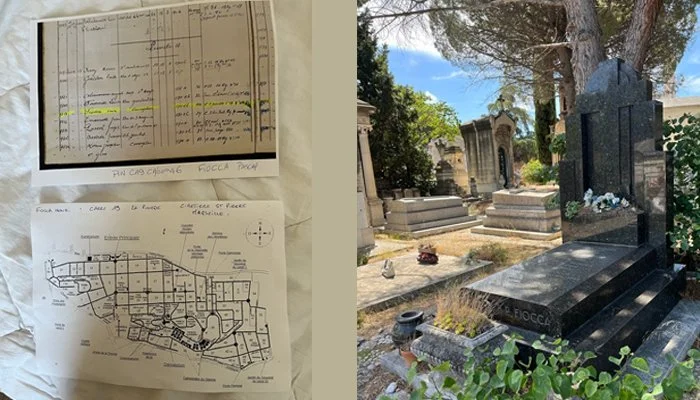
Until suddenly the scarcely dressed official came down again, with papers in her hand. And they held the archive number she’d tried to find. She explained they couldn't find him by his name alone, but with the archive number they could: the tomb had been bought by Pascal Fiocca, who was Henri Fiocca's father, and the exact plot was there on the papers — where the tombstone stood.
I thought: this isn't possible. I was high fiving my taxi driver and he had a big smile as well. I didn't dare look straight at the playsuit lady, as I had tried to hurry her along; but I thanked her deeply, while I felt all she thought was, what a strange, agitated woman looking for a man dead for decades.
The papers the office handed me — the register entry for Pascal Fiocca (highlighted) and the plot map of the Cimetière Saint-Pierre: Carré 19, La Pinède (click image to enlarge)
Anyway, we went inside the taxi, because one can drive right across the cemetery — it's that huge. Really, I've never seen a graveyard so big. Of course there's no navigation in there. My poor driver had to feel his way around and take wrong turns, with as help only the site map we’d been given and some quick instructions it was near the crematorium.
At some point he parked the Ford and said, "It must be really near here, we’ll search from here." He made sure we found it together — he was not going to let me wander around there looking for the dead on my own.
When we spotted the tomb, I did first, he stepped away and said, "Take your time. I'll just be waiting a little further on." It was so gallant. I saw him standing there with a small cigar, and I thought: what a wonderful man.
It was quite something to finally find that grave and I had to adjust a moment where I was. I realised, standing there in the half shade in front of that black marble tomb, I may be the only one alive now who knows where it is.
In former days, people surely knew where Henri Fiocca was buried — but I don't think any of the historians I'm in contact with know exactly where the plot is, because it took me an entire morning to find it. So that's something I can share with the people who care about these details. It felt valuable, but that was still my outside reacting to standing there after the intense search and believing I wouldn’t.
Then I landed and looked at this rather unremarkable tomb — not what you'd expect from a millionaire family. It was just a family grave. There were a couple of women — a grandmother, a mother, maybe an aunt — and a few men's names. And then just Henri Fiocca, with his date of birth and his date of death. Nothing about him. And finally, the last name, Pascal, his father, who died in 1954. Nothing that mentioned his heroic death; nothing that he was connected to Nancy Wake.
Just family, family, family. And somehow that was more moving than if it had been a grand tribute to a great hero.
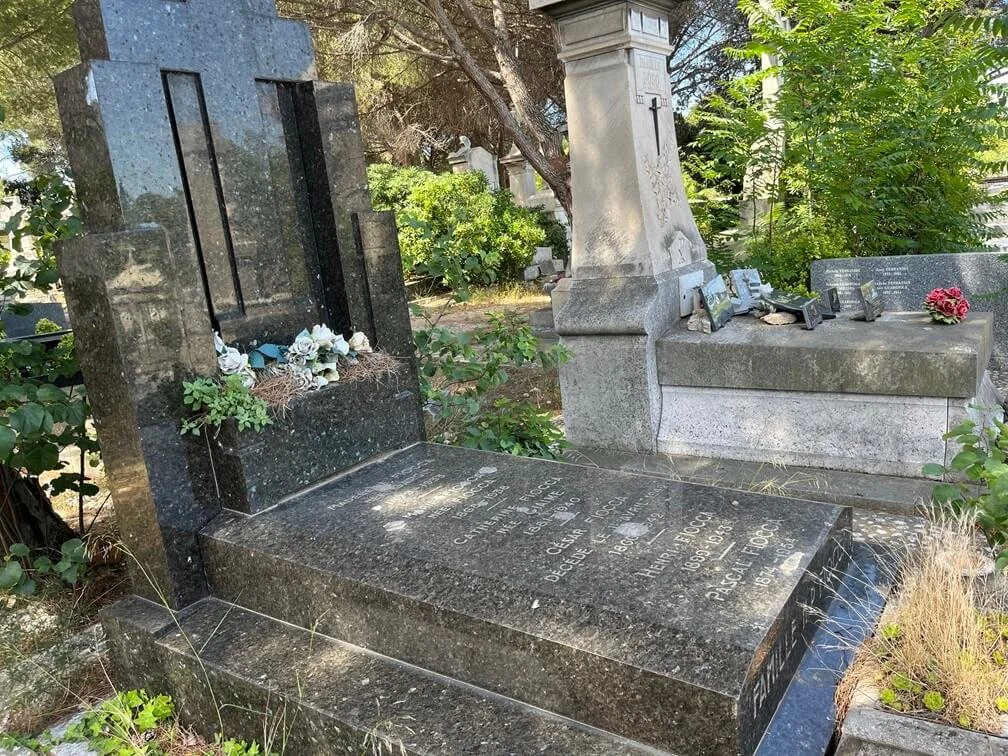
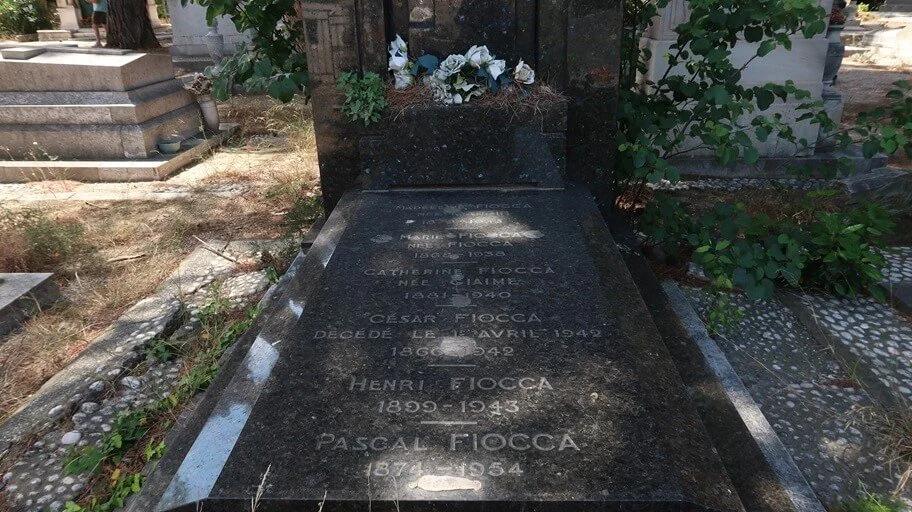
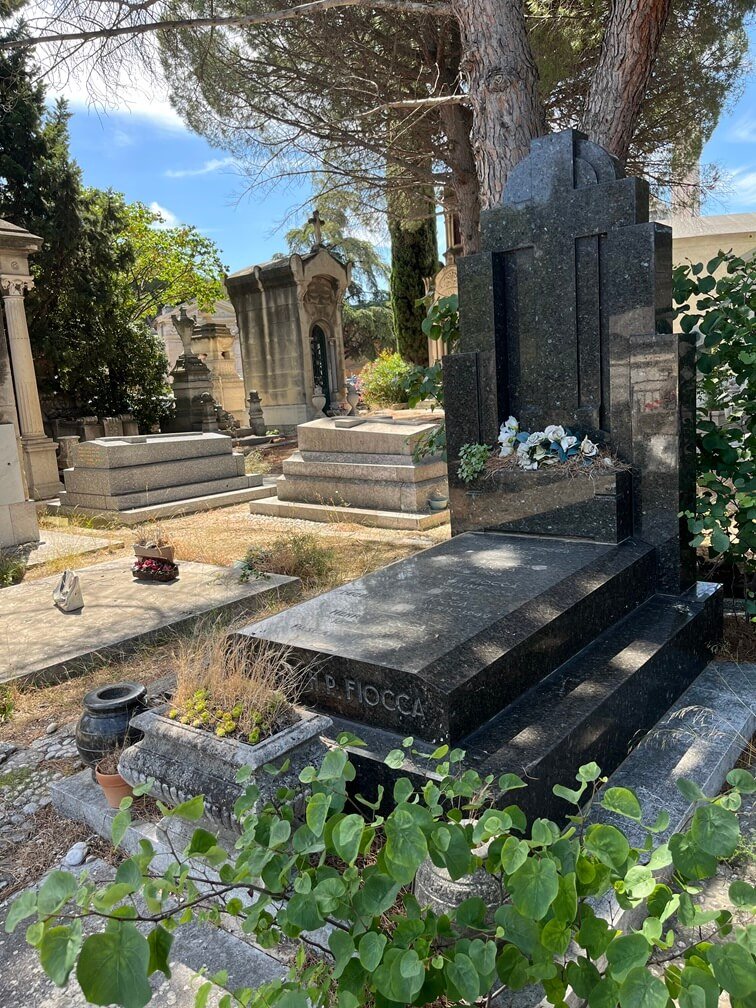
The Fiocca family grave in the Cimetière Saint-Pierre. Henri among his own — no mention of heroism, no mention of Nancy. The grave among the quiet rows of the Cimetière Saint-Pierre. (Click images to enlarge)
I recorded a short video, in which I told Henri and his family that I was quite moved — I'm still moved thinking I stood there — and I thanked him for what he had done, for keeping Nancy safe, for the sacrifice he made, for the feeling that his sacrifice deserves to be remembered more widely.
That's why, in a way — I've written these books about him, and although I never knew him, I have imagined him, imagined his relationship with Nancy. And something came through during my visit to Marseille that really spoke of the heart of the city: this family who weren't truly involved in the Resistance and yet paid such an enormous price. Just a Marseille family mourning the loss of a son and heir in silence. Forever.
It was a moment of deep contemplation for me — to the point that, back in the taxi, I wasn't chattering anymore. So, some kilometres away from Cimetière Saint Pierre and Henri’s grave, the dear driver simply asked me, "Ça va?" — are you all right? After everything — the long morning of searching, the grave, the video, the emotion of it all — that was what he asked. Just: are you all right? And somehow, coming from him, it meant the world.
When we got back to the Vieux Port, I was bracing myself for an enormous bill — we'd been out the whole morning. But he said it was one hundred euros. I gave him twenty euros on top, for his “déjeuner” he said he really needed now.
Looking back, I think I should have tipped him more, but I was still a little dazed.
I had gone looking for two women, Lise and Nancy. I came home with one man on my mind and the sacrifice he had made.
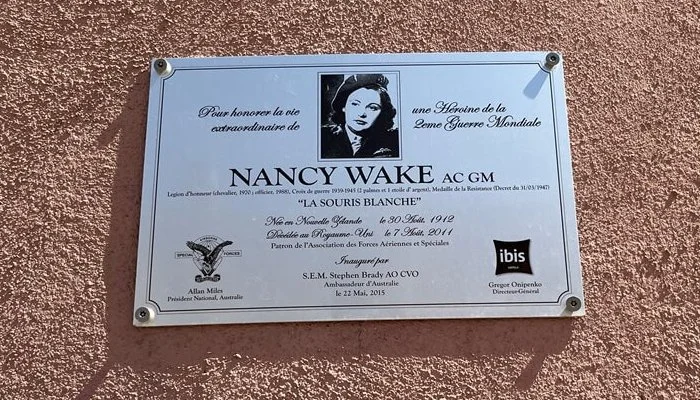
Has Marseille Forgotten Nancy Wake?
I expected Marseille to be full of reminders of Nancy Wake. Instead, I found a plaque almost nobody knew existed, a house that had vanished, and a city that seemed to have quietly moved on. Sometimes historical research is as much about what isn't there as what is.
A View Across Marseille (all images clickable to enlarge)
One of the things I wanted to find in Marseille was a plaque dedicated to Nancy Wake. According to my notes, it was somewhere on the Ibis hotel near Gare Saint-Charles.
So one very hot afternoon I walked up from my hotel through the narrow streets towards the station. It was the first time I climbed the famous staircase of Gare Saint-Charles and looked out over Marseille. Standing there, with the city spread out before me, I couldn't help thinking that this had once been Nancy's city.
From there I followed my navigation to the hotel. Finding the hotel was easy. Finding the plaque wasn't.
A Tiny Plaque
I walked all around the building without seeing anything. Eventually I went inside, partly because I hoped it would be cooler than outside, but also to ask at reception. Nobody knew anything about a plaque, which seemed odd to me. But as it was really supposed to be here, I went outside again and searched a second time. Still nothing.
Across the street I noticed a police officer. Perhaps he would know. As I asked in my slightly improved French, he shook his head. Never heard of a plaque. Never heard of Nancy Wake.
But instead of simply shrugging his shoulders, he said he’d help me look because now he was curious too. Together we searched every corner of the hotel until eventually we spotted something about two metres above our heads.
It was tiny. So tiny that neither of us could read it from the pavement. Fortunately, the police officer was taller than I was. He took a photograph with my phone and only then could I read the inscription.
Click to enlarge
The plaque had only been unveiled in 2015, four years after Nancy's death, by the Australian Ambassador to France after staying at the hotel. No wonder we had struggled to find it. And the police officer laughed that he’d worked in the office across the street for years and had never noticed it either.
I thanked him for his help, went back inside the hotel and showed the photograph to the reception staff. Suddenly it rang a bell.
"Oh yes..."
One Last Address
By then the heat had really begun to catch up with m so I asked the hotel to call me a taxi. As I waited, I thought there was one final place connected to Nancy that I wanted to see. After her marriage, she and Henri Fiocca had lived at 5 Rue Édouard Stephan in the 4th Arrondissement.
I asked the taxi driver whether he could drive me past the address. At first, he mumbled something that sounded very much like "no, that’s not permitted." Then, after a moment's thought, he must have changed his mind, because after taking endless roads left and right, he suddenly announced.
"We're here."
I looked out of the window. It looked like a very ordinary street to me that bordered on a small park. Not anything fancy and expensive, which I had also already wriggled out of the taxi driver. No not a posh area perse, never had been. Henri Fiocca? The successful industrialist? Somehow, I had imagined something grander. Instead, it looked like an ordinary neighbourhood.
But it was clear that the building where they used to live had long since disappeared, replaced by a modern apartment block. I took a photograph of the house anyway, because what else could I do? By now, I suspect the taxi driver thought I was a rather odd passenger anyway.
Opposite what used to have been their house, stood an old tree so I also took a picture of that hoping that stood there already when Nancy looked out of the window. But who knows?
A City That Had Moved On
As the taciturn taxi driver drove me back towards the Vieux-Port, I couldn't help thinking how strange this afternoon had been. Nancy Wake had once carried the highest bounty on her head offered by the Gestapo. 5 million Francs. She is remembered throughout the world as the White Mouse, the famous WW2 resistance fighter. She’d kept that image of herself alive for decades, but it seemed to have faded after her death.
Here, in the city where so much of her resistance work begun, I’d found remarkably little that still spoke of her. A tiny plaque almost nobody knew existed. A house that no longer stood.
Marseille, it seemed, had quietly moved on. At that moment I thought my search for traces of Nancy Wake had come to an end. They had.
But I had no idea that the following day I would stumble upon something that will keep her memory alive in my mind forever.
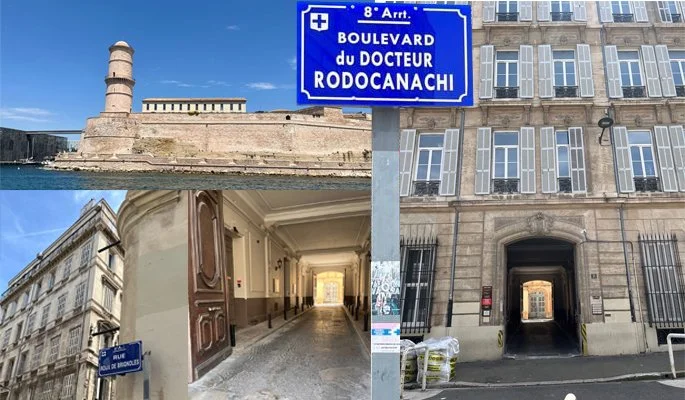
Only the Avenue Remembers Dr. Rodocanachi | Following Nancy Wake's Footsteps in Marseille
Following Nancy Wake’s route from Fort Saint-Jean to Dr. Rodocanachi’s house in Marseille, I expected to find an address. Instead, I found a forgotten story, a helpful car mechanic named Mohammed, and a place that quietly changed the way I imagine one of Nancy Wake's wartime missions.
Fort Saint-Jean
My feet were already quite tired from walking in the Marseille heat. I'd walked along one side of the Vieux-Port to find Lise de Baissac's house, but I decided I still wanted to see Fort Saint-Jean. It had played such an important part in Nancy Wake's early resistance work through Ian Garrow's escape line, which would later become the Pat O'Leary Line.
My research at home had shown me that you could walk around the grounds and the ramparts of the fort without buying a ticket for the museum. I wasn't particularly interested in spending the afternoon learning about the fort's seventeenth-century history, but by the time I finally reached the far end of the Vieux-Port I was simply too tired to go inside anyway.
I took a few photographs and just stood there, thinking, This is where Nancy stood. This is where she helped escaped British officers in 1940 and beyond. And from here she took them to Dr. Rodocanachi's house.
Memorial for people who couldn't leave Marseille during WW2 Fort Saint Jean
I had already looked up the doctor's apartment at 21 Rue Roux de Brignoles, in the 6th arrondissement, and despite the heat and my sore feet decided to go there next because it was much closer than I had imagined while writing The Ace of Nerve.
Somehow, in my imagination, Fort Saint-Jean had always been much farther outside Marseille, but now I realised that transporting those officers, still in uniform, in the back of Félix's plumber's van had actually been a journey of only about a mile and a half.
That didn't make it any less dangerous, but it changed the logistics.
Looking for Dr. Rodocanachi
After a short rest, I climbed the steep road up to 21 Rue Roux de Brignoles and was surprised to find such an ordinary-looking street. The house numbers had changed over the years, so I found myself looking around wondering, Is it this house? Or perhaps that one?
It struck me that this is often the case with places connected to the Resistance. They rarely announce themselves. Extraordinary courage was so often hidden behind the doors of perfectly ordinary buildings.
As I stood there, someone who was looking at a few cars nearby came over to me. It was Sunday, so he wasn't actually working. He introduced himself as Mr. Mohammed and asked, quite understandably, what I was doing. He had seen other people taking photographs of the building and wondered why.
In my simple French, but with my usual enthusiasm, I explained I was looking for the house of Dr. Georges Rodocanachi, an important member of the French Resistance during the Second World War.
He had never heard of the doctor, or of Nancy Wake, or of British officers being hidden in a plumber's van, but my enthusiasm clearly intrigued him. I showed him my map with the address and a photograph of the Boulevard du Docteur Rodocanachi, which I had already taken.
Scratching his grizzled head, he said, "Well, I really don't know anything about him. I've lived here for quite a while in one of the rooms upstairs, but I'm just a car mechanic. Still... perhaps you should come back tomorrow. The owners of the building are Greek, and I think there are many old photographs inside the offices. Maybe they know something."
House of Dr. Rodocanachi (click to enlarge)
Then he suddenly pointed above the entrance.
"Look."
The modern number beside the door read 21, but carved into the stone above the archway was the original number 25.
"The numbers have changed," he said.
It was another little clue in the puzzle I was trying to solve.
I had already noticed that part of the building now housed lawyers' offices, but nowhere had I seen the name Rodocanachi.
By now Mr. Mohammed had become almost as invested in the search as I was.
"Come."
He led me through the entrance hall and started pounding on the office doors, hoping somebody might be there on a Sunday. Nobody answered.
"Come back tomorrow," he said. "Tell them Mohammed sent you."
So, in the same heat, I walked back down the hill, rested in my hotel room and hoped that perhaps the next day I would be lucky.
One More Attempt
The following afternoon I climbed the hill again. This time I didn't see Mr. Mohammed, but I rang the bell. A young woman opened the door. She was friendly but had absolutely no idea who Dr. Rodocanachi was or what the history of the building was. She was simply the secretary to the lawyers. Nancy Wake meant nothing to her either.
She asked me to wait in the wonderfully cool lobby while she fetched one of the lawyers. He came out in a smart suit, and I immediately pictured him on an expensive yacht in Monaco. He had that sort of air about him.
Listening carefully to my story—or at least giving that impression—he admitted he didn't know anything about the history of the building either.
"But yes," he said, "the director of the company is Greek, so perhaps he knows."
I handed him my business card, the first one I had ever used after hastily creating it before leaving for Marseille, and I must admit I felt rather grand about it. The smart-looking lawyer promised that when the Greek director returned, he would ask him to contact me.
I watched my phone and my email for the rest of the day and the next morning. No phone call. No email. So my search for Dr. Rodocanachi and his wife Fanny ended there.
Only the Avenue Remembers
As I reflect on the one mission in Marseille that produced the fewest answers, I mostly think with gratitude about Mr. Mohammed. The car mechanic has become characteristic, for me, of the people I met in Marseille. He tried to help me with everything he had because I was so determined to find a doctor who had lived there more than eighty years ago—a man he'd never heard of, but who somehow became important to him because he was important to me.
And I certainly didn't leave empty-handed. I now have a much clearer picture of the route Nancy must have travelled many times. I stood where she stood. I walked the streets she walked. Standing in the entrance passage of 21 Rue Roux de Brignoles, I suddenly found myself imagining Félix driving the plumber's van through the gateway before the heavy doors closed behind him, allowing the escaped British officers to disappear from sight.
I don't know whether that is exactly how it happened. But now I could stand there, I could picture it. And how, unfortunately the loyal doctor must have been arrested there, never to return. Visiting Marseille has changed the images I carried in my mind while writing The Ace of Nerve.
Dr. Rodocanachi was arrested in 1943 and later murdered in Buchenwald. His wife, Fanny, survived the war. Today, people stroll beneath the leavy trees of the Boulevard du Docteur Rodocanachi in the 8th Arrondissement probably without giving the name on the blue street sign a second thought. Yet Marseille still remembers him.
And I do, and perhaps, through my stories, a few more people will too.
Snippet from The Ace of Nerve, Book 2, where Nancy first meets the doctor.
A slight, white-haired man appeared in the kitchen doorway, in a doctor's white coat with slim golden spectacles catching the light. He came to Nancy first and took her hand in both of his. They were soft and very steady, the hands of a man who’s been doing precise work for many decades.
"It is an honour to finally meet you, Madame Fiocca," he said warmly. "I have known your husband for many years, of course, but we have never had the pleasure. I am Dr Georges Rodocanachi."
"The honour is mine, Doctor," Nancy smiled, glad for both his steadiness and his warmth.
"And this," said Dr Rodocanachi, turning, "is my wife Fanny."
Fanny Rodocanachi was indeed a good deal taller than her husband. A composed, handsome woman with dark eyes. Younger than her spouse and very French in the way that required no announcement. The two women shook hands briefly and Nancy liked Fanny immediately.
"Coffee!" the doctor’s wife announced to the room at large, and she disappeared into the kitchen, reappearing only moments later with a tray of five cups and a steaming pot. After setting it down, she withdrew quietly. Nancy noted the five cups. Fanny had counted her in without being asked, just as Garrow predicted.
"I'll leave you to it, Captain," Dr Rodocanachi addressed Garrow with the ease manners of a man who’s long decided that trust, once given, requires no supervision. "I'll be in my consulting room should you need me. Take your time. This room is yours today."
And with that he retreated after his wife, closing the door softly behind him.
The White Mouse will be available at the end of August 2026
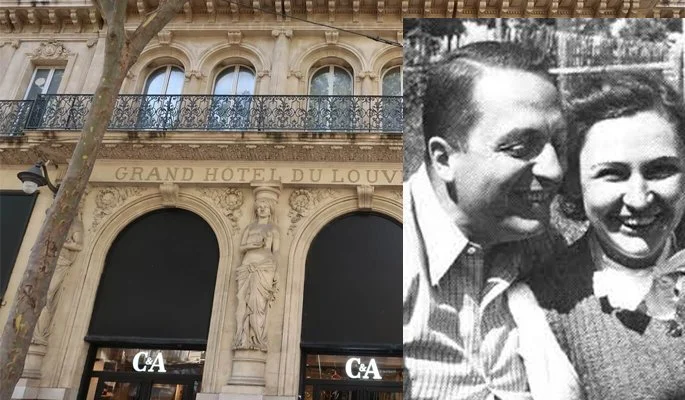
Nancy Wake Married Here. Today It's a C&A.
In 1939, Nancy Wake and Henri Fiocca celebrated their wedding at Marseille's grand Hôtel du Louvre et de la Paix in Marseille. When I went looking for it nearly ninety years later, I found... a C&A. Join me on La Canebière as history, humour and fiction unexpectedly meet.
Henri Fiocca and Nancy Wake, Photo by anonymous (c. late 1930s). Source unknown. Wikimedia.
Nancy Wake lived in Marseille for three and a half years, from 1939, when she arrived as a young journalist in love, until early 1943, when the Gestapo forced her to flee. It isn't long in a life that stretched to ninety-eight years, but those few years changed everything. They gave her a husband, Henri Fiocca, a life of wealth she'd never imagined, and eventually set her on the path to becoming one of the most famous resistance agents of the Second World War.
One place, more than any other, witnessed the beginning of her life as Madame Fiocca: the Hôtel du Louvre et de la Paix on La Canebière. One of Marseille's grandest hotels, it was a favourite meeting place for the city's upper classes, and Nancy and Henri were frequent visitors. It was only natural, then, that after their wedding in November 1939 they celebrated their reception there, surrounded by Henri's family and friends. Nancy's own family, on the other side of the world in Australia, could not be there.
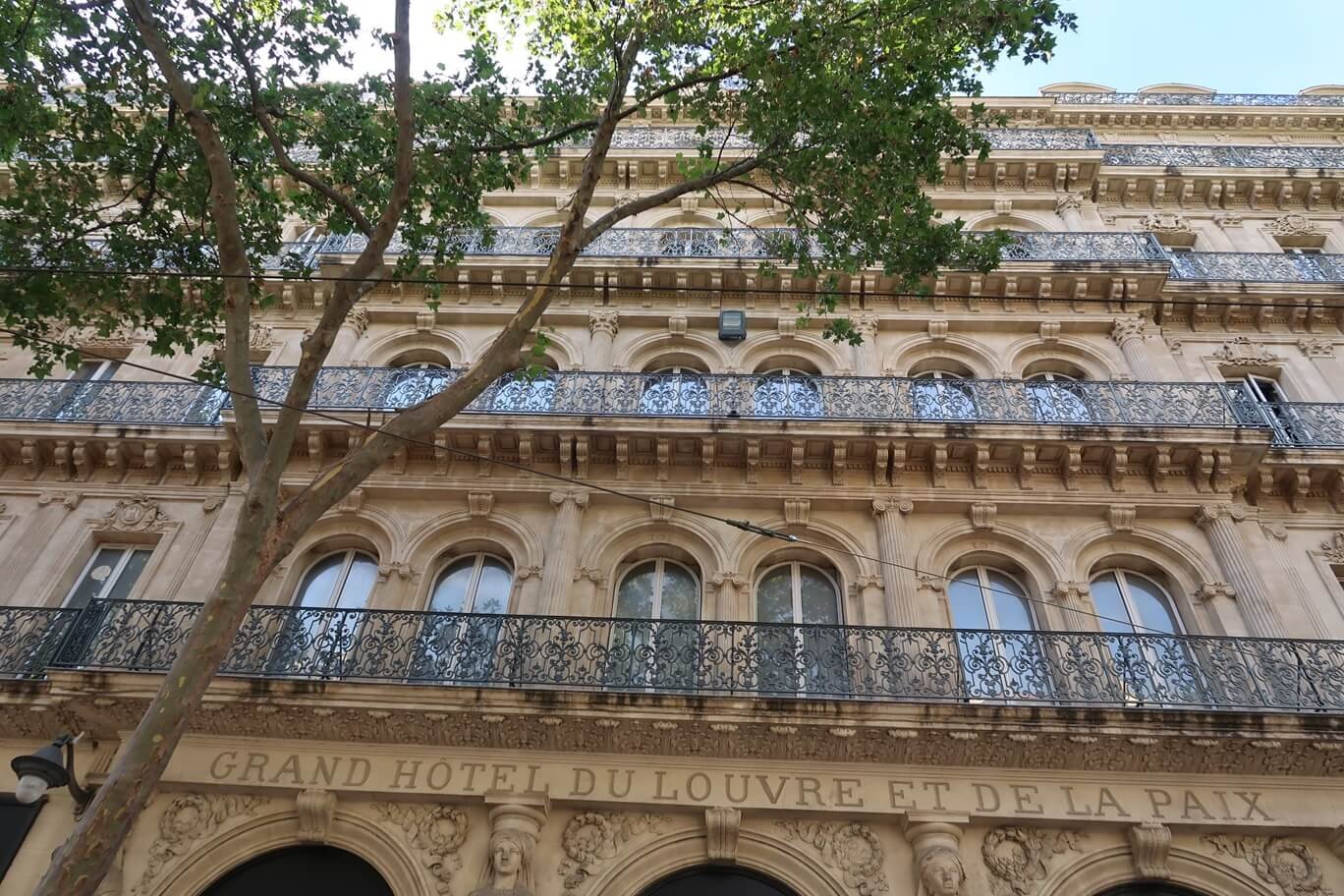
Façade of the former Hôtel du Louvre et de la Paix, Hannah Byron 2026
In June 2026, while researching my forthcoming novel The White Mouse, I had the wonderful opportunity to stand in front of the building myself, almost like a novelist peering through time and imagining the glamorous couple and their guests arriving beneath its grand façade in evening gowns, furs and tailcoats nearly ninety years ago.
But the perfect pictures I'd carried around in my head were a far cry from reality. There was very little glamour to be found. Unless, of course, one considers the summer dresses and khaki shorts displayed in the windows of C&A to be the height of elegance.
I had to look twice to make sure I was standing in front of the right building. I checked my map again. Yes. 53 La Canebière.
I looked up once more, past the bright shop signs, the window displays and the revolving doors, and there they were: the words Hôtel du Louvre et de la Paix, still carved proudly into the stone above the shopfronts.
But if I had to look that hard to find them, it's hardly surprising that nobody else notices them. After all, I was probably the only person walking along La Canebière that Sunday afternoon wondering what life had been like there in 1939. To everyone else, it was simply a C&A.
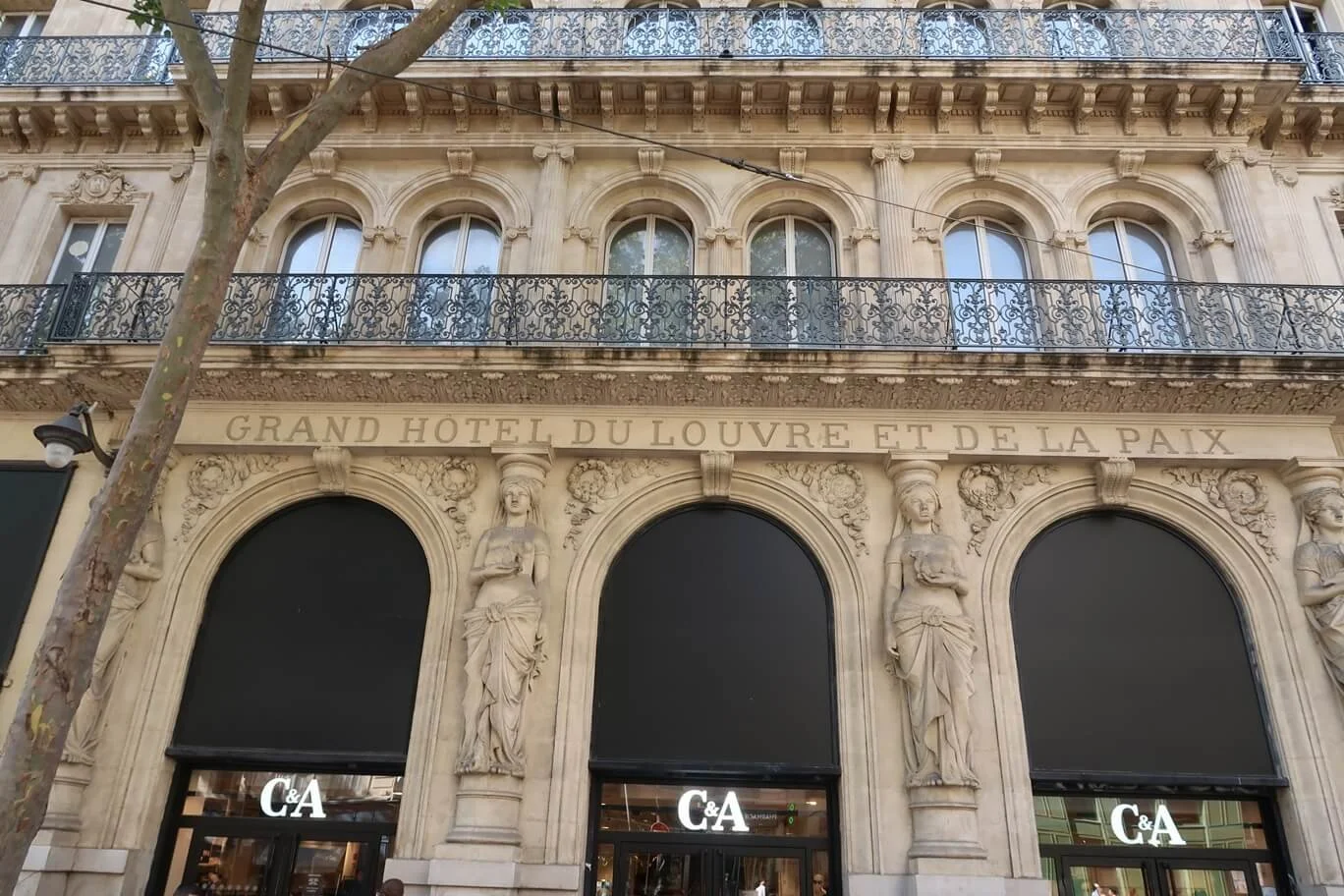
C&A shop signs visible on the former Hôtel du Louvre et de la Paix, Hannah Byron 2026
But I found her. The grand hotel, hiding in plain sight.
As I stood there taking photographs, while trams rattled past and tourists wandered by with ice creams, Marseille unfolded around me in all its glorious unpredictability. Across the street, an elderly woman leaned over her balcony, loudly berating several men below. I think she was speaking Arabic, though I couldn't be sure, and whatever the disagreement was about, the men didn't seem particularly impressed by her dramatic performance. Then, as if the city had decided one spectacle wasn't enough for a Sunday afternoon, a Catholic procession appeared. Priests, children, women in long dresses and men in dark suits walked slowly towards the Vieux Port beneath banners and singing. They disappeared from sight, only to return a little later, still singing. That procession wasn't very 2026 to my eyes. But as it happened to be my birthday, I thoroughly enjoyed the entertainment.
Back to the hotel, standing quietly apart from all the present-day bustle. Like a grand old lady keeping her dignity while the world hurried past.
Curiosity got the better of me, so I crossed the street, waited politely for the tail end of the procession to pass and stepped through the revolving doors. In my mind I was entering a grand hotel. In reality, I was entering a clothes shop.
I approached the young security guard and, in my battered French, asked whether anything inside still reminded visitors of the building's history. Perhaps a plaque. A photograph. Some small memorial.
He understood my French perfectly well. What he didn't understand was what I was asking him and why.
I tried again, explaining that this had once been an important place during the Second World War and that Nancy Wake, one of the most famous women of the French Resistance, had celebrated her wedding reception there.
His head kept shaking. Had I asked him where the men's underwear department was, I'm quite sure he would have been more helpful.
A few moments later I found myself back outside on the sunny La Canebière, the revolving doors still spinning behind me. 2026 bringing me back into reality.
As I Imagined It
Let me invite you to my Hôtel du Louvre et de la Paix in 1939 with Nancy and Henri in the picture.
The Hôtel du Louvre et Paix blazed like a cruise ship anchored to the Canebière, its windows throwing golden rectangles onto the freshly cleaned pavement below. From inside came the swell of an upbeat string quartet, ripples of laughter, and the clink of crystal flutes, sounds that belonged to another époque, an époque that hadn't yet understood it was about to end.
Draped in a mink stole over her silk dress, the seams of her stockings straight as an arrow above her high heels, Nancy paused at the entrance, Picon squirming on one hip. Henri, immaculate in his evening suit, gleaming black shoes and not one hair on his pomaded head out of place, offered his elbow with the patience of a man who had long since accepted that his wife would never arrive anywhere without causing some sort of commotion.
"You're not seriously bringing the dog," he tried nonetheless.
"The dog's name is Picon and Picon is family. Hence, Picon is coming."
Henri sighed the sigh of a husband already learning to choose his battles. "At least keep him off the tablecloths."
"No promises."
…..
This scene is from The White Mouse, the second novel in my The Ace of Nerve trilogy, which will be published at the end of August.
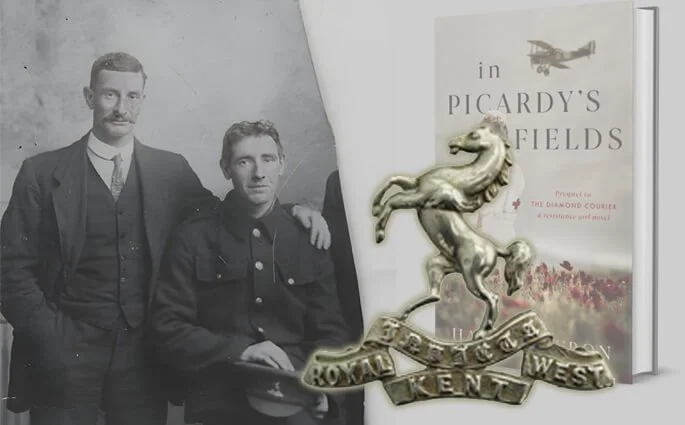
My great-uncles Jack & William Westcott and In Picardy's Fields — Part 2: The Search
Two brothers, dead within eight days of each other — one at the bottom of the North Sea, one in the fields of northern France. How I traced my great-uncles through the war archives, and the cap emblem that finally led me to Jack.
In my last post, I told you how finding an old photograph set me on the path to writing In Picardy's Fields. Now for the search itself.
My search for Jack and William's war records
At first, I had no idea where to begin with my search for my great-uncles' war history. The information my mother had left was sparse and there were no family members alive to tell me more about this generation 'before'. Well one Uncle, also named Jack, but he knew nothing.
I found that the first step to trace British WW1 dead is to go to the Commonwealth War Graves Commission, which is a treasure-trove when you have first and last names. You wouldn't believe how many names there are in that register, but within seconds the names of both my great-uncles popped up.
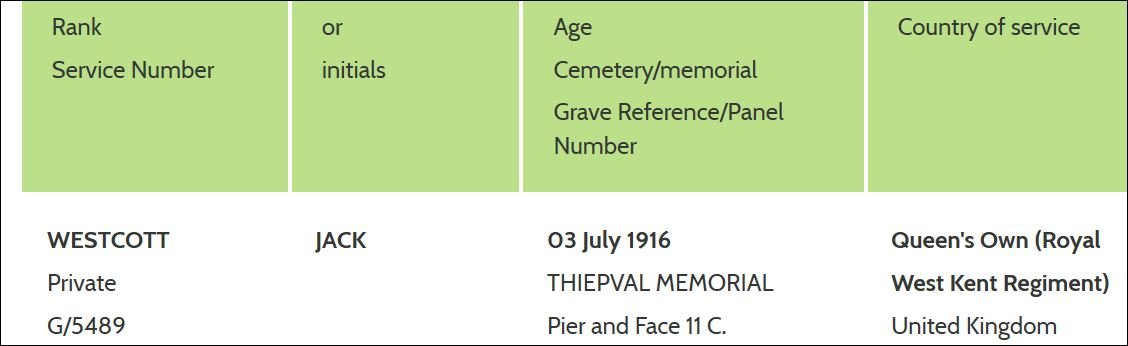
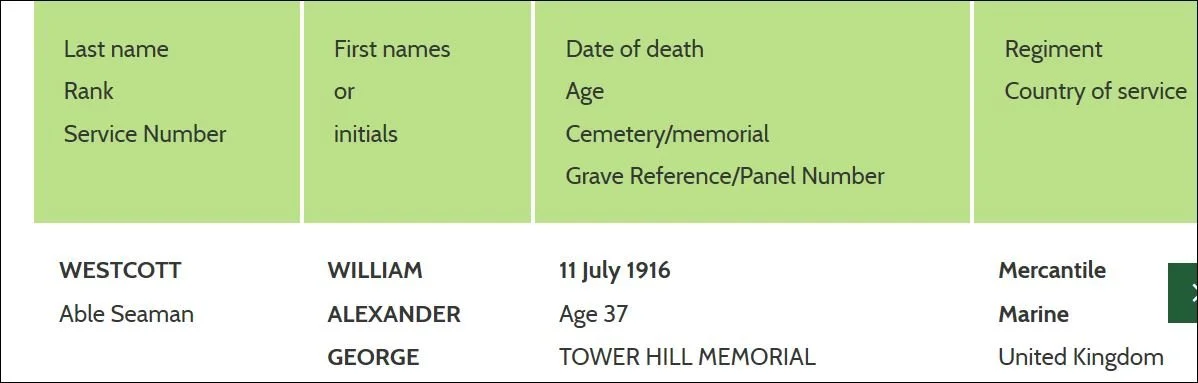
Register Commonwealth War Graves Commission
But then I was faced with a discrepancy. Either the War Graves Commission had their deaths wrong, or my mother didn't have the facts. I will never know where she got hers, but they were wrong. Though just by one month.
My great-uncles, unbeknown to each other, died within eight days of each other, William aboard the S.S. Calypso, lying now on the bottom of the North Sea, 15 miles west of Listafjorden, Norway and Jack near Ovillers, in hilly northern France. The Westcott family lost its eldest and youngest son and brother in a matter of days.
Private Jack Westcott
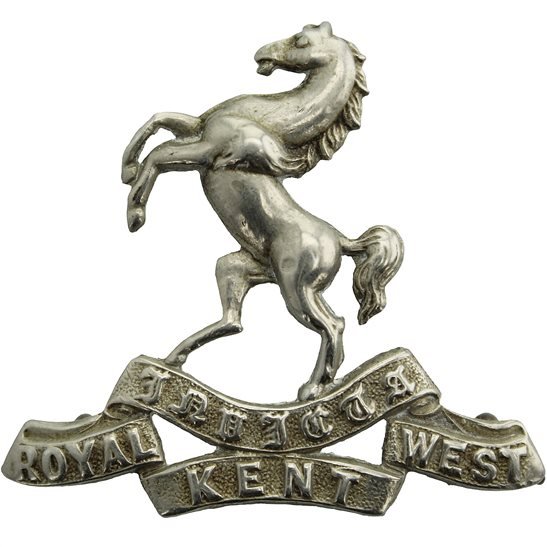
Emblem Royal West Kent Regiment
For the French connection I concentrated my research on Jack Westcott. I was able to trace his path, and more is known about him than about William. It starts with the cap resting on his knee in the photograph. The emblem is of the Queen's Own (Royal West Kent Regiment).
But it took a while to find that out. I enlarged the vague, 110-year-old photograph until I could see more clearly the jumping horse and started down a rabbit hole on the Internet until I found his regiment. They still sport that same emblem today!
With his name, his regiment, his number and approximately his whereabouts, it was time for me to take action. This was in late August 2019, just months before COVID disrupted all our plans. I could still freely travel from Holland to the North of France.
In the Field: Picardy and the Battle of the Somme
And so I went. I stood at the Thiepval Memorial, among the names of the missing of the Somme, and found Jack's name carved in stone. Even now, years later, those images are still vivid and emotional for me.
Jack and William never came home. But they are no longer anonymous men in an archive. Their story — and that of the women who stayed behind — lives on in In Picardy's Fields, the novel I dedicated to my great-uncles.
Step into Jack and William's world →
My great-uncles Jack & William Westcott and In Picardy’s Fields
One of the men shown in the 1916 Battle of the Somme footage could well have been my great-uncle, Private Jack Westcott. He never came home. Neither did his brother William. Here is how I found them — and why I had to write their story.
June is the history and personal month behind my first historical fiction novel, In Picardy’s Fields — a story rooted in my own WW1 family history. If you’ve read my June newsletter, you’ll know why this month matters so much to me personally. Here is where it all began.
In the description of this film — the 1916 Battle of the Somme footage, one of the earliest documentary films ever made — I mentioned my great-uncle, Private Jack Westcott. One of the men shown in that footage could well have been him. Here is his story, and that of his brother William and my ancestry.
How my WW1 family history began
Helen as a young boarding school teacher, 1950, age 22 [Byron Archives]
Two things struck me about this photo. Firstly she wrote on the back that she’s wearing an expensive suit bought at Harrods for her first job at Battle Abbey Girls’ School. It would start off her life-long career as a teacher of French and English in 3 different countries (England, France and Holland). Secondly, how is she sitting in this chair?
Anyway.
My late mother, Helen Ferguson was a keen amateur genealogist of both her own British/Irish ancestry and of the Dutch branch of my father’s family.
At first, I did not share my mum’s fascination for stuffy archives and bone-dry Internet sites, but I inherited the yellow envelopes with all her scribbles and earmarked photographs on her passing in 2017. Moving the envelopes one day – I had cautiously marked them ‘Hannah’s retirement project’- this photo fell out.
Standing left: William Alexander Westcott, sitting Jack Westcott (photo Jan 1915) [Byron Archives]
Written note on back of photo
Now this was intriguing. First someone other than my mother had tried to identify the two relatives who had apparently died in WW1 (see different handwriting in middle of backside note). Then my mother had done some more research and found out they were her uncles William Alexander Westcott and Jack Westcott, brothers to my maternal grandmother.
The WW1 story of my family
A 1915 photograph of family members who have died in the Great War triggered something deeper in me than my mother’s envelopes with her notes. These men were my blood relations, men who had given their lives for our freedom.
And with their ultimate sacrifice, young and childless, they had since my discovery become as forgotten and untraceable as their bodies were, as I was to find out. As both brothers are MIA, they have become anonymous men, listed in archives and on memorials.
Unless I change their fate and write about them, in a small attempt to honour their legacy.
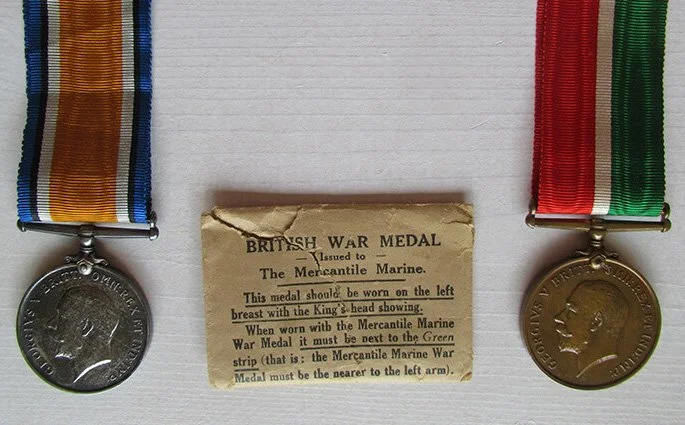
It saddens me that my great-uncles never knew they were war heroes, awarded these medals, let alone pin them proudly on their lapels. So I made it my duty to clean and polish them and iron the worn ribbons. As I was doing this, it struck me that no one today can even publicly wear these medals anymore. They are really history now. Publicly and privately.
William and Jack’s WW1 war medal [Byron Archives]
But something else happened as I took care of the photograph and the medals. I wanted to do more, to also pay homage to the women who stayed behind and suffered the losses. Their silent grief. Jack and William’s mother, my Irish great-grandmother Mary-Ann Meehan, and my grandmother, their sister, only 22 at the time.
And I would write a historical fiction novel about the Battle of the Somme, in which I would sneak in my family’s personal history. It was to become In Picardy’s Fields, dedicated to my great-uncles.
My great-grandmother Mary-Ann Meehan
My grandmother Gertrude at age 20

In the Field: Picardy and the Battle of the Somme
So this month I will take you with me on that trip to the Thiepval Memorial in Picardy and all the other places around it. Even now, years later, all these images are still so vivid and emotional for me. I hope you will find it interesting to know more about the background of In Picardy’s Fields, my very first historical fiction novel.
I’ve started a Pinterest board called “In the Field”. Several times a week throughout June a new pin will drop with a short background story, so make sure you go there regularly, or follow me: Hannah Byron on Pinterest and search the board.
There are YouTube videos to watch here: Hannah Byron on Youtube
Please subscribe!
And, of course, my Patreon, which I hope you will join for an in-depth look into the Making of In Picardy’s Fields, the foundation of my Resistance Girl Series and much more to come: Hannah Byron on Patreon
FIELD NOTE #3 — A Shift in Rhythm
As I walk and cycle these miles, the second book of The Ace of Nerve trilogy is growing. Aroha’s Māori heritage continues to anchor her character — not as a lesson, but as a quiet force shaping the way she sees the world. Every miles deepens her voice and her journey. Sometimes Nancy Wake is the echo and sometimes Aroha. Here’s a snippet…
From Ninety Mile Beach to the Waitangi Treaty Grounds — and my winter miles here in the Netherlands.
Postcards from the Trail
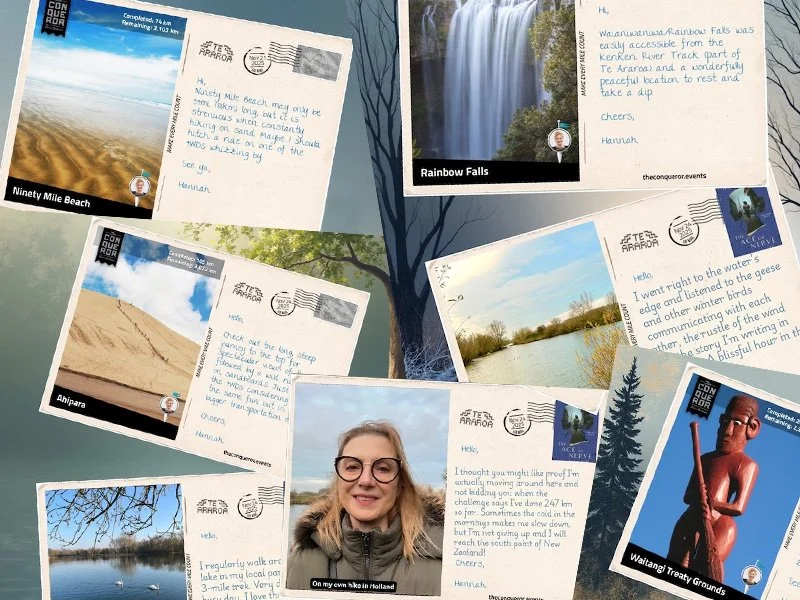
The past fortnight on Te Araroa took me from the endless sands of Ninety Mile Beach to the quiet beauty of Rainbow Falls and finally the significant carving at the Waitangi Treaty Grounds. All the while, my real-world miles unfolded here in the Netherlands — beside canals, lakes, and winter fields.
Here are the next four postcard pairs from my journey:
Click to enlarge
Te Araroa: New Zealand Landscape 1
Ninety Mile Beach
My virtual journey continued down this legendary stretch: 55 miles of wind, surf, and soft sand. Even virtually, you get a sense of the endurance required. There’s something meditative about following a coastline that seems to never end. A place where the mind can wander — as mine often does — into Aroha’s world.
My Dutch Miles: Reflection 1
Maxima Canal, NL
Much like the beach miles in NZ, my rides along the Maxima Canal are rhythmic and steady. This bicycle has carried me more than 7,000 miles these past two years — my silent companion through all seasons and all drafts.
Click to enlarge
Te Araroa : New Zealand Landscape 2
Ahipara Dunes
From flat sand to dramatic slopes, Ahipara brought a shift in energy. The long, steep climb rewards you with sweeping views of the bay, followed by the temptation of a wild ride down the dunes. Part challenge, part adventure — the perfect metaphor for writing the middle of a trilogy.
My Dutch Miles: Reflection 2
Van Zwietenpark, ’s-Hertogenbosch
This lake has become my personal Hyde Park. A short, gentle loop that clears the mind. I walk here when the writing is heavy or when I need a reminder that not all progress must be fast.
Click to enlarge
Te Araroa : New Zealand Landscape 3
Rainbow Falls (Waianiwaniwa)
A softer moment on the trail. The Kerikeri River Track leads to a waterfall that feels almost suspended in stillness. This part of the postcard felt like a breath — the kind a writer takes when a story deepens and begins to speak back.
My Dutch Miles: Reflection 3
The River Meuse in Winter
A favourite spot for listening — geese, winter birds, the rustle of reeds, and the quiet conversations between wind and water. It’s often in places like this that a scene suddenly clicks into place.
Click to enlarge
Te Araroa : New Zealand Landscape 4
Waitangi Treaty Grounds
Here, history steps forward. The carving shown on the postcard stands atop the Māori meeting house, Te Whare Rūnanga, and is thought to represent Kupe, the Polynesian explorer who discovered Aotearoa. Even virtually, this stop carries weight. A reminder of ancestral journeys, origins, and belonging — themes that weave through Aroha’s storyline.
My Dutch Miles: Reflection 4
A Cold Morning Hike
Proof that I really am moving my body while the kilometres advance on the virtual trail. Some mornings are frigid and slow, but I’m determined to “reach the South Island” one Dutch mile at a time.
Where The Trail Meets the Trilogy
As I walk and cycle these miles, the second book of The Ace of Nerve trilogy is growing. Aroha’s Māori heritage continues to anchor her character — not as a lesson, but as a quiet force shaping the way she sees the world. Every miles deepens her voice and her journey. Sometimes Nancy Wake is the echo and sometimes Aroha. Here’s a snippet.
“Regret wastes powder and time.” Nancy replied curtly, “listen to me, Princess. You think denying the pull of your heart will make you strong. I tell you; it will only make you lonely. There’s a difference.”
The room seemed to hold its breath in the silence that followed. Outside, a breeze rippled the surface of the Thames, while a lone gull wrote a perfect arc against the leaden sky.
“I can live with lonely.” Aroha’s voice came steady. “I can’t live with betraying what I am.”
Nancy regarded her for a long moment, respect slowly rising in the blue eyes. “Then be very sure, girl, which part of you is truly ‘what you are’ and which part is fear dressed as duty.”
A Note on Seasons
Winter is settling in here. The days are short, the nights long. My photos are turning as blue as my fingers, the air is crisp and sharp, and the pace a little slower, at times. But there’s beauty in this season — a softness that mirrors the quieter parts of the trail. And of life.
Until Next Time
Noho haumaru me te mahana
Blijf veilig en warm
Stay safe and warm
See you in the next Field Note.
— Hannah
FIELD NOTE #2 — Steady Miles, New Rhythms
Choosing the Te Araroa challenge now seems like a God given.
It’s long, it’s beautiful, and it offers me a way to walk alongside the world of my characters while staying healthy here in the Netherlands.
Writing a novel is a marathon on its own. Writing a trilogy is a triple marathon. Some days you sprint; some days you inch forward. But what I’ve found — and what surprises me again and again — is how the rhythm of moving my body in nature helps the rhythm of writing.
As I make my way along the (virtual) coastline of Aotearoa, two things are happening…
Click to enlarge
Where I Am on the Trail This Week
Te Araroa — Maunganui Bluff → Ninety Mile Beach (42–74 km)
This stretch of the trail takes me along rugged coastline, soft sand, and long horizons. The postcard says it all: wild cliffs, shifting weather, and beach full of boulders, which is both beautiful and tiring.
At home — Maaspoort at night in ‘s-Hertogenbosch
Meanwhile, my real miles happened closer to home: an evening walk beneath tree-lined paths, a quick stop at the mall for some groceries, and a moment of wonder about the reflections of neon in still water. And then back home to write another scene in my pleasantly warm office.
Why I’m Doing These Virtual Challenges
I’ve been walking, cycling, and hiking for years, but for the longest time those miles just lived quietly in my legs and my day-to-day life.
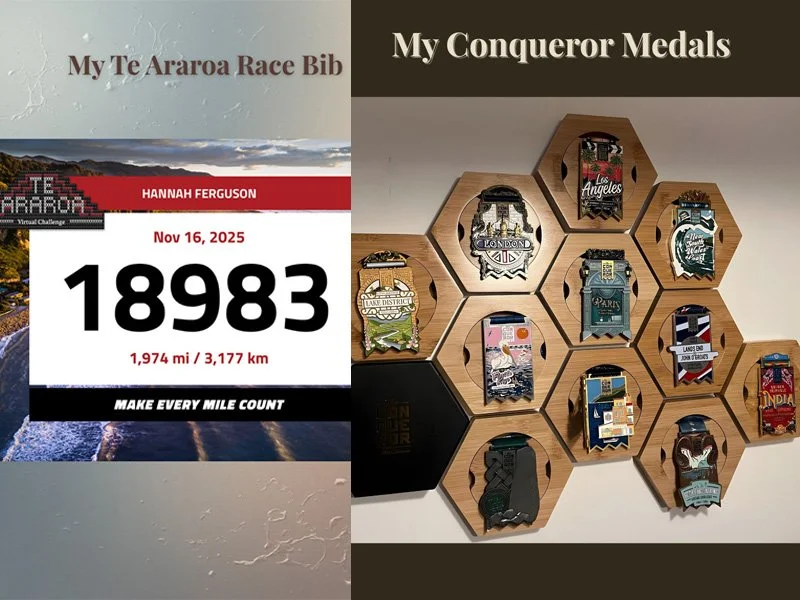
Then, two years ago, I discovered The Conqueror Virtual Challenges, and something clicked.
Suddenly those invisible miles became stories: Paris, the Lake District, Los Angeles, India, Lands End to John O’Groats… and now, Aotearoa New Zealand.
This isn’t just about fitness for me. It’s about rhythm, grounding, fresh air, and the reminder that steady steps — even small ones — can take you across whole continents if you let them.
I’m decorating my wall with my medals. They’re not just trophies; they’re also markers of my endurance and my unquenchable curiosity. I’m truly an airchair traveller. Soon, I’m adding New York (my last challenge) and I will show you how exquisite these medals really are.
Choosing the Te Araroa challenge now seems like a God given.
It’s long, it’s beautiful, and it offers me a way to walk alongside the world of my characters while staying healthy here in the Netherlands.
Click to enlarge
3. How My Te Araroa Trail into The Ace of Nerve Trilogy
Writing a novel is a marathon on its own. Writing a trilogy is a triple marathon. Some days you sprint; some days you inch forward. But what I’ve found — and what surprises me again and again — is how the rhythm of moving my body in nature helps the rhythm of writing.
As I make my way along the (virtual) coastline of Aotearoa, two things are happening:
Aroha becomes clearer to me — her grounding calm, her connection to land, her quiet resilience.
Nancy sharpens — her contradictions, her bravado, the shadows she hides with charm.
There’s something about a long-distance trail, even a virtual one, that opens a door in the mind. Scenes settle. Voices become steady. Characters start speaking when they’re ready.
I’ll share more about Aroha’s early chapters soon, but for now, I’m letting the miles work their magic.
Weather, Mood, and the Week’s Small Things
Here in Brabant, the weather has slipped decisively into late November: damp mornings, early twilight, and a cold that makes you tuck your scarf tighter.
Yet there’s beauty in it too: the glow of streetlamps on wet pavement filled with autumn leaves, the quiet of a near-empty park, the mirrored stillness of a gazillion stars at the firmament.
These changes will color the photos I take over the coming months. Winter, spring, and eventually summer will each leave their own impression on the journey.
Until Next Time
Steady steps, warm layers, and pages waiting to be written.
More postcards soon — both from Aotearoa and from my corner of the Netherlands.
Kia tau te rangimārie — Ga in vrede — May peace settle upon you.
— Hannah
Click to enlarge
FIELD NOTE #1 — Where the Trail Begins
Although Nancy Wake’s New Zealand years were brief — she left young — she was born there. That’s the quiet thread between her life and Aroha’s. And this trail lets me walk that thread gently.
How My Araroa Trail Supports the Ace of Nerve Trilogy
As I’ll be writing write the second book over the coming months, the trail will be my rhythm: miles for thinking, miles for untangling scenes, miles for letting the characters come forward when they’re ready.
Aroha’s voice in particular feels clearer when I’m moving. There’s something grounding in walking her homeland — even virtually.
Click to enlarge
Where I Am on the Trail This Week
Every journey has a beginning.
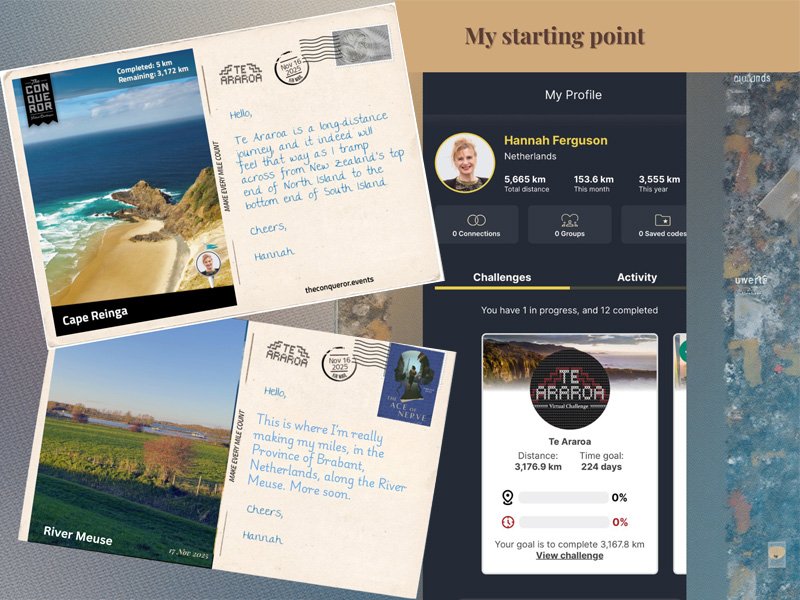
For Te Araroa, that beginning lies at Cape Reinga, at the northern tip of Aotearoa New Zealand — a place rich with Māori meaning, where the spirits are said to leave this world and begin their path home.
And for me here in the Netherlands, my starting point is far more familiar:
the River Meuse, the long winding waterway, that has its origin in the Plateau des Langres in France, and where I walk, cycle, and gather most of my miles.
These two places could not be more different.
Yet they now run side by side — one in my imagination, one under my feet.
Why I’m Doing This Trail — And Why Now
Movement has always kept me steady: long walks, quiet bike rides, treadmill miles on a rainy day. But for years, I never tracked them.
Two years ago, I discovered The Conqueror Challenges, and suddenly my uncounted miles became something I could see:
badges, postcards, medals — little markers of endurance.
Now I’m taking on their longest challenge yet — Te Araroa, 3,177 km from the top of New Zealand to the bottom.
Why choose this trail now?
Because I’m writing this trilogy — The Ace of Nerve — and one of its central voices, Aroha Tui, carries her heritage from Aotearoa.
Walking this trail feels like the right way to stay connected to her world while living here in Brabant, Netherlands.
And although Nancy Wake’s New Zealand years were brief — she left young — she was born there. That’s the quiet thread between her life and Aroha’s. And this trail lets me walk that thread gently.
How My Araroa Trail Supports the Ace of Nerve Trilogy
As I’ll be writing write the second book over the coming months, the trail will be my rhythm:
miles for thinking,
miles for untangling scenes,
miles for letting the characters come forward when they’re ready.
Aroha’s voice in particular feels clearer when I’m moving. There’s something grounding in walking her homeland — even virtually.
Weather, Mood & This Week’s Small Things
Here in Brabant, November has fully settled in: grey skies, bright breaks of cold sun, a hush over the fields near the Meuse.
It’s the kind of weather that makes you walk briskly, hands tucked into your pockets, woolen hat, always thinking about what comes next. The warm cup of coffee when I return.
There’s a quiet beauty in starting something big in the stillness of the last part of 2025.
Until Next Time
This is where the journey begins — in Aotearoa and in ‘s-Hertogenbosch.
Kia haumaru te haere — Goede reis — Safe travels.
— Hannah
Click to enlarge

The Miracle of Empel: An Unconventional Christmas Tale
For the exceptional tale of The Miracle of Empel (Milagro de Empel in Spanish) we’re – for once - not talking about the Second World War but about the Eighty Years’ War which raged between Spain and Holland in the 16th century.
The Miracle of Empel happened in my backyard here in the Netherlands, so let me share this amazing field trip experience.
Introduction
For the exceptional tale of The Miracle of Empel (Milagro de Empel in Spanish) we’re – for once - not talking about the Second World War but about the Eighty Years’ War which raged between Spain and Holland in the 16th century.
The Miracle of Empel happened in my backyard here in the Netherlands, so let me share this amazing Spanish victory over the Dutch on 8 December 1585. The miracle is still celebrated every year by Spaniards flocking to the shores of the river Meuse. This year, on 8 December 2023, I experienced the first part of this remarkable ceremony down by the river.
Visiting the Event on 8 December
Background
How did the Immaculate Conception become the Patroness saint of Spain and of the Spanish Armed Forces?
In December 1585, the Spanish soldiers of the Tercio Viejo de Zamora found themselves surrounded in Empel, a town on the river Meuse in the Netherlands, after the Dutch rebels opened the dikes and water flooded the entire area.
When all seemed lost, a Spanish soldier found a panel with the image of the Immaculate Conception, surely hidden by local Catholics to keep it safe from the image destruction campaign unleashed by the Calvinists.
Spanish soldiers, seeking the Immaculate Conception's protection, witnessed a miraculous event: a sudden icy wind descended upon the river Meuse, freezing the water. This enabled the Tercio Viejo of Zamora to break the siege and triumph over the terrified rebels, a moment now known as the Miracle of Empel.
From that day forward, the Immaculate Conception became the guardian of the Spanish Tercios. In 1892, she was officially declared the Patroness of the Spanish Infantry, a title she had held unofficially for centuries. Additionally, the Immaculate Conception holds various other patronages within the Spanish Army.
Obsessi apud Bommeliam Hispani Anno 1585 - The Spaniards were driven out of the Bommelerwaard by breaking the dikes 1585
Since 2004, the Spanish Army has made it a custom to pay tribute to its patron saint in that Dutch town where the miracle occurred. The soldiers taking part are stationed at the Allied Joint Force Headquarters in Brunssum in the Netherlands.
Hundreds of Spanish citizens from all over Europe flock to the, now tiny, village of Empel on this Holy Day of The Immaculate Conception to celebrate their patron and their historic victory.
The Empel Maria
The Empel Chapel
On 8 December 2000 a small chapel was erased in Empel on the place where all earlier Empel Catholic churches stood. The last church was bombed in WW2. From the ceremony on the river, the Spaniards paid tribute to the chapel and then went to a communal Mass in New Empel.
On YouTube you can watch more on this ceremony (in Spanish). Below is a short explanation of the videos.

From The Crystal Butterfly to The London Spymaker
Field trip to Canadian War Cemetery at Groesbeek and last week to read - as sneak peek - the first chapters of The London Spymaker!
Two months ago, I shared a video (link below) on YouTube, recounting the remarkable liberation of Amsterdam in May 1945. Little did I expect it would capture the hearts and minds of 54,000 viewers, many of whom were touched by the heroics of their Canadian relatives, who played a pivotal role in Holland's liberation. All these reactions from viewers ignited a spark in me, and made me think with even more fondness why I wrote my book on the Dutch Resistance, "The Crystal Butterfly." In the 7th book in The Resistance Girl Series, our heroine, Edda Van der Valk (then Edda Valkena), joins in the jubilation of Amsterdam's liberation.
The popularity of the old Dutch news reel also evoked a profound sense of gratitude in me towards the brave Canadians, Brits, Americans, Australians, and others who landed on Normandy's beaches on that historic day of June 6, 1944 to begin their relentless march northward. It spanned eleven grueling months and was marked by countless sacrifices before the European Continent was liberated from Hitler's Third Reich. How the SOE secret agents played a vital role in assisting the Allied forces with their sabotage actions will be at the core of my new series “Timeless Spies”, coming in 2024.
At an hour’s drive from where I live lies the Canadian War Cemetery at Groesbeek, Netherlands. Two weeks’ ago, on a sunny Sunday, I went on a field trip to honor these young heroes who gave their lives for our cherished freedom. Over 7,600 Canadian soldiers died for the liberation of Holland, and 2,331 of them found their eternal rest at Groesbeek. It stands as an immense Canadian Commonwealth Cemetery, with a minority of other nationalities interred alongside.
The original Canadian cemetery 1946
The Canadian cemetery 1947
My fascination with the Secret Operations Executive (SOE), as discussed in last week's blog, led me to discover that two of the five Canadian secret agents who were murdered in concentration camps while serving in the French section of SOE are commemorated on one pillar at this graveyard. That was my second motivation to pay a visit and pay tribute.
I also reached out to the Commonwealth War Graves Commission and became a Foundation member, granting me the opportunity to contribute to their vital work. It puzzled me that the records showed that three agents were commemorated at Groesbeek - Pickersgill, Sabourin Biéler (correct spelling) -, whereas I could only find two names. (See photo left). The War Graves Commission told me that WW2 casualties with no known graves, like these five agents, may only be commemorated in one location. Where Biéler is commemorated elsewhere I’m still in the process of finding out. Considering that all 104 fallen agents of the French Section are commemorated on the Valencay Memorial in France (see last week’s post), the French memorial is not classified as a Commonwealth War Graves Cemetery. A valuable lesson learnt.
Mind you, these men are heroes of the highest class. They fought alone!
The author at Groesbeek, left of me you can see the two agents’ names
The 5 Canadian SOE agents who died in concentration camps
I invite you to watch my visit to Groesbeek through the video linked below, and I'm excited to share that you have one more week to download and read for free the first chapters of "The London Spymaker," set to be released next March.
The link between The London Spymaker and SOE
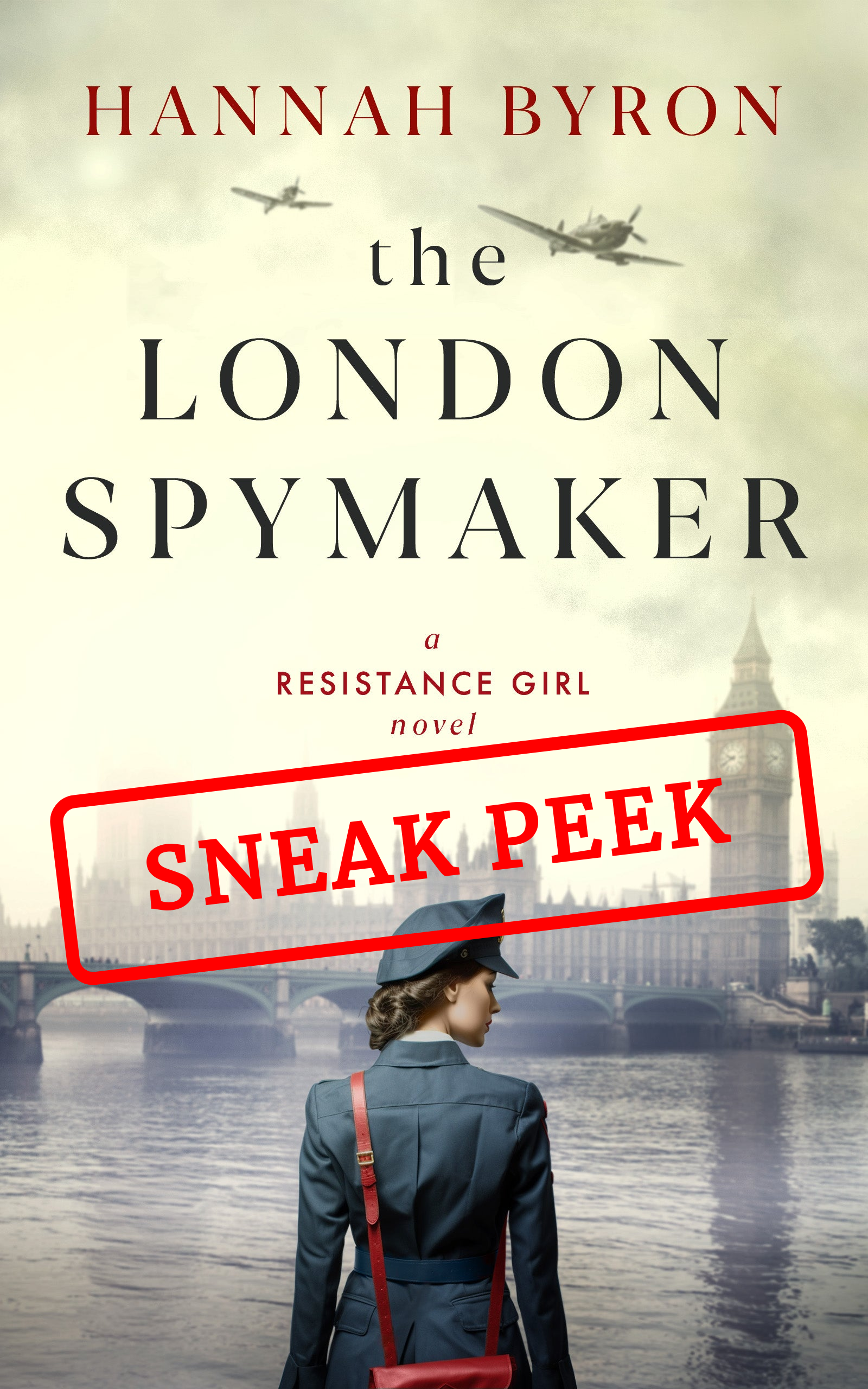
Read the rough draft of the first chapters of The London Spymaker! It will give you a taste of the history and research behind Anna’s story and SOE. The book is on preorder and will be available on 7 March 2024.
As I’m writing the last book in The Resistance Girl Series (for now), I’m already transitioning to what I’m going to specialize in for probably the rest of my writing career. The secret agents of SOE, an abbreviation for the Secret Operations Executive. A name and organization as shrouded in mystery as its non-descript name.
Hannah at SOE plaque in Beaulieu
In book 7 in The Resistance Girl Series, titled The London Spymaker, I’m already deeply invested in SOE, the British organization Winston Churchill launched in July 1940 “to set Europe Ablaze” with irregular warfare and sabotage actions. Flight officer Anna Adams in The London Spymaker, though fictive, is based on Vera Atkins’ remarkable position at the London-based organization, as the second person behind Colonel Maurice Buckmaster, the head of SOE’s French section.

Vera Atkins
From 1941 till after D-Day in June 1944 some 400 Section F agents were dropped into France. 109 of them didn’t survive the arrests, torture, and murder by the Gestapo. Most of these heroic agents, who came from all walks of life, were killed in concentration camps. Of the 40 brave women, whom SOE started recruiting in 1942 as women could more easily blend in with the French population and were less likely to be stopped by the Germans, 13 did not survive their missions. 104 of these agents are commemorated on the Valencay Memorial in France, which I will certainly visit in person one day and tell you all about.
Valencay memorial for SOE French Section
With Anna’s story, we start at the end of the second World War as she flies to post-war Germany in search of her “missing agents.” In the chaos after the liberation, with hundreds of thousands of bewildered and traumatized holocaust survivors trying to find their way to safety, it was often unclear what had happened to political prisoners, especially these agents whom Hitler had branded the worst enemies of the Third Reich. They fell in the “Nacht und Nebel” category, people the Nazis didn’t want to leave any trace of where they’d gone (Night and Fog), so their families would never know what had happened to them.

Anna not only attends the opening of the Nuremburg trials in November 1945, she also interrogates arrested camp commanders from Ravensbrück and Sachsenhausen to find out about the fate of “her girls”. The real Vera Atkins made it her life’s mission after the war to trace all the agents so she could tell their families what had happened to them.
To give you a taste of the history and research behind Anna’s story, you can read the rough draft of the first chapters of The London Spymaker here. The book is on preorder and will be available on 7 March 2024.

The London Spymaker sneak peek - click to download
Next week I will tell you about my visit to the Canadian War Cemetery in Groesbeek, where 2 of the 5 French-Canadian SOE male agents are commemorated. Though I intend to start my new series “Timeless Spies” (2024) with the female agents, in time I’d like to honour the brave men as well. What’s more, they usually worked together in teams.

In the footsteps of Audrey Hepburn
Visiting the places where Audrey Hepburn lived during WW2: Arnhem and Velp.
For my final blog for Book 6 in the Resistance Girl Series, The Crystal Butterfly, I spent a day in the footsteps of the famous 20th century actress Audrey Hepburn. During her life, little was known about her war years as a teenager in The Netherlands, but one of her more recent biographers, Robert Matzen, together with Audrey’s youngest son, Luca Dotti, unraveled most of the mysteries around this period in the moving and impressive biography Dutch Girl. Audrey Hepburn and World War II.

Robert Matzen's Dutch Girl, Audrey Hepburn and World War II
I read Robert’s book as part of my research for my own book on a ballerina under German occupation in The Netherlands. And also, because I’ve been a lifelong fan of Audrey Hepburn. Robert’s detailed description of Audrey’s life in Oosterbeek (before the war), Arnhem and ultimately Velp, three places in the Province of Gelderland, made me decide to visit all the places where she either lived or spent (dancing) time.
Come with me on my trip.
There’s just one aspect of Robert’s book, which I highly recommend, by the way, I want to touch on because I’m not sure many people knew this about Audrey. She, herself, had a lifelong admiration and tender spot for Anne Frank, who in a way was her soul-sister. After the liberation in 1945, Audrey moved to Amsterdam with her mother so that she could take dance lessons with the famous Sonia Gaskell.
They happened to live in the same building as the editor working on Anne Frank’s Diary. Audrey was the first to read this moving account of a girl only six weeks apart in age. She was also among the very first to visit “Het Achterhuis” on the Prinsengracht, where the Frank family hid until they were betrayed.
Of course, Audrey heard when the Diary of A Young Girl became an instant bestseller in America. Then she was asked to portray Anne in George Stevens’ 1958 movie on the Jewish girl who died in Bergen-Belsen. Typically, the thoughtful and emphatic Audrey refused the role. Even after meeting up with Anne’s father Otto in Switzerland, who asked her to reconsider, Audrey declined. The war and its scars were still too raw for her. And how could she accept money for a role about a girl who felt like a sister to her but who hadn’t survived the war?
However, in the 1980s Audrey went on a tour through the US to give readings of Anne’s Diary in her function as a UNICEF Goodwill Ambassador. And thus, raised money for the organization that meant everything to her.
I wanted to share with you this story of Anne and Audrey to round off my series of blogs for The Crystal Butterfly.
Click to enlarge
Click to enlarge
Click to enlarge
There is no mention of Audrey Hepburn in my own book, of course, as Edda–my main character - was unaware of that budding film star and ballerina - who would capture the hearts of millions a decade later - living in the same country as she was. But there are many similarities. Both are dark-haired ballerinas, resilient girls that strive for the top. Both have parents that embrace Hitler’s Nazism, and both come from Frisian nobility.
Here's the link to Robert’s book Dutch Girl:
https://www.amazon.com/Dutch-Girl-Audrey-Hepburn-World-ebook/dp/B07MSCBVBJ/
(Amazon US store but I’m sure it’s available everywhere)

In the footsteps of Anne Frank in Amsterdam…
Visiting the places where Anne Frank lived during WW2 in Amsterdam.
Anne Frank's importance for the world stems from her powerful and poignant account of her life in hiding during the Holocaust, documented in her now-famous diary, "The Diary of a Young Girl." Why was the voice of a teenage girl so significant?
Though Anne doesn’t play an active role in my fictive book on the Dutch resistance and Jewish persecution in WW2, “The Crystal Butterfly”, she is an important symbol of Holland in WW2. No wonder, that her name came up time and time again in my research. Both in Amsterdam and in transit Camp Westerbork.
Partly to honour Anne, I have my main character, Edda, keep a diary as well. But Edda, who is not Jewish but the daughter of collaborators and a resistance fighter, only writes what she witnesses around her during the Nazi occupation. So it’s not a personal diary like Anne’s.
Also, Edda is at almost the same time in Transit Camp Westerbork, when Anne briefly stayed there with her family before being transported to the German concentration camps.
Enough reason for me to go to Amsterdam and visit the two places where Anne lived and the one place where she is commemorated with all other 120,000 murdered Jews, Sintis and Romas. Will you join me in her footsteps?
But what is – in a nutshell - Anne Frank’s legacy?
Anne Frank's importance for the world stems from her powerful and poignant account of her life in hiding during the Holocaust, documented in her now-famous diary, "The Diary of a Young Girl." Why was the voice of a teenage girl so significant?
Symbol of the Holocaust
Anne Frank's diary provides a personal and relatable perspective on the horrors of the Holocaust. Through her writing, she humanizes the millions of victims and gives a voice to the countless innocent lives lost during World War II.
Impact on Education
Anne's diary has become an essential educational tool in schools worldwide. It helps students learn about the Holocaust, discrimination, and the consequences of hatred, fostering empathy and understanding.
Testament to Resilience
Despite facing extreme hardship, Anne's diary reflects her resilience and optimism. Her courage and determination to keep hope alive amid despair serve as an inspiration to people facing difficult situations.
Human Rights Advocacy
Anne Frank's story has become a symbol for promoting human rights, tolerance, and inclusivity. Her words remind us of the importance of standing against prejudice, discrimination, and injustice.
Preservation of History
Anne's diary provides a first-hand account of life during the Holocaust, preserving an important historical record for future generations.
Global Recognition
The Anne Frank House in Amsterdam, where Anne and her family hid, is now a museum attracting millions of visitors each year. This international attention helps ensure that her story reaches people from all walks of life.
Cultural Impact
Anne's diary has been translated into numerous languages, making her story accessible to people around the world. It has also inspired various adaptations, including plays, films, and other literary works.
Unfinished Potential
Anne Frank's untimely death at the Bergen-Belsen concentration camp in 1945, shortly before the camp's liberation, serves as a poignant reminder of the potential that was lost due to hatred and intolerance.
In summary, Anne Frank's significance lies in her ability to humanize the Holocaust and serve as a beacon of hope, education, and inspiration for generations to come. Her enduring legacy reminds us of the importance of promoting understanding, compassion, and the protection of human rights.
Anne Frank statue Merwedeplein
Significant Anne Frank sites

WW2 Field Research to "Mussert's Wall" Netherlands
I invite you to join me on my field trip to Mussert’s Wall. Anton Mussert was the leader of the NSB. Learn more about World War 2 in Holland, about the Dutch NSB Party and Collaboration during WW2.
Unveiling the Dark Pages of History: The Dutch NSB Party and Collaboration during World War 2 in Holland.
In an upcoming blog I will shed light on the rise of De Nationaal-Socialistische Beweging, the National Socialist Movement (NSB), in the Netherlands before and during World War 2 and its collaboration with Hitler’s Germany.
The most controversial part of writing The Crystal Butterfly for me was Edda’s parents’ membership of the NSB and their support of Hitler’s ideology. I strongly felt, though–when writing a book on Holland in WW2–collaboration needed to be addressed. Most Dutch people remained neutral during the war, a small yet active part resisted and quite a significant number actively collaborated with the Nazis, whether or not they were a member of the NSB.
I went on a field trip to Mussert’s Wall. Anton Mussert was the leader of the NSB. I invite you to join me on my field trip using the video below.
In 2018 after a lot of debate it was decided that this wall shouldn’t be taken down, as it is an important remembrance for people what happened here. On my photograph you can see what it looks like today and compare it to when it was used over 80 years ago.
Mussert's Wall in 1940
Mussert's Wall in 2023
Feel free to comment below. Share your thoughts, knowledge, experiences. All appreciated!
And stay tuned for more research on WW2 in the Netherlands.
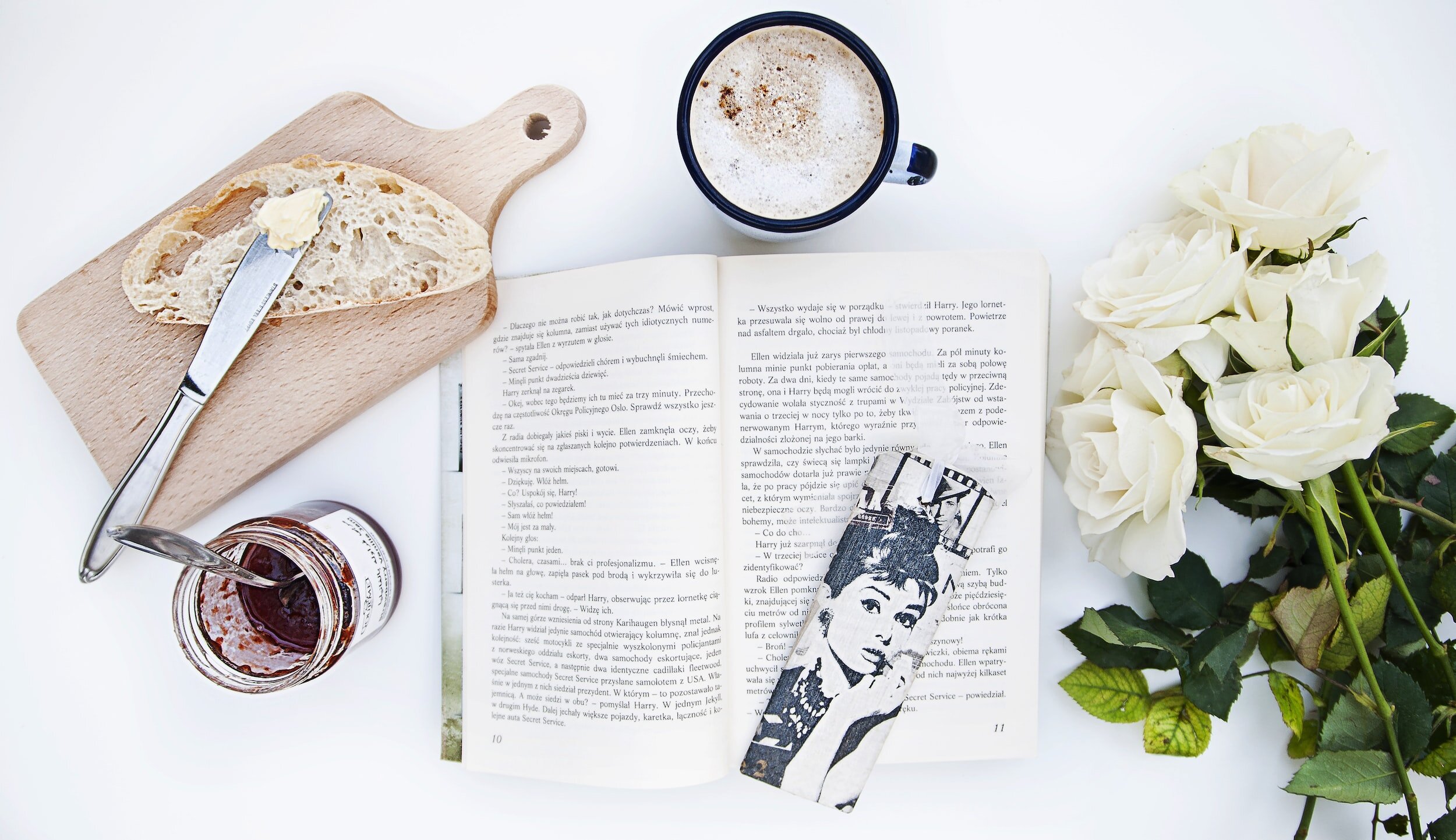
2023: the birth of a new book
New book, but also a new home and a new website. Years of research on European countries during World Wars NOT lost, and more to come! Did you know about Audrey Hepburn’s Dutch war years?
Since book 5 in The Resistance Girl Series, The Highland Raven, came out, I took a short break from writing about my main topic World War 2. In the interim I launched a new historical detective series, titled The Mrs Imogene Lynch Series. I also moved to another part of Holland at the end of December ‘22 and became a first-time grandmother in January. All very exciting but very distracting from my WW2 writing schedule! :-)
In January 2023 I began writing The Crystal Butterfly, my newest book in The Resistance Girl Series. This book is about the Dutch Resistance. It was a Godsent to be able this time to do all my groundwork ‘around the corner’ and I’ll share plenty of my (on the spot) research with you on this blog.
I took the time to deep-dive into the new story and get to the heart of my heroine’s journey before and during WW2. Her name is Edda Van der Valk and in The Crystal Butterfly she will take you through her Dutch war years.
As I now live close to Den Bosch - which is in the centre of Holland - I can easily travel to the most important places of action during WW2 in this country. So let me take you with me on my field trips as I retrace my steps to that gruesome part of our history, now some 80 years ago.
Few people living through WW2 are still with us today. The medalled-up veterans and bravely surviving Jews have become sparse centenaries, whose live presence in TV shows and newspaper articles are almost non-existent. WW2 is now almost history, lived through by the generation of our parents, grandparents, great-grandparents. But I still feel it is my duty to keep the history alive LEST WE FORGET.
The Crystal Butterfly is also inspired by - though far from identical to - Audrey Hepburn’s Dutch war years, so I’ll take you to places where she lived and spent some of the most arduous years of her life. And, of course, Anne Frank cannot be ignored in a book that is centred heavily on the deportations of Dutch-based Jewish people. After all, the arrest of Edda’s big love, Asher Hoffmann, was her reason for joining the Resistance.

PS For avid readers of my blog you may notice I have a new website and miss the abundant archive of years of research on many European countries during the World Wars. Fear not for it will return in an even clearer and more user friendly way.


Hello Reader
Welcome to Historical Facts & Fiction. Here imagination meets reality. I created this blog as a space to assemble my own research that had no place in my World War novels. Find out more about the background to The Resistance Girl Series!
Welcome to Historical Facts & Fiction. Here imagination meets reality. I created this blog as a space to assemble my own research that had no place in my World War novels. I hope you’ll enjoy finding out more about the background to The Resistance Girl Series.
Titbits of research certainly have their place in historical fiction, but when it becomes info dump, it’s too much. But in a blog there’s enough space to share all in-depth investigations and fieldwork to my heart’s content.
Most Historical Fiction readers are fervent researchers themselves; half the fun of reading a good HF novel is popping onto the net to fact-check what you’ve just read. You simply must know if SOE really had women spies, or if Eva Braun actually married Hitler hours before joining him in death. The internet is our treasure trove. I know I can’t stop myself, and love learning a thing or two in the process.
Have you ever wondered where HF authors get their ideas for a new book or series, or how they do their research? No two HF authors are alike – of course – but we all do rely heavily on today’s search engines. No work gets done without it.
However, as you’ll read in an upcoming blog post, my reason for starting The Resistance Girl Series was a family photo I found by chance. Curiosity is a good start. As a European with lineage in several countries, I not only study the lives of these people. They are in my bloodline.
My Great-uncles William and Jack Westcott
But it wasn’t just my uncles’ photograph that incited me to write In Picardy’s Fields. It may sound terrible to say - and I won’t do so aloud - but I love the World Wars. For me as a fiction writer these intense and dark periods in recent human history provide the greatest canvas on which to splash my stories, in an endless variety; this was the period – par excellence – in which ordinary people performed extraordinary deeds. And we all love us a decent hero(ine)!
I’m never tired of learning more about the first half of the 20th century and how it’s shaped our current society. So, please permit me to infect you with some of that passion.
Next to online studies, you can also join me on my field trips to various countries while I do my onsite research.
On to the first blog now…
Thank you for being here!