The Girl Who Was Almost Audrey
Audrey Hepburn and a Ferrari in Rome, Italy in March 1961, during a fashion shoot for Givenchy. Photographer was Pierluigi Praturlon (public domain) Hepburn's husband Mel Ferrer is to the right. Ferrari historians claim this is the s/n 1879GT which was used in a Pink Panther movie as well.
I have loved Audrey Hepburn all my life.
When I was young, the loveliest thing anyone could say to me was that I looked a little like her. I never quite believed it, but I treasured the compliment more than any other — because to be told you resemble Audrey Hepburn is to be told you resemble grace itself. And perhaps the kinship I felt ran a little deeper than a face. Audrey was half-Dutch, with a baroness for a mother — grand blood and hardship braided together. I am no aristocrat, but I know something of that braiding: a whisper of nobility on my father’s side, old family arms and all, and plain working-class Britain on my mother’s. Grand and ordinary, in the same person. She was, quite simply, everything I longed to be.
But it was never the glamour that moved me most. Anyone can admire the gowns and the cheekbones. What held me was something quieter: that Audrey had come through so much in her childhood — hunger, fear, the long years of occupation — and had carried all of it with such lightness afterwards, as though grace were a decision you made every morning rather than a gift you were handed.
The thing I didn’t know
It was only much later that I learned the rest of her story.
As a girl in the Dutch town of Velp, living with her mother and her grandfather through the German occupation, Audrey had played her own small, quiet part in the resistance. And before any of it — before the films, before the fame — she had wanted to be a ballerina. She had trained for it, dreamed of it, danced through the war on too little food and too much fear.
A ballerina, in the Dutch resistance. I couldn’t let it go.
Where Edda van der Valk came from
So Audrey’s Dutch years was the spark for The Crystal Butterfly.
I wanted to write a ballerina who finds her way into the resistance — a girl whose discipline and grace become something harder and braver when her country is taken from her. Her name is Edda van der Valk, and I want to be clear: Edda’s story is entirely her own. It is not Audrey’s life in disguise. But Audrey was always there as I wrote, somewhere at the back of my mind, a presence rather than a template — the reason the book exists at all.
An unexpected honour
While I was writing, I did something I still can hardly believe I dared to do: I got in touch with Robert Matzen.
Robert is the author of Dutch Girl: Audrey Hepburn and World War II, the definitive account of exactly those years in Velp — a book written with the cooperation of Audrey’s youngest son Luca Dotti, and with access to material no one else had seen. He is the person who knows this story better than anyone alive.
And he became one of the very first readers of The Crystal Butterfly.
“Hannah Byron brings the fight against Nazi occupation in World War II vividly to life. The Crystal Butterfly is a page-turner that authentically captures the times and its heroes. I loved this book.” — Robert Matzen, international bestselling author of Season of the Gods and Dutch Girl: Audrey Hepburn and World War II
I have kept that review close ever since.
Walking the real streets
I couldn’t write about Velp and Arnhem from photographs alone. So I went. I walked the streets Audrey walked, stood where she stood, and took my own pictures of the places that shaped both her story and, in its own way, Edda’s.
I wrote all of that up separately — the discoveries, the corners that still remember the war, the small shocks of standing in a real place after imagining it for so long.
Read about my footsteps through Audrey’s Arnhem and Velp here
Adriaantje
There is one more thread, and it is the one I have never quite been able to explain.
Audrey’s grandfather called her Adriaantje — a small, tender Dutch endearment. My own second name is Adriana. And somewhere along the way I quietly took her name for mine, too: I have called myself Hannah Audrey ever since.
I don’t offer this as evidence of anything — only as the truth of how deep some admirations go. Long before I knew about Velp, or the resistance, or the girl who danced through the war, some part of me had already folded Audrey’s name into my own. Perhaps writing Edda was simply the moment it finally rose to the surface.
Where the book began
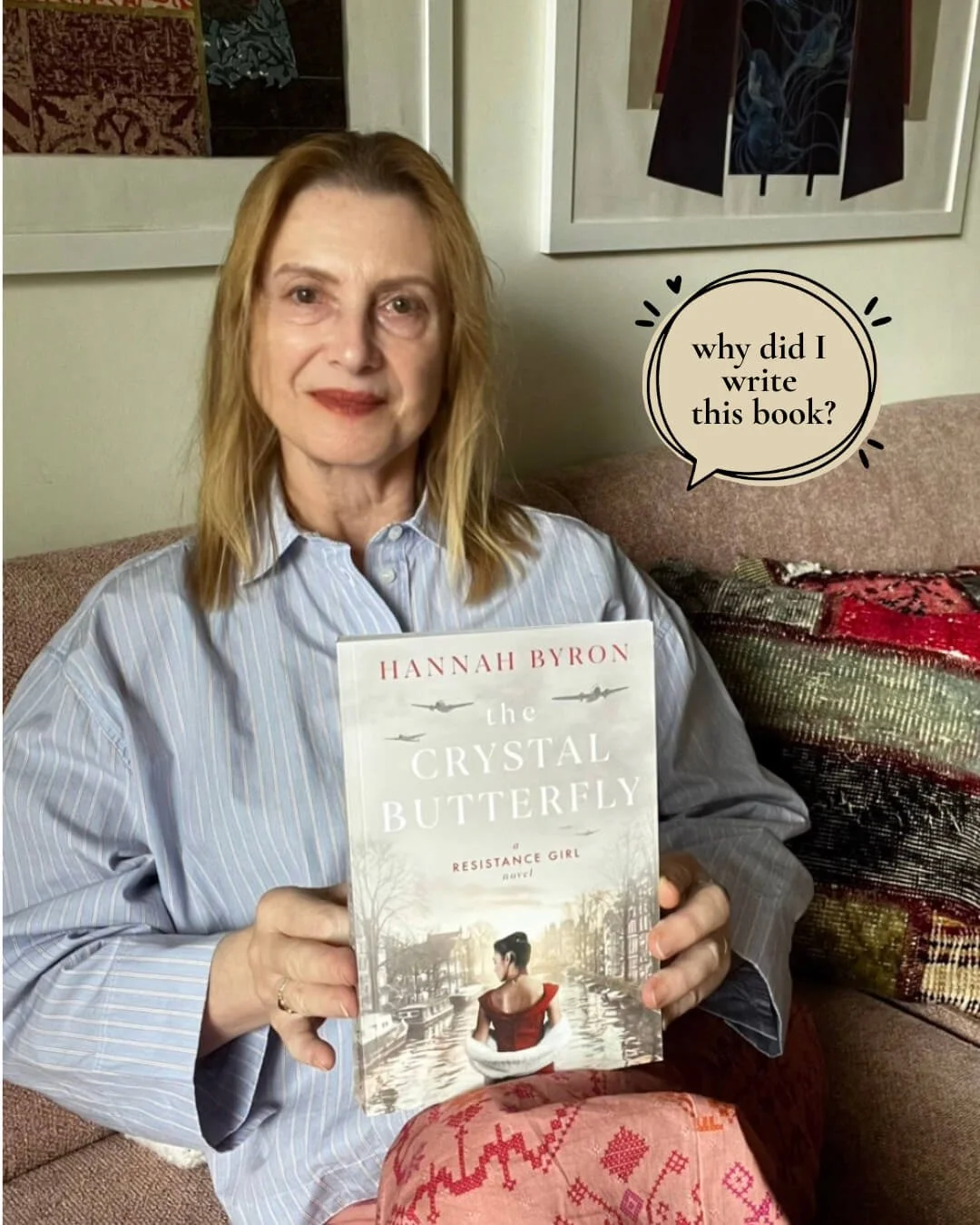
So that is the honest answer to why did I write this book?
Not because I set out to fictionalise Audrey Hepburn. I never would. But because a lifelong love, and one astonishing fact — a ballerina in the resistance — lodged in me and would not leave until I had written my way toward it. The Crystal Butterfly, a Resistance Girl novel, is where that finally led.