Nancy Wake Married Here. Today It's a C&A.
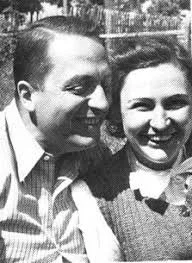
Henri Fiocca and Nancy Wake, Photo by anonymous (c. late 1930s). Source unknown. Wikimedia.
Nancy Wake lived in Marseille for three and a half years, from 1939, when she arrived as a young journalist in love, until early 1943, when the Gestapo forced her to flee. It isn't long in a life that stretched to ninety-eight years, but those few years changed everything. They gave her a husband, Henri Fiocca, a life of wealth she'd never imagined, and eventually set her on the path to becoming one of the most famous resistance agents of the Second World War.
One place, more than any other, witnessed the beginning of her life as Madame Fiocca: the Hôtel du Louvre et de la Paix on La Canebière. One of Marseille's grandest hotels, it was a favourite meeting place for the city's upper classes, and Nancy and Henri were frequent visitors. It was only natural, then, that after their wedding in November 1939 they celebrated their reception there, surrounded by Henri's family and friends. Nancy's own family, on the other side of the world in Australia, could not be there.
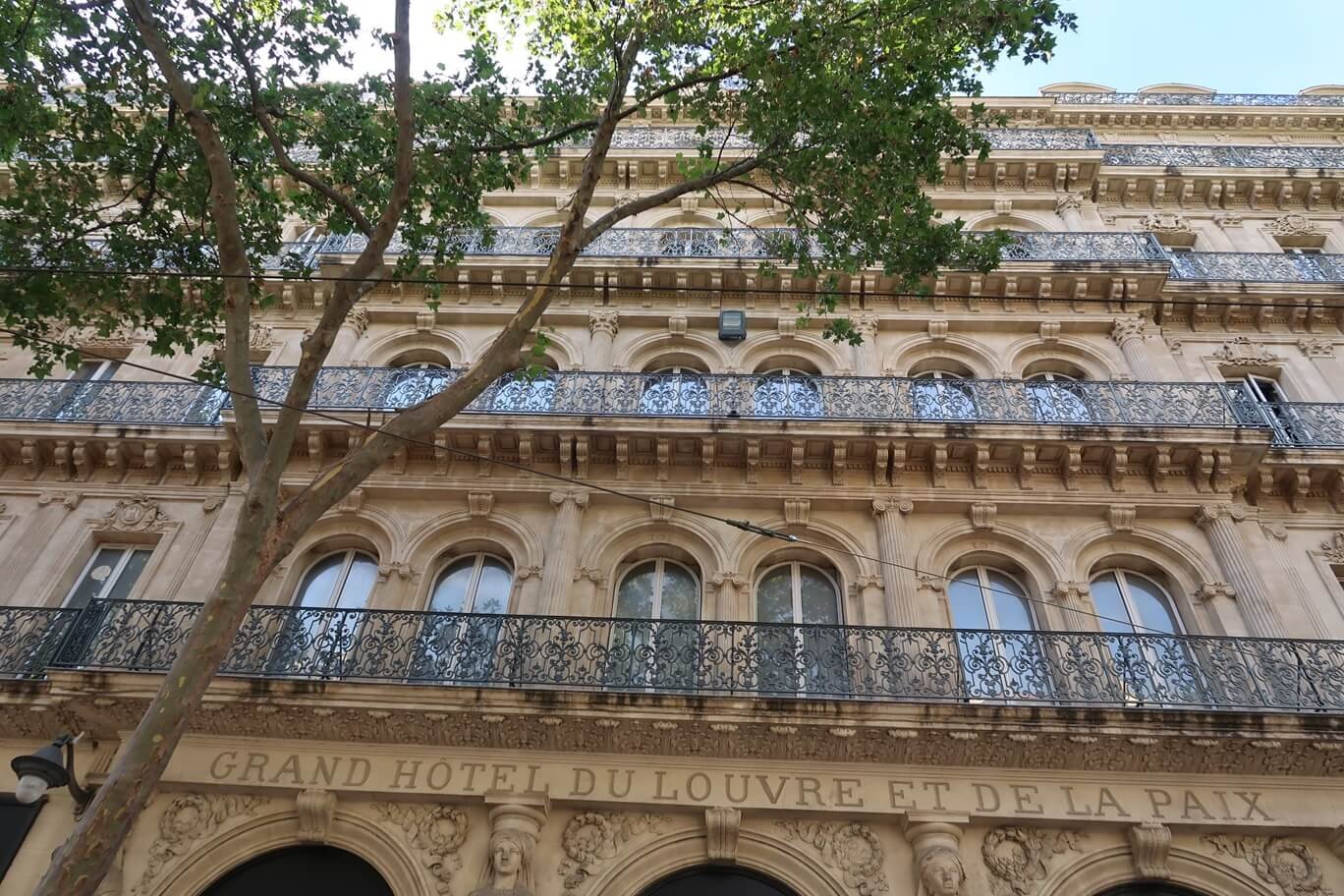
Façade of the former Hôtel du Louvre et de la Paix, Hannah Byron 2026
In June 2026, while researching my forthcoming novel The White Mouse, I had the wonderful opportunity to stand in front of the building myself, almost like a novelist peering through time and imagining the glamorous couple and their guests arriving beneath its grand façade in evening gowns, furs and tailcoats nearly ninety years ago.
But the perfect pictures I'd carried around in my head were a far cry from reality. There was very little glamour to be found. Unless, of course, one considers the summer dresses and khaki shorts displayed in the windows of C&A to be the height of elegance.
I had to look twice to make sure I was standing in front of the right building. I checked my map again. Yes. 53 La Canebière.
I looked up once more, past the bright shop signs, the window displays and the revolving doors, and there they were: the words Hôtel du Louvre et de la Paix, still carved proudly into the stone above the shopfronts.
But if I had to look that hard to find them, it's hardly surprising that nobody else notices them. After all, I was probably the only person walking along La Canebière that Sunday afternoon wondering what life had been like there in 1939. To everyone else, it was simply a C&A.
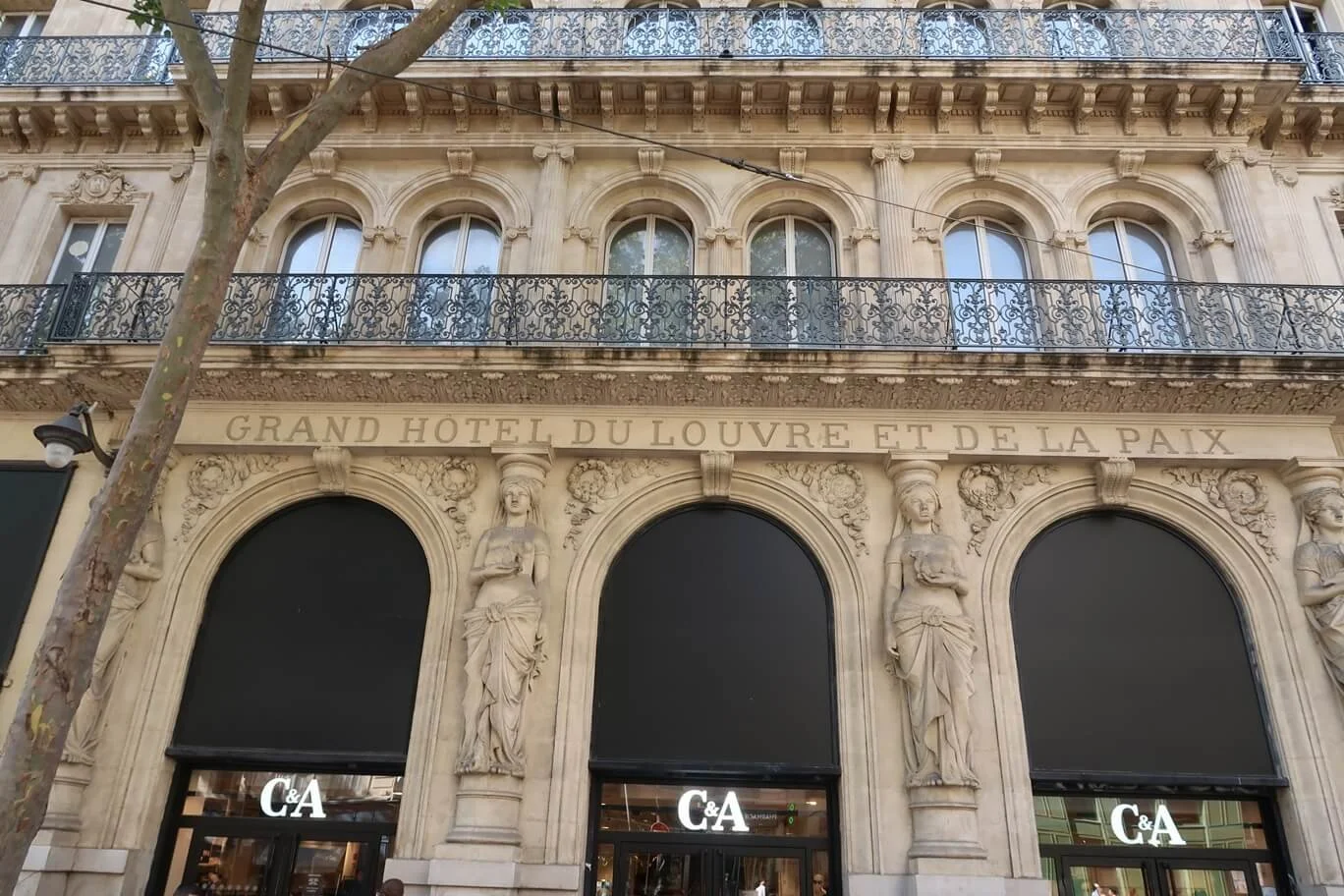
C&A shop signs visible on the former Hôtel du Louvre et de la Paix, Hannah Byron 2026
But I found her. The grand hotel, hiding in plain sight.
As I stood there taking photographs, while trams rattled past and tourists wandered by with ice creams, Marseille unfolded around me in all its glorious unpredictability. Across the street, an elderly woman leaned over her balcony, loudly berating several men below. I think she was speaking Arabic, though I couldn't be sure, and whatever the disagreement was about, the men didn't seem particularly impressed by her dramatic performance. Then, as if the city had decided one spectacle wasn't enough for a Sunday afternoon, a Catholic procession appeared. Priests, children, women in long dresses and men in dark suits walked slowly towards the Vieux Port beneath banners and singing. They disappeared from sight, only to return a little later, still singing. That procession wasn't very 2026 to my eyes. But as it happened to be my birthday, I thoroughly enjoyed the entertainment.
Back to the hotel, standing quietly apart from all the present-day bustle. Like a grand old lady keeping her dignity while the world hurried past.
Curiosity got the better of me, so I crossed the street, waited politely for the tail end of the procession to pass and stepped through the revolving doors. In my mind I was entering a grand hotel. In reality, I was entering a clothes shop.
I approached the young security guard and, in my battered French, asked whether anything inside still reminded visitors of the building's history. Perhaps a plaque. A photograph. Some small memorial.
He understood my French perfectly well. What he didn't understand was what I was asking him and why.
I tried again, explaining that this had once been an important place during the Second World War and that Nancy Wake, one of the most famous women of the French Resistance, had celebrated her wedding reception there.
His head kept shaking. Had I asked him where the men's underwear department was, I'm quite sure he would have been more helpful.
A few moments later I found myself back outside on the sunny La Canebière, the revolving doors still spinning behind me. 2026 bringing me back into reality.
As I Imagined It
Let me invite you to my Hôtel du Louvre et de la Paix in 1939 with Nancy and Henri in the picture.
The Hôtel du Louvre et Paix blazed like a cruise ship anchored to the Canebière, its windows throwing golden rectangles onto the freshly cleaned pavement below. From inside came the swell of an upbeat string quartet, ripples of laughter, and the clink of crystal flutes, sounds that belonged to another époque, an époque that hadn't yet understood it was about to end.
Draped in a mink stole over her silk dress, the seams of her stockings straight as an arrow above her high heels, Nancy paused at the entrance, Picon squirming on one hip. Henri, immaculate in his evening suit, gleaming black shoes and not one hair on his pomaded head out of place, offered his elbow with the patience of a man who had long since accepted that his wife would never arrive anywhere without causing some sort of commotion.
"You're not seriously bringing the dog," he tried nonetheless.
"The dog's name is Picon and Picon is family. Hence, Picon is coming."
Henri sighed the sigh of a husband already learning to choose his battles. "At least keep him off the tablecloths."
"No promises."
…..
This scene is from The White Mouse, the second novel in my The Ace of Nerve trilogy, which will be published at the end of August.