While researching my trip to Marseille, I’d found out that the city had named a street after Henri Fiocca, Nancy Wake’s husband, so I wanted to see that with my own eyes and take a picture. Marseille had honoured its late citizen with a street in the 1st Arrondissement, not far from my hotel on the Vieux Port.
There was, however, one place I couldn't find. I knew Henri, after been tortured and killed by the Gestapo in 1943, had been buried on the Cimetière Saint-Pierre, the largest graveyard in Marseille, but for the life of me I couldn’t find the exact tomb on that enormous graveyard.
I wrote to the cemetery office and to the archives, hoping someone might be able to tell me the exact location of the Fiocca family tomb. No one replied, so I decided that once I arrived in Marseille, I'd simply try my luck at the cemetery itself. The website cited an onsite office, open all weekdays. My simple French and I would manage.
I assumed the family concession might no longer exist. Why else had nobody been able to tell me where Henri was buried? Why else couldn’t I find it in this day and age where everything and everyone is traced and recorded? But it was worth the try.
So I set out on the Monday morning, with little hope but plenty of determination. What I imagined would be a straightforward enquiry – sorry Madame, no longer here - turned into the most memorable event of my entire trip.
My “arranged” taxi driver who only spoke French, while I communicated in my broken French — and I set out on what turned out to be a bit of a drive to the north of the city. I was really excited — and when I'm excited, I talk a lot. So I was telling this originally Marseillaise driver of Algerian descent a great deal about why I wanted to go there but what I expected. He seemed half interested, but also clearly thinking: this lady, trying to find people who died in 1943, in this heat, when everybody else is just thinking about ice creams.
When we arrived, we found the office crowded with people waiting and only one lady behind the counter. My heart sank, so I looked at my driver and said, "Maybe we should just turn around — this is going to take ages, and it's going to cost me a lot of money with the meter running." But he replied, "No, no. Let's sit down and wait."
At some point I got restless, breaking my mind how to speed this thing up, so I said to him, "I have a phone number here in one evasive email I got back — maybe you could ring them, because my French isn’t good enough to explain what I want on the phone. If you'd be willing…" And he said, "Yes, of course." He went outside to make the call and told me to listen for a phone ringing in the office.
It didn’t but soon after a blonde woman in her forties came down the stairs, in a rather ridiculous short playsuit — not meant to be sexy or anything, just the fashion, I guess. She came up, a bit hazy, and said, "What do you want?" I explained, and she said, "Okay, okay," and wrote it down on a Post-it, ready to drift over to another waiting person. French efficiency.
My Marseillaise driver came back inside and he made sure the office lady had all the details he'd pieced together from my broken French. He repeated it to her, and she said, "Yeah, yeah, yeah," and hopped off in her little playsuit, up the stairs again, to see what she could do for us.
Meanwhile my driver sat down next to me, now searching and scrolling on his phone. He was looking up Henri Fiocca, going through the archives himself, trying everything. He even came up with a photo of Nancy Wake — "Is that the woman?" Yes, yes, yes. He was quite invested in my quest by now.
I was getting more nervous by the minute, because the woman in her playsuit wasn't coming back. And the people just kept crowding into that office. There was also a man in a business suit with a briefcase under his arm, who looked very much the part — but he was just hopping from one person to the next, and he never looked my way.
It seemed nobody was going to help me, except my taxi driver. Then the blonde lady came down again, only to run off to somebody else. I went up to her before she could escape again and said, "Listen — how long is this going to take? I've got a taxi waiting for me, and this driver may have other clients waiting." That made her a little snappy, as she clearly didn’t want to be hurried along: "I'm doing my best, that’s all I can do." And off she went upstairs again.
I just sighed and thought: this is not going to work. We're never going to find him. The tomb probably isn't even here anymore — it's so many years ago. So I had basically given up.
Until suddenly the scarcely dressed official came down again, with papers in her hand. And they held the archive number she’d tried to find. She explained they couldn't find him by his name alone, but with the archive number they could: the tomb had been bought by Pascal Fiocca, who was Henri Fiocca's father, and the exact plot was there on the papers — where the tombstone stood.
I thought: this isn't possible. I was high fiving my taxi driver and he had a big smile as well. I didn't dare look straight at the playsuit lady, as I had tried to hurry her along; but I thanked her deeply, while I felt all she thought was, what a strange, agitated woman looking for a man dead for decades.
The papers the office handed me — the register entry for Pascal Fiocca (highlighted) and the plot map of the Cimetière Saint-Pierre: Carré 19, La Pinède (click image to enlarge)
Anyway, we went inside the taxi, because one can drive right across the cemetery — it's that huge. Really, I've never seen a graveyard so big. Of course there's no navigation in there. My poor driver had to feel his way around and take wrong turns, with as help only the site map we’d been given and some quick instructions it was near the crematorium.
At some point he parked the Ford and said, "It must be really near here, we’ll search from here." He made sure we found it together — he was not going to let me wander around there looking for the dead on my own.
When we spotted the tomb, I did first, he stepped away and said, "Take your time. I'll just be waiting a little further on." It was so gallant. I saw him standing there with a small cigar, and I thought: what a wonderful man.
It was quite something to finally find that grave and I had to adjust a moment where I was. I realised, standing there in the half shade in front of that black marble tomb, I may be the only one alive now who knows where it is.
In former days, people surely knew where Henri Fiocca was buried — but I don't think any of the historians I'm in contact with know exactly where the plot is, because it took me an entire morning to find it. So that's something I can share with the people who care about these details. It felt valuable, but that was still my outside reacting to standing there after the intense search and believing I wouldn’t.
Then I landed and looked at this rather unremarkable tomb — not what you'd expect from a millionaire family. It was just a family grave. There were a couple of women — a grandmother, a mother, maybe an aunt — and a few men's names. And then just Henri Fiocca, with his date of birth and his date of death. Nothing about him. And finally, the last name, Pascal, his father, who died in 1954. Nothing that mentioned his heroic death; nothing that he was connected to Nancy Wake.
Just family, family, family. And somehow that was more moving than if it had been a grand tribute to a great hero.
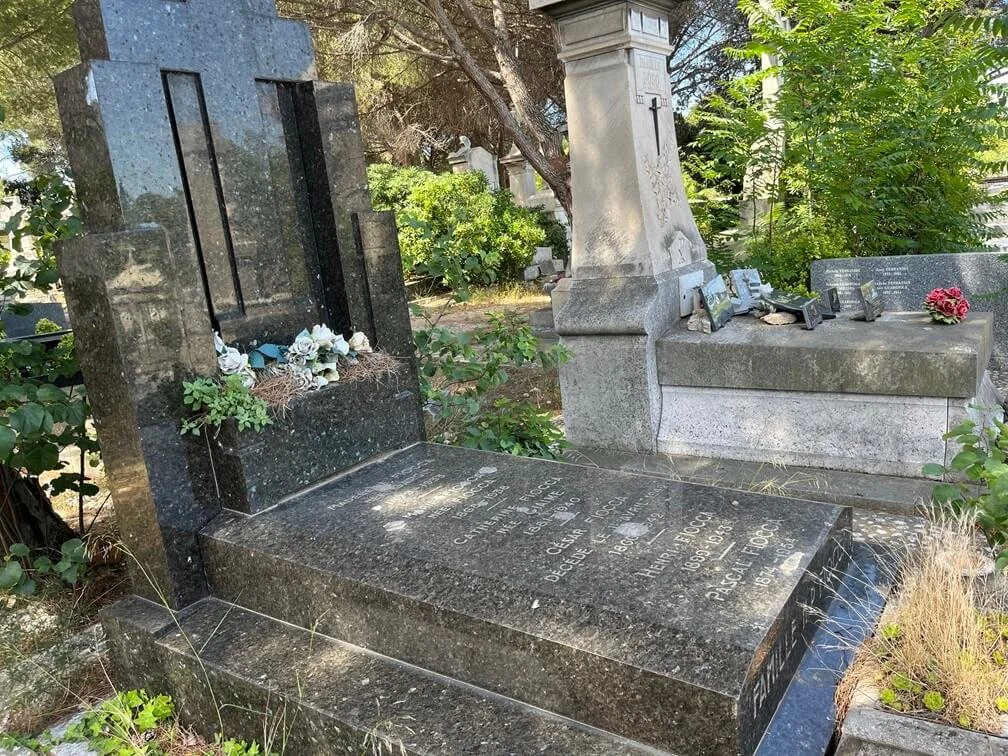
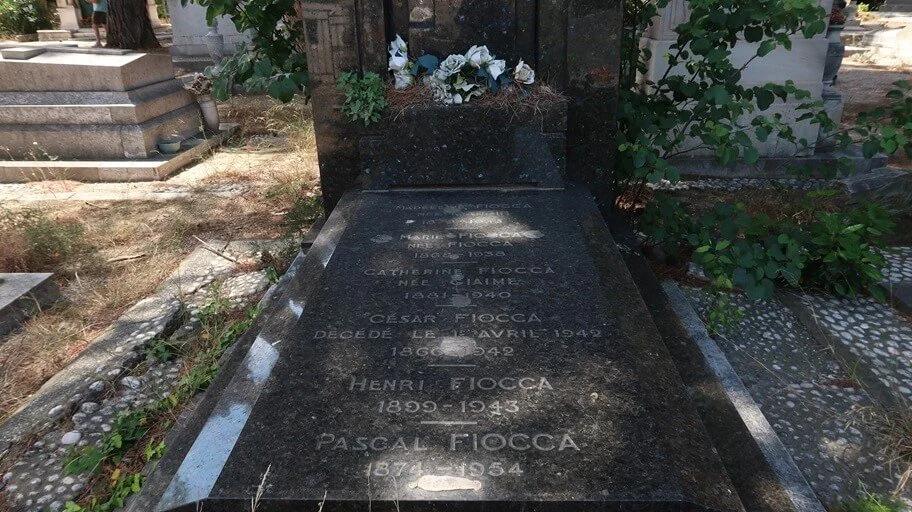
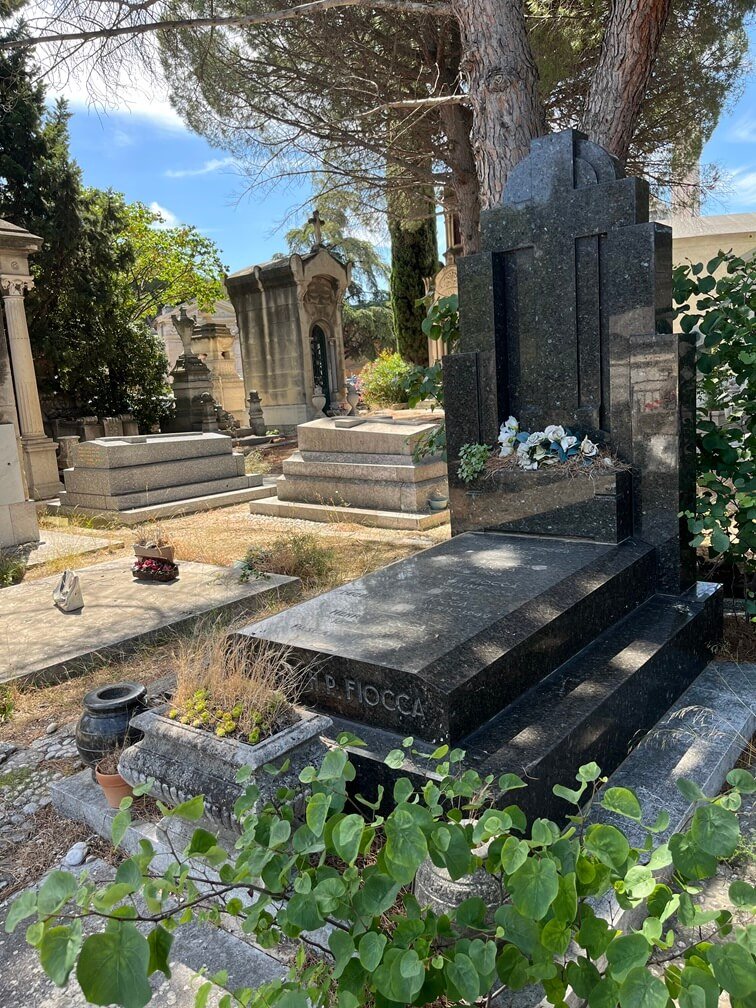
The Fiocca family grave in the Cimetière Saint-Pierre. Henri among his own — no mention of heroism, no mention of Nancy. The grave among the quiet rows of the Cimetière Saint-Pierre. (Click images to enlarge)
I recorded a short video, in which I told Henri and his family that I was quite moved — I'm still moved thinking I stood there — and I thanked him for what he had done, for keeping Nancy safe, for the sacrifice he made, for the feeling that his sacrifice deserves to be remembered more widely.
That's why, in a way — I've written these books about him, and although I never knew him, I have imagined him, imagined his relationship with Nancy. And something came through during my visit to Marseille that really spoke of the heart of the city: this family who weren't truly involved in the Resistance and yet paid such an enormous price. Just a Marseille family mourning the loss of a son and heir in silence. Forever.
It was a moment of deep contemplation for me — to the point that, back in the taxi, I wasn't chattering anymore. So, some kilometres away from Cimetière Saint Pierre and Henri’s grave, the dear driver simply asked me, "Ça va?" — are you all right? After everything — the long morning of searching, the grave, the video, the emotion of it all — that was what he asked. Just: are you all right? And somehow, coming from him, it meant the world.
When we got back to the Vieux Port, I was bracing myself for an enormous bill — we'd been out the whole morning. But he said it was one hundred euros. I gave him twenty euros on top, for his “déjeuner” he said he really needed now.
Looking back, I think I should have tipped him more, but I was still a little dazed.
I had gone looking for two women, Lise and Nancy. I came home with one man on my mind and the sacrifice he had made.