
Blog categories
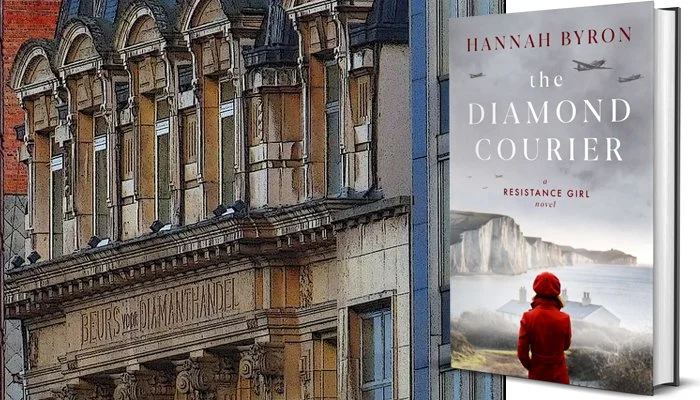
The Story behind The Diamond Courier
While writing The Diamond Courier, I discovered the remarkable wartime history of Antwerp's Jewish diamond industry. What began as historical research became the inspiration for Lili Hamilton's story—a novel rooted in the quiet courage of the men and women who risked everything to smuggle diamonds out of occupied Belgium.
The ornate stone façade of Antwerp Central Station with its grand dome, turrets and arched glass window rising above the station square.
I’ve lived close to Antwerp for most of my life and have always been fascinated by this city at the mouth of the River Scheldt, with its rich history and love of good food. It is a city that has produced painters like Peter Paul Rubens, writers such as Willem Elsschot, and designers including Dries van Noten and Raf Simons.
But Antwerp has another glittering heart: its diamond industry.
The diamond district, also known as the Diamond Quarter (Diamantkwartier) and often called the Square Mile, is an area in the centre of Antwerp. It consists of several square blocks covering no more than about one square mile.
Although much of the gem cutting and polishing historically carried out in Antwerp has moved to countries with lower labour costs, about 84% of the world’s rough diamonds still pass through the district, making it the largest diamond centre in the world. With a workforce of around 30,000 people, it remains one of Antwerp’s most important industries.
The Beurs voor Diamanthandel building in Antwerp's diamond district, its name carved above classical columns.
Within the district is the Antwerp World Diamond Centre and four trading exchanges, including the Diamond Club of Antwerp and the Beurs voor Diamanthandel, both founded by Hasidic diamantaires, as well as the Antwerpsche Diamantkring and the Vrije Diamanthandel.
The neighbourhood has long been dominated by Jewish diamantaires, alongside Jain Indian, Lebanese Maronite Christian and Armenian dealers. Historically, Yiddish was one of the principal languages spoken on the diamond exchange, and no business was conducted on Saturdays.
Behind these elegant buildings, however, lies a complicated wartime legacy: one of brilliance, betrayal, survival and silence.
As I was writing World War II fiction at the time, I wanted one of my novels to explore this difficult chapter of Antwerp’s history. That became The Diamond Courier, the story of a young British woman who is drawn into the dangerous task of smuggling precious diamonds out of occupied Antwerp and bringing them safely to London.
Although Lili Hamilton’s story and her contacts with the Goldmunz family in Antwerp are fictional, many real stories exist of diamonds being hidden and smuggled out of the city to keep them from Nazi hands.
The Black Falcon, a 612.34-carat black carbonado diamond shaped like a falcon's head
While researching The Diamond Courier, I had the honour of corresponding with the Belgian historian Eric Laureys, author of Meesters van het diamant. De Belgische diamantsector tijdens het nazibewind (Masters of the Diamond: The Belgian Diamond Sector during the Nazi Occupation). He generously answered my many questions and even read The Diamond Courier before publication, kindly giving it his approval.
His book offers a rare and meticulously documented look at how the Nazi occupation reshaped Antwerp’s Jewish diamond industry, both through brutal suppression and, more unexpectedly, through moments of calculated tolerance.
The Antwerp Diamond Industry Before the War
By the late 1930s Antwerp was already one of the world’s great diamond centres. More than 25,000 people worked in the trade as cutters, polishers, dealers and brokers. The Jewish community stood at the heart of this world, particularly on the commercial and export side. Many families had come from Eastern Europe and worked alongside Flemish artisans in a close-knit, highly skilled industry.
Tolerance, Then Seizure
When Nazi Germany invaded Belgium in May 1940, the pattern of occupation was anything but uniform. Unlike Amsterdam, where the Jewish diamond industry was seized almost immediately, Antwerp’s Jewish diamantaires were, for a time, allowed to continue working.
Why?
Because the Nazis needed them. Their expertise could not easily be replaced.
That uneasy tolerance began to disappear by mid-1942. The SS established the Deutsche Diamant- und Edelstein Gesellschaft, a centralised agency that forced all sales through Aryanised firms in Brussels. Jews who had not yet fled or been arrested were increasingly barred from the trade. Their workshops were closed. Their assets were looted. And their names disappeared from the books.
Resistance Through Stones
But the story didn’t end there. Some diamantaires defied the system. They hid diamonds, passed them to trusted contacts and joined the underground.
Eric Laureys recounts cases in which diamonds were sewn into coat linings and carried across borders by couriers posing as fashion buyers or students. Many of those couriers were women, calm, alert and brave.
It was while reading these accounts that Lili Hamilton slowly began to take shape in my imagination. I wanted her courage to be rooted in the real acts of ordinary people whose names history has largely forgotten.
The smuggled stones were sold or used to finance escape networks, bribe collaborators and keep Resistance organisations alive. These were quiet acts of defiance, but vital ones.
Aftermath and Reconstruction
After the war Antwerp slowly rebuilt its diamond trade. Some Jewish families returned, shattered and scarred, and attempted to reclaim what they had lost. Many others settled in the newly established state of Israel or in cities such as New York and London, where new diamond centres developed.
Yet Antwerp remained closely tied to the diamond trade, and new firms gradually rose in place of the old, although the shadow of wartime looting and collaboration never completely disappeared.
Laureys’s work does more than expose injustice. It restores dignity to those who resisted, even in the smallest ways: those who hid a pouch of uncut diamonds instead of handing them over, and those who crossed a border knowing they might never come back.
After reading his book, I couldn’t stop thinking about the unnamed men and women who carried diamonds through occupied Europe, unarmed, untrained and utterly brave.
It was then that Lili Hamilton came to life.
Although The Diamond Courier is a work of fiction, it is firmly rooted in the courage of those forgotten men and women whose quiet acts of resistance helped save lives.
This remains one of the lesser-known stories of the Belgian Resistance, and I’m deeply grateful to Eric Laureys for helping illuminate this forgotten chapter of history and for so generously sharing his knowledge while I was writing The Diamond Courier.
Further Reading
· Eric Laureys, Meesters van het diamant (Lannoo, 2005)
· The Plundering of Antwerp’s Jewish Diamond Dealers, 1940–1944 – United States Holocaust Memorial Museum symposium
· Antwerp Diamond Centre archives and post-war restitution files (Royal Library of Belgium)
In Lise de Baissac’s Footsteps in Marseille
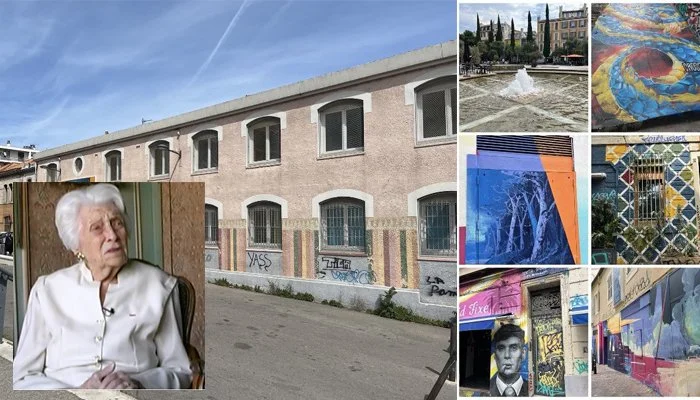
Following in SOE agent Lise de Baissac’s footsteps through Marseille took me from her former home overlooking the Vieux-Port to a street bearing her name that I couldn’t find — and finally to the graffiti-covered streets of Cours Julien, where history unexpectedly met my fiction.
Finding Lise’s apartment on the Quai Rive Neuve
Before travelling to the south of France, I knew that Lise de Baissac had lived in an apartment overlooking the Vieux-Port after the war on the Rive Neuve side, but I hadn't been able to work out exactly in which building she lived. So, sitting in my hotel room overlooking the harbour and having walked up and down in vain, I decided to email Martyn Cox, who had interviewed Lise in her house in the early 2000s, not long before she passed away, to ask whether he happened to remember her address.
Within ten minutes, he replied: 15 Quai de Rive Neuve. Not only that, he sent me photographs to help me recognise the building, and when I looked out of my hotel window I realised, rather wonderfully, that I could actually see Lise's house from my room.
So I immediately set out on my expedition with the address in hand. The building was still there, rather unremarkable between its more imposing neighbours, above the Bar de la Marine, although the first thing I noticed was that the front door was covered in graffiti.
"Oh no, I don't want that for Lise," was my first thought. “How can that be in such respectable surroundings?”
I went into the Bar de la Marine and spoke briefly with two young waiters, who did know that Lise de Baissac had once lived upstairs, although they probably were still in diapers when she died in 2004. The patron may have known more, but he wasn’t in.
From her house I walked a little further down and took the ferry that crosses from one side of the harbour to the other, so I could look back at her house from the water. It was nice to realise I was seeing and enjoying sights she had probably cherished for decades: all the vitality of a busy port city, both on the road and on the water.
A Street without a Sign
There was another trace of Lise I wanted to find because my research had shown me Marseille had named a street after her: Rue Lise de Baissac in Saint-Mauront in the 3rd Arrondissement.
I had been advised not to wander around that particular area alone, so I found a young English-speaking taxi driver and explained what I was looking for. He took me there in his Tesla — my first ride in one, incidentally — and we gradually left the familiar Marseille around the Vieux-Port behind for a very different part of the city, with tower blocks, satellite dishes, washing hanging from balconies and, once again, an extraordinary amount of graffiti.
According to Google Maps, Rue Lise de Baissac should have been alongside an primary school school, and we found the school easily enough, which was closed on Sunday, of course. What we couldn't find was any evidence whatsoever of the street name or sign.
We parked the Tesla and walked around the school and the block several times while I stared at Google Maps and the taxi driver got more confused by the minute. If the street existed as Google Maps showed, there should be a sign, according to his taxi driver mind. I was quite prepared to accept defeat, but not the young Tesla driver.
“Stay close to me,” he warned, and although I was taller than him and he didn’t look particularly muscled, it sounded reassuring. “This is an area where you have to stay very vigilant. Keep your bag close and don’t leave my side.”
We spotted a group of young men loitering outside the closed school entrance and he resolutely walked over to them. I watched him trying to explain who Lise de Baissac had been and why this English historical novelist desperately wanted to photograph a street sign with her name on it, but they were too drugged and disinterested to provide him with anything but a vague stare and a shake of heads. Tesla man gave up as well.
I took a photograph of the school instead, just to be sure.
I’ll never know whether we missed the sign or it simply wasn’t there.
Cours Julien
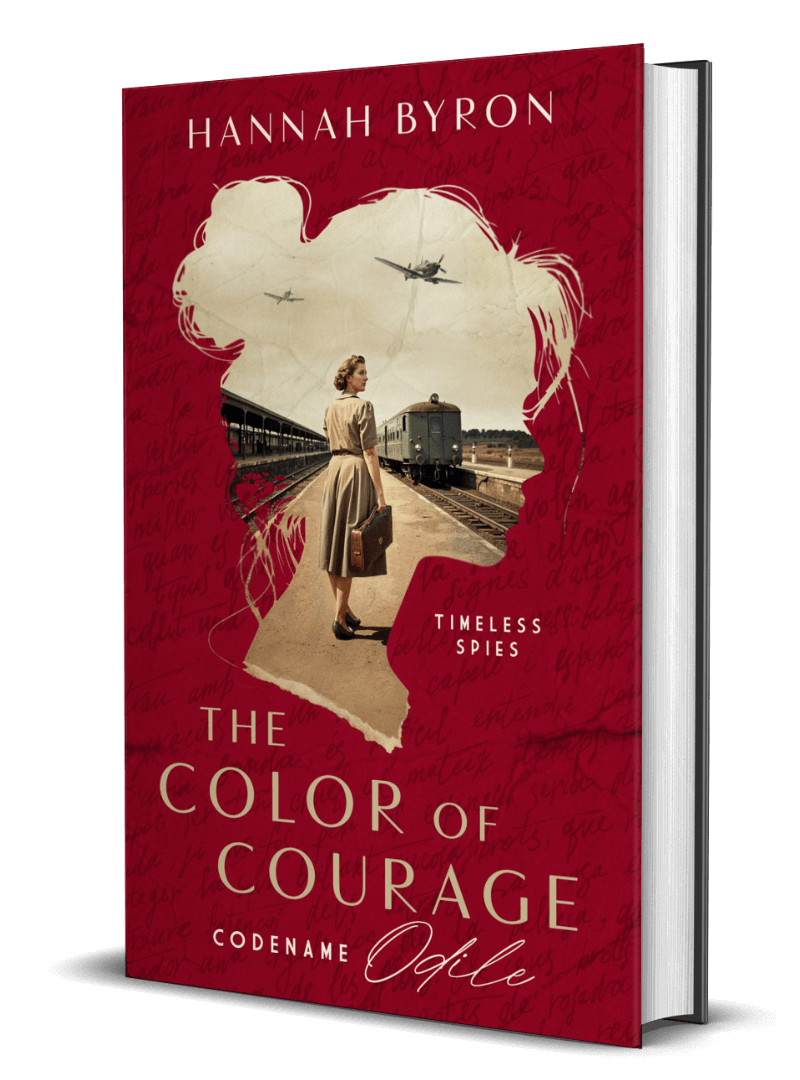
The third place I wanted to visit in relation to my book had nothing to do with the historical Lise de Baissac. It was about The Colour of Courage.
The contemporary part of my novel takes place in Marseille in 2004, and my modern heroine, Sil Anderson, is a young graffiti artist. I had deliberately brought Sil to Marseille because of its street-art culture, so Cours Julien was an area I very much wanted to see.
I went early in the morning, before the shops and restaurants had opened, and wandered around taking photographs of the murals. Some were wonderful, although there was also a lot of scribbling over some, and I wondered if Cours Julien might actually have become more run-down over the years. Not an artist in sight, but they probably slept in.
I couldn’t suppress the thought that — unbeknownst to me when writing my novel — graffiti seemed to follow Lise throughout my Marseille research. It was on the front door of the house where she’d lived, all around the neighbourhood where I couldn't find the street bearing her name, and now it surrounded me in Cours Julien, where it had become part of the fictional story I had written about her.
Lise, quite the aristocratic lady, probably wouldn’t have approved, but then again she married a painter, Gustave Villameur, so who knows? She might even have enjoyed wandering around Cours Julien herself and remembered that she too had once been young and a bit of a rebel, parachuting into France to fight the Nazis.
The Girl Who Was Almost Audrey
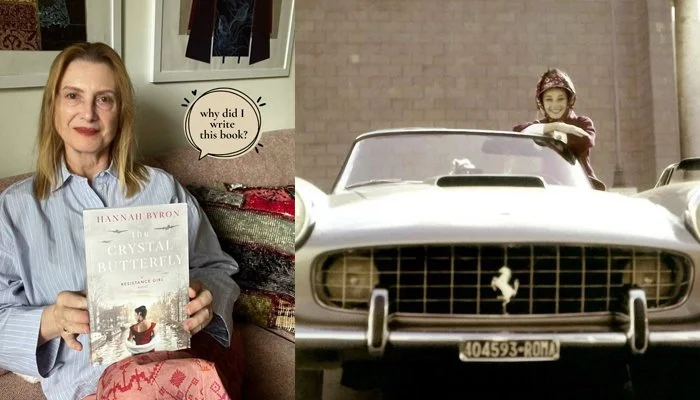
I have loved Audrey Hepburn all my life — long before I knew she had been a ballerina, and a girl in the Dutch resistance. This is the story of how that lifelong love, and one astonishing fact, became The Crystal Butterfly.
Audrey Hepburn and a Ferrari in Rome, Italy in March 1961, during a fashion shoot for Givenchy. Photographer was Pierluigi Praturlon (public domain) Hepburn's husband Mel Ferrer is to the right. Ferrari historians claim this is the s/n 1879GT which was used in a Pink Panther movie as well.
I have loved Audrey Hepburn all my life.
When I was young, the loveliest thing anyone could say to me was that I looked a little like her. I never quite believed it, but I treasured the compliment more than any other — because to be told you resemble Audrey Hepburn is to be told you resemble grace itself. And perhaps the kinship I felt ran a little deeper than a face. Audrey was half-Dutch, with a baroness for a mother — grand blood and hardship braided together. I am no aristocrat, but I know something of that braiding: a whisper of nobility on my father’s side, old family arms and all, and plain working-class Britain on my mother’s. Grand and ordinary, in the same person. She was, quite simply, everything I longed to be.
But it was never the glamour that moved me most. Anyone can admire the gowns and the cheekbones. What held me was something quieter: that Audrey had come through so much in her childhood — hunger, fear, the long years of occupation — and had carried all of it with such lightness afterwards, as though grace were a decision you made every morning rather than a gift you were handed.
The thing I didn’t know
It was only much later that I learned the rest of her story.
As a girl in the Dutch town of Velp, living with her mother and her grandfather through the German occupation, Audrey had played her own small, quiet part in the resistance. And before any of it — before the films, before the fame — she had wanted to be a ballerina. She had trained for it, dreamed of it, danced through the war on too little food and too much fear.
A ballerina, in the Dutch resistance. I couldn’t let it go.
Where Edda van der Valk came from
So Audrey’s Dutch years was the spark for The Crystal Butterfly.
I wanted to write a ballerina who finds her way into the resistance — a girl whose discipline and grace become something harder and braver when her country is taken from her. Her name is Edda van der Valk, and I want to be clear: Edda’s story is entirely her own. It is not Audrey’s life in disguise. But Audrey was always there as I wrote, somewhere at the back of my mind, a presence rather than a template — the reason the book exists at all.
An unexpected honour
While I was writing, I did something I still can hardly believe I dared to do: I got in touch with Robert Matzen.
Robert is the author of Dutch Girl: Audrey Hepburn and World War II, the definitive account of exactly those years in Velp — a book written with the cooperation of Audrey’s youngest son Luca Dotti, and with access to material no one else had seen. He is the person who knows this story better than anyone alive.
And he became one of the very first readers of The Crystal Butterfly.
“Hannah Byron brings the fight against Nazi occupation in World War II vividly to life. The Crystal Butterfly is a page-turner that authentically captures the times and its heroes. I loved this book.” — Robert Matzen, international bestselling author of Season of the Gods and Dutch Girl: Audrey Hepburn and World War II
I have kept that review close ever since.
Walking the real streets
I couldn’t write about Velp and Arnhem from photographs alone. So I went. I walked the streets Audrey walked, stood where she stood, and took my own pictures of the places that shaped both her story and, in its own way, Edda’s.
I wrote all of that up separately — the discoveries, the corners that still remember the war, the small shocks of standing in a real place after imagining it for so long.
Read about my footsteps through Audrey’s Arnhem and Velp here
Adriaantje
There is one more thread, and it is the one I have never quite been able to explain.
Audrey’s grandfather called her Adriaantje — a small, tender Dutch endearment. My own second name is Adriana. And somewhere along the way I quietly took her name for mine, too: I have called myself Hannah Audrey ever since.
I don’t offer this as evidence of anything — only as the truth of how deep some admirations go. Long before I knew about Velp, or the resistance, or the girl who danced through the war, some part of me had already folded Audrey’s name into my own. Perhaps writing Edda was simply the moment it finally rose to the surface.
Where the book began
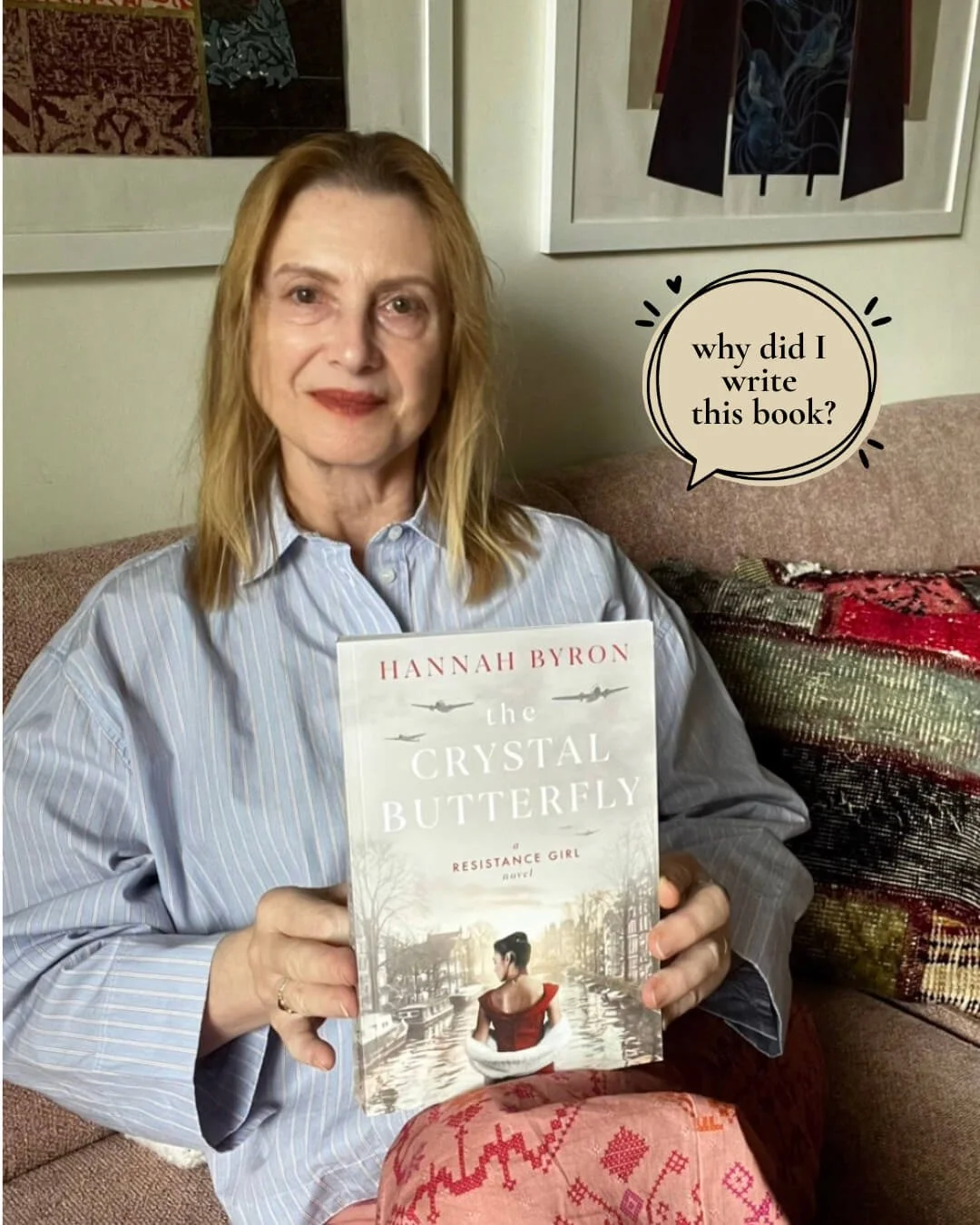
So that is the honest answer to why did I write this book?
Not because I set out to fictionalise Audrey Hepburn. I never would. But because a lifelong love, and one astonishing fact — a ballerina in the resistance — lodged in me and would not leave until I had written my way toward it. The Crystal Butterfly, a Resistance Girl novel, is where that finally led.
When Finding a Grave Became a Mission
Finding Henri Fiocca's grave in Marseille became an unexpected mission. With the help of a kind taxi driver and a determined cemetery clerk, I finally stood before the family tomb of the man who gave his life protecting Nancy Wake. It was the most moving moment of my entire research trip.
While researching my trip to Marseille, I’d found out that the city had named a street after Henri Fiocca, Nancy Wake’s husband, so I wanted to see that with my own eyes and take a picture. Marseille had honoured its late citizen with a street in the 1st Arrondissement, not far from my hotel on the Vieux Port.
There was, however, one place I couldn't find. I knew Henri, after been tortured and killed by the Gestapo in 1943, had been buried on the Cimetière Saint-Pierre, the largest graveyard in Marseille, but for the life of me I couldn’t find the exact tomb on that enormous graveyard.
I wrote to the cemetery office and to the archives, hoping someone might be able to tell me the exact location of the Fiocca family tomb. No one replied, so I decided that once I arrived in Marseille, I'd simply try my luck at the cemetery itself. The website cited an onsite office, open all weekdays. My simple French and I would manage.
I assumed the family concession might no longer exist. Why else had nobody been able to tell me where Henri was buried? Why else couldn’t I find it in this day and age where everything and everyone is traced and recorded? But it was worth the try.
So I set out on the Monday morning, with little hope but plenty of determination. What I imagined would be a straightforward enquiry – sorry Madame, no longer here - turned into the most memorable event of my entire trip.
My “arranged” taxi driver who only spoke French, while I communicated in my broken French — and I set out on what turned out to be a bit of a drive to the north of the city. I was really excited — and when I'm excited, I talk a lot. So I was telling this originally Marseillaise driver of Algerian descent a great deal about why I wanted to go there but what I expected. He seemed half interested, but also clearly thinking: this lady, trying to find people who died in 1943, in this heat, when everybody else is just thinking about ice creams.
When we arrived, we found the office crowded with people waiting and only one lady behind the counter. My heart sank, so I looked at my driver and said, "Maybe we should just turn around — this is going to take ages, and it's going to cost me a lot of money with the meter running." But he replied, "No, no. Let's sit down and wait."
At some point I got restless, breaking my mind how to speed this thing up, so I said to him, "I have a phone number here in one evasive email I got back — maybe you could ring them, because my French isn’t good enough to explain what I want on the phone. If you'd be willing…" And he said, "Yes, of course." He went outside to make the call and told me to listen for a phone ringing in the office.
It didn’t but soon after a blonde woman in her forties came down the stairs, in a rather ridiculous short playsuit — not meant to be sexy or anything, just the fashion, I guess. She came up, a bit hazy, and said, "What do you want?" I explained, and she said, "Okay, okay," and wrote it down on a Post-it, ready to drift over to another waiting person. French efficiency.
My Marseillaise driver came back inside and he made sure the office lady had all the details he'd pieced together from my broken French. He repeated it to her, and she said, "Yeah, yeah, yeah," and hopped off in her little playsuit, up the stairs again, to see what she could do for us.
Meanwhile my driver sat down next to me, now searching and scrolling on his phone. He was looking up Henri Fiocca, going through the archives himself, trying everything. He even came up with a photo of Nancy Wake — "Is that the woman?" Yes, yes, yes. He was quite invested in my quest by now.
I was getting more nervous by the minute, because the woman in her playsuit wasn't coming back. And the people just kept crowding into that office. There was also a man in a business suit with a briefcase under his arm, who looked very much the part — but he was just hopping from one person to the next, and he never looked my way.
It seemed nobody was going to help me, except my taxi driver. Then the blonde lady came down again, only to run off to somebody else. I went up to her before she could escape again and said, "Listen — how long is this going to take? I've got a taxi waiting for me, and this driver may have other clients waiting." That made her a little snappy, as she clearly didn’t want to be hurried along: "I'm doing my best, that’s all I can do." And off she went upstairs again.
I just sighed and thought: this is not going to work. We're never going to find him. The tomb probably isn't even here anymore — it's so many years ago. So I had basically given up.
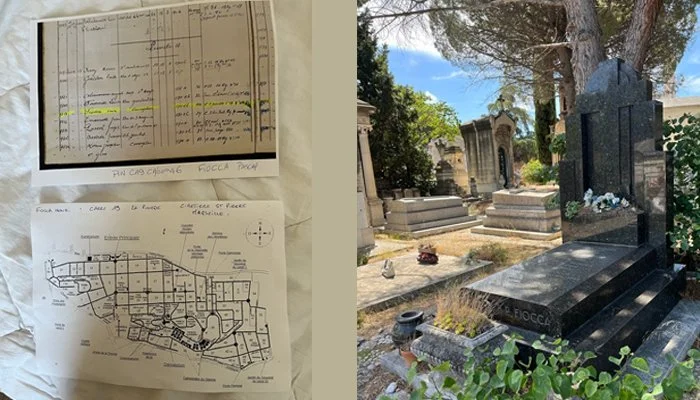
Until suddenly the scarcely dressed official came down again, with papers in her hand. And they held the archive number she’d tried to find. She explained they couldn't find him by his name alone, but with the archive number they could: the tomb had been bought by Pascal Fiocca, who was Henri Fiocca's father, and the exact plot was there on the papers — where the tombstone stood.
I thought: this isn't possible. I was high fiving my taxi driver and he had a big smile as well. I didn't dare look straight at the playsuit lady, as I had tried to hurry her along; but I thanked her deeply, while I felt all she thought was, what a strange, agitated woman looking for a man dead for decades.
The papers the office handed me — the register entry for Pascal Fiocca (highlighted) and the plot map of the Cimetière Saint-Pierre: Carré 19, La Pinède (click image to enlarge)
Anyway, we went inside the taxi, because one can drive right across the cemetery — it's that huge. Really, I've never seen a graveyard so big. Of course there's no navigation in there. My poor driver had to feel his way around and take wrong turns, with as help only the site map we’d been given and some quick instructions it was near the crematorium.
At some point he parked the Ford and said, "It must be really near here, we’ll search from here." He made sure we found it together — he was not going to let me wander around there looking for the dead on my own.
When we spotted the tomb, I did first, he stepped away and said, "Take your time. I'll just be waiting a little further on." It was so gallant. I saw him standing there with a small cigar, and I thought: what a wonderful man.
It was quite something to finally find that grave and I had to adjust a moment where I was. I realised, standing there in the half shade in front of that black marble tomb, I may be the only one alive now who knows where it is.
In former days, people surely knew where Henri Fiocca was buried — but I don't think any of the historians I'm in contact with know exactly where the plot is, because it took me an entire morning to find it. So that's something I can share with the people who care about these details. It felt valuable, but that was still my outside reacting to standing there after the intense search and believing I wouldn’t.
Then I landed and looked at this rather unremarkable tomb — not what you'd expect from a millionaire family. It was just a family grave. There were a couple of women — a grandmother, a mother, maybe an aunt — and a few men's names. And then just Henri Fiocca, with his date of birth and his date of death. Nothing about him. And finally, the last name, Pascal, his father, who died in 1954. Nothing that mentioned his heroic death; nothing that he was connected to Nancy Wake.
Just family, family, family. And somehow that was more moving than if it had been a grand tribute to a great hero.
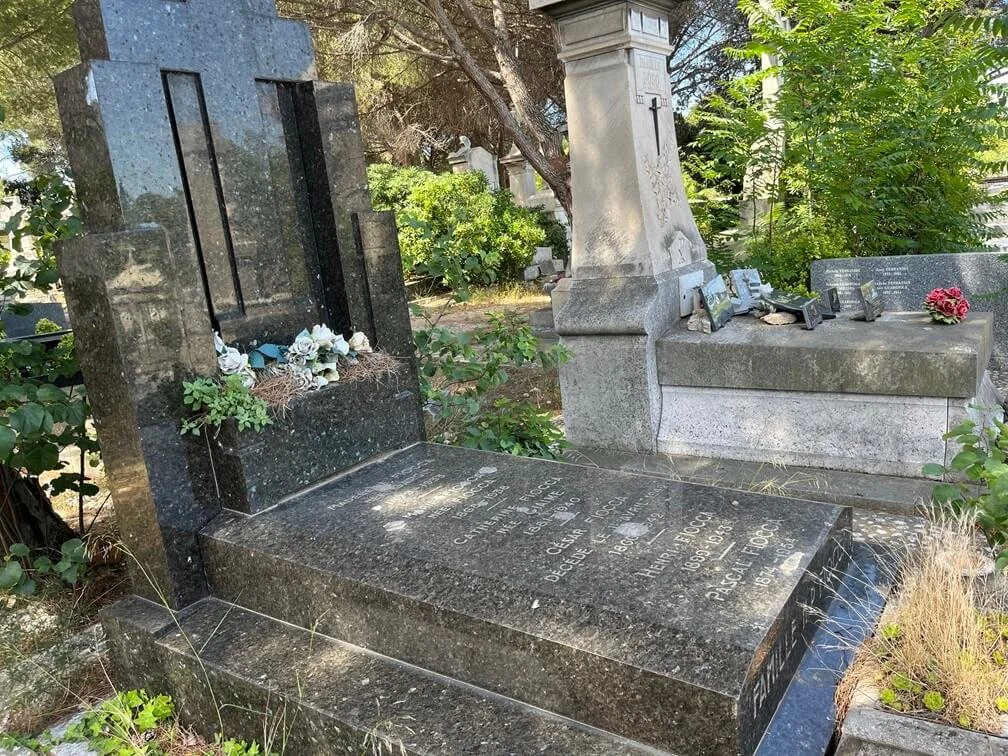
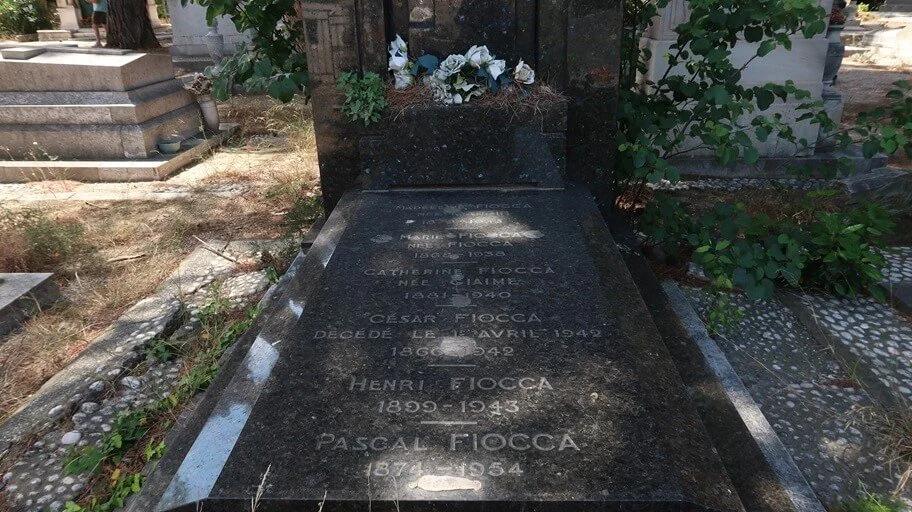
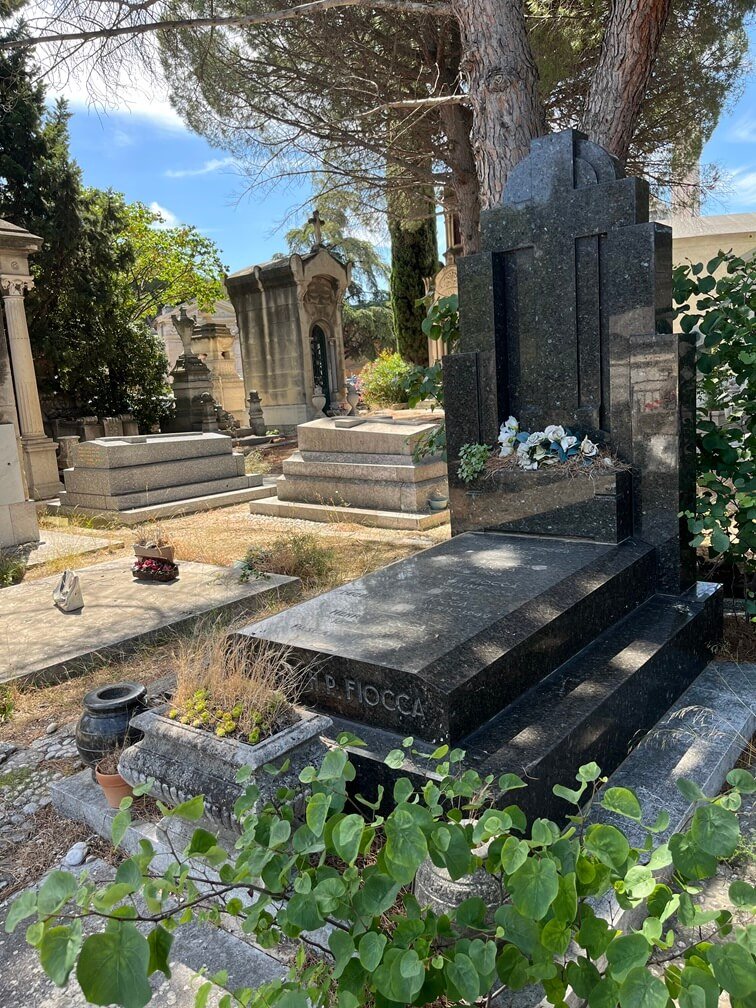
The Fiocca family grave in the Cimetière Saint-Pierre. Henri among his own — no mention of heroism, no mention of Nancy. The grave among the quiet rows of the Cimetière Saint-Pierre. (Click images to enlarge)
I recorded a short video, in which I told Henri and his family that I was quite moved — I'm still moved thinking I stood there — and I thanked him for what he had done, for keeping Nancy safe, for the sacrifice he made, for the feeling that his sacrifice deserves to be remembered more widely.
That's why, in a way — I've written these books about him, and although I never knew him, I have imagined him, imagined his relationship with Nancy. And something came through during my visit to Marseille that really spoke of the heart of the city: this family who weren't truly involved in the Resistance and yet paid such an enormous price. Just a Marseille family mourning the loss of a son and heir in silence. Forever.
It was a moment of deep contemplation for me — to the point that, back in the taxi, I wasn't chattering anymore. So, some kilometres away from Cimetière Saint Pierre and Henri’s grave, the dear driver simply asked me, "Ça va?" — are you all right? After everything — the long morning of searching, the grave, the video, the emotion of it all — that was what he asked. Just: are you all right? And somehow, coming from him, it meant the world.
When we got back to the Vieux Port, I was bracing myself for an enormous bill — we'd been out the whole morning. But he said it was one hundred euros. I gave him twenty euros on top, for his “déjeuner” he said he really needed now.
Looking back, I think I should have tipped him more, but I was still a little dazed.
I had gone looking for two women, Lise and Nancy. I came home with one man on my mind and the sacrifice he had made.
Has Marseille Forgotten Nancy Wake?
I expected Marseille to be full of reminders of Nancy Wake. Instead, I found a plaque almost nobody knew existed, a house that had vanished, and a city that seemed to have quietly moved on. Sometimes historical research is as much about what isn't there as what is.
A View Across Marseille (all images clickable to enlarge)
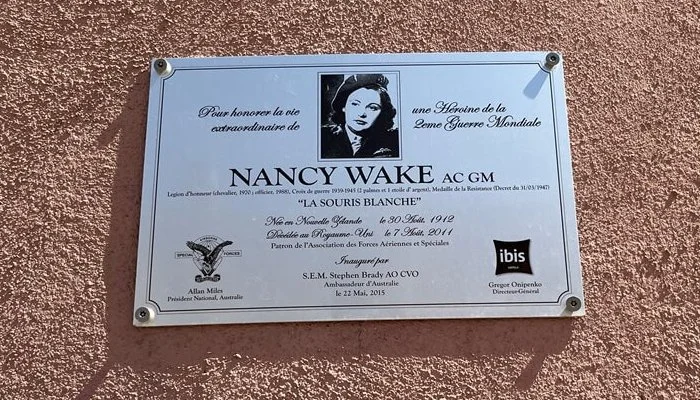
One of the things I wanted to find in Marseille was a plaque dedicated to Nancy Wake. According to my notes, it was somewhere on the Ibis hotel near Gare Saint-Charles.
So one very hot afternoon I walked up from my hotel through the narrow streets towards the station. It was the first time I climbed the famous staircase of Gare Saint-Charles and looked out over Marseille. Standing there, with the city spread out before me, I couldn't help thinking that this had once been Nancy's city.
From there I followed my navigation to the hotel. Finding the hotel was easy. Finding the plaque wasn't.
A Tiny Plaque
I walked all around the building without seeing anything. Eventually I went inside, partly because I hoped it would be cooler than outside, but also to ask at reception. Nobody knew anything about a plaque, which seemed odd to me. But as it was really supposed to be here, I went outside again and searched a second time. Still nothing.
Across the street I noticed a police officer. Perhaps he would know. As I asked in my slightly improved French, he shook his head. Never heard of a plaque. Never heard of Nancy Wake.
But instead of simply shrugging his shoulders, he said he’d help me look because now he was curious too. Together we searched every corner of the hotel until eventually we spotted something about two metres above our heads.
It was tiny. So tiny that neither of us could read it from the pavement. Fortunately, the police officer was taller than I was. He took a photograph with my phone and only then could I read the inscription.
Click to enlarge
The plaque had only been unveiled in 2015, four years after Nancy's death, by the Australian Ambassador to France after staying at the hotel. No wonder we had struggled to find it. And the police officer laughed that he’d worked in the office across the street for years and had never noticed it either.
I thanked him for his help, went back inside the hotel and showed the photograph to the reception staff. Suddenly it rang a bell.
"Oh yes..."
One Last Address
By then the heat had really begun to catch up with m so I asked the hotel to call me a taxi. As I waited, I thought there was one final place connected to Nancy that I wanted to see. After her marriage, she and Henri Fiocca had lived at 5 Rue Édouard Stephan in the 4th Arrondissement.
I asked the taxi driver whether he could drive me past the address. At first, he mumbled something that sounded very much like "no, that’s not permitted." Then, after a moment's thought, he must have changed his mind, because after taking endless roads left and right, he suddenly announced.
"We're here."
I looked out of the window. It looked like a very ordinary street to me that bordered on a small park. Not anything fancy and expensive, which I had also already wriggled out of the taxi driver. No not a posh area perse, never had been. Henri Fiocca? The successful industrialist? Somehow, I had imagined something grander. Instead, it looked like an ordinary neighbourhood.
But it was clear that the building where they used to live had long since disappeared, replaced by a modern apartment block. I took a photograph of the house anyway, because what else could I do? By now, I suspect the taxi driver thought I was a rather odd passenger anyway.
Opposite what used to have been their house, stood an old tree so I also took a picture of that hoping that stood there already when Nancy looked out of the window. But who knows?
A City That Had Moved On
As the taciturn taxi driver drove me back towards the Vieux-Port, I couldn't help thinking how strange this afternoon had been. Nancy Wake had once carried the highest bounty on her head offered by the Gestapo. 5 million Francs. She is remembered throughout the world as the White Mouse, the famous WW2 resistance fighter. She’d kept that image of herself alive for decades, but it seemed to have faded after her death.
Here, in the city where so much of her resistance work begun, I’d found remarkably little that still spoke of her. A tiny plaque almost nobody knew existed. A house that no longer stood.
Marseille, it seemed, had quietly moved on. At that moment I thought my search for traces of Nancy Wake had come to an end. They had.
But I had no idea that the following day I would stumble upon something that will keep her memory alive in my mind forever.
Only the Avenue Remembers Dr. Rodocanachi | Following Nancy Wake's Footsteps in Marseille
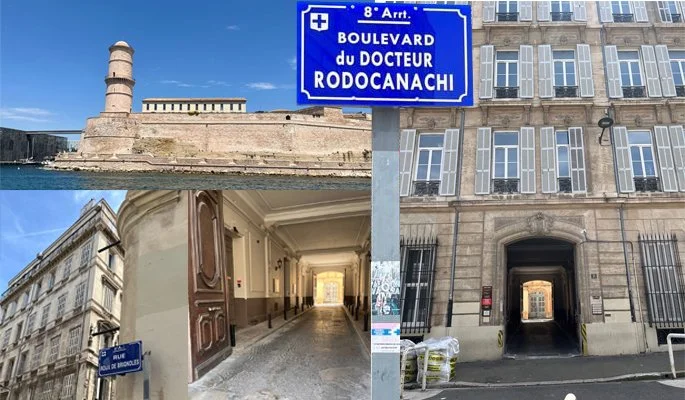
Following Nancy Wake’s route from Fort Saint-Jean to Dr. Rodocanachi’s house in Marseille, I expected to find an address. Instead, I found a forgotten story, a helpful car mechanic named Mohammed, and a place that quietly changed the way I imagine one of Nancy Wake's wartime missions.
Fort Saint-Jean
My feet were already quite tired from walking in the Marseille heat. I'd walked along one side of the Vieux-Port to find Lise de Baissac's house, but I decided I still wanted to see Fort Saint-Jean. It had played such an important part in Nancy Wake's early resistance work through Ian Garrow's escape line, which would later become the Pat O'Leary Line.
My research at home had shown me that you could walk around the grounds and the ramparts of the fort without buying a ticket for the museum. I wasn't particularly interested in spending the afternoon learning about the fort's seventeenth-century history, but by the time I finally reached the far end of the Vieux-Port I was simply too tired to go inside anyway.
I took a few photographs and just stood there, thinking, This is where Nancy stood. This is where she helped escaped British officers in 1940 and beyond. And from here she took them to Dr. Rodocanachi's house.
Memorial for people who couldn't leave Marseille during WW2 Fort Saint Jean
I had already looked up the doctor's apartment at 21 Rue Roux de Brignoles, in the 6th arrondissement, and despite the heat and my sore feet decided to go there next because it was much closer than I had imagined while writing The Ace of Nerve.
Somehow, in my imagination, Fort Saint-Jean had always been much farther outside Marseille, but now I realised that transporting those officers, still in uniform, in the back of Félix's plumber's van had actually been a journey of only about a mile and a half.
That didn't make it any less dangerous, but it changed the logistics.
Looking for Dr. Rodocanachi
After a short rest, I climbed the steep road up to 21 Rue Roux de Brignoles and was surprised to find such an ordinary-looking street. The house numbers had changed over the years, so I found myself looking around wondering, Is it this house? Or perhaps that one?
It struck me that this is often the case with places connected to the Resistance. They rarely announce themselves. Extraordinary courage was so often hidden behind the doors of perfectly ordinary buildings.
As I stood there, someone who was looking at a few cars nearby came over to me. It was Sunday, so he wasn't actually working. He introduced himself as Mr. Mohammed and asked, quite understandably, what I was doing. He had seen other people taking photographs of the building and wondered why.
In my simple French, but with my usual enthusiasm, I explained I was looking for the house of Dr. Georges Rodocanachi, an important member of the French Resistance during the Second World War.
He had never heard of the doctor, or of Nancy Wake, or of British officers being hidden in a plumber's van, but my enthusiasm clearly intrigued him. I showed him my map with the address and a photograph of the Boulevard du Docteur Rodocanachi, which I had already taken.
Scratching his grizzled head, he said, "Well, I really don't know anything about him. I've lived here for quite a while in one of the rooms upstairs, but I'm just a car mechanic. Still... perhaps you should come back tomorrow. The owners of the building are Greek, and I think there are many old photographs inside the offices. Maybe they know something."
House of Dr. Rodocanachi (click to enlarge)
Then he suddenly pointed above the entrance.
"Look."
The modern number beside the door read 21, but carved into the stone above the archway was the original number 25.
"The numbers have changed," he said.
It was another little clue in the puzzle I was trying to solve.
I had already noticed that part of the building now housed lawyers' offices, but nowhere had I seen the name Rodocanachi.
By now Mr. Mohammed had become almost as invested in the search as I was.
"Come."
He led me through the entrance hall and started pounding on the office doors, hoping somebody might be there on a Sunday. Nobody answered.
"Come back tomorrow," he said. "Tell them Mohammed sent you."
So, in the same heat, I walked back down the hill, rested in my hotel room and hoped that perhaps the next day I would be lucky.
One More Attempt
The following afternoon I climbed the hill again. This time I didn't see Mr. Mohammed, but I rang the bell. A young woman opened the door. She was friendly but had absolutely no idea who Dr. Rodocanachi was or what the history of the building was. She was simply the secretary to the lawyers. Nancy Wake meant nothing to her either.
She asked me to wait in the wonderfully cool lobby while she fetched one of the lawyers. He came out in a smart suit, and I immediately pictured him on an expensive yacht in Monaco. He had that sort of air about him.
Listening carefully to my story—or at least giving that impression—he admitted he didn't know anything about the history of the building either.
"But yes," he said, "the director of the company is Greek, so perhaps he knows."
I handed him my business card, the first one I had ever used after hastily creating it before leaving for Marseille, and I must admit I felt rather grand about it. The smart-looking lawyer promised that when the Greek director returned, he would ask him to contact me.
I watched my phone and my email for the rest of the day and the next morning. No phone call. No email. So my search for Dr. Rodocanachi and his wife Fanny ended there.
Only the Avenue Remembers
As I reflect on the one mission in Marseille that produced the fewest answers, I mostly think with gratitude about Mr. Mohammed. The car mechanic has become characteristic, for me, of the people I met in Marseille. He tried to help me with everything he had because I was so determined to find a doctor who had lived there more than eighty years ago—a man he'd never heard of, but who somehow became important to him because he was important to me.
And I certainly didn't leave empty-handed. I now have a much clearer picture of the route Nancy must have travelled many times. I stood where she stood. I walked the streets she walked. Standing in the entrance passage of 21 Rue Roux de Brignoles, I suddenly found myself imagining Félix driving the plumber's van through the gateway before the heavy doors closed behind him, allowing the escaped British officers to disappear from sight.
I don't know whether that is exactly how it happened. But now I could stand there, I could picture it. And how, unfortunately the loyal doctor must have been arrested there, never to return. Visiting Marseille has changed the images I carried in my mind while writing The Ace of Nerve.
Dr. Rodocanachi was arrested in 1943 and later murdered in Buchenwald. His wife, Fanny, survived the war. Today, people stroll beneath the leavy trees of the Boulevard du Docteur Rodocanachi in the 8th Arrondissement probably without giving the name on the blue street sign a second thought. Yet Marseille still remembers him.
And I do, and perhaps, through my stories, a few more people will too.
Snippet from The Ace of Nerve, Book 2, where Nancy first meets the doctor.
A slight, white-haired man appeared in the kitchen doorway, in a doctor's white coat with slim golden spectacles catching the light. He came to Nancy first and took her hand in both of his. They were soft and very steady, the hands of a man who’s been doing precise work for many decades.
"It is an honour to finally meet you, Madame Fiocca," he said warmly. "I have known your husband for many years, of course, but we have never had the pleasure. I am Dr Georges Rodocanachi."
"The honour is mine, Doctor," Nancy smiled, glad for both his steadiness and his warmth.
"And this," said Dr Rodocanachi, turning, "is my wife Fanny."
Fanny Rodocanachi was indeed a good deal taller than her husband. A composed, handsome woman with dark eyes. Younger than her spouse and very French in the way that required no announcement. The two women shook hands briefly and Nancy liked Fanny immediately.
"Coffee!" the doctor’s wife announced to the room at large, and she disappeared into the kitchen, reappearing only moments later with a tray of five cups and a steaming pot. After setting it down, she withdrew quietly. Nancy noted the five cups. Fanny had counted her in without being asked, just as Garrow predicted.
"I'll leave you to it, Captain," Dr Rodocanachi addressed Garrow with the ease manners of a man who’s long decided that trust, once given, requires no supervision. "I'll be in my consulting room should you need me. Take your time. This room is yours today."
And with that he retreated after his wife, closing the door softly behind him.
The White Mouse will be available at the end of August 2026
My great-uncles Jack & William Westcott and In Picardy's Fields — Part 2: The Search
Two brothers, dead within eight days of each other — one at the bottom of the North Sea, one in the fields of northern France. How I traced my great-uncles through the war archives, and the cap emblem that finally led me to Jack.
In my last post, I told you how finding an old photograph set me on the path to writing In Picardy's Fields. Now for the search itself.
My search for Jack and William's war records
At first, I had no idea where to begin with my search for my great-uncles' war history. The information my mother had left was sparse and there were no family members alive to tell me more about this generation 'before'. Well one Uncle, also named Jack, but he knew nothing.
I found that the first step to trace British WW1 dead is to go to the Commonwealth War Graves Commission, which is a treasure-trove when you have first and last names. You wouldn't believe how many names there are in that register, but within seconds the names of both my great-uncles popped up.
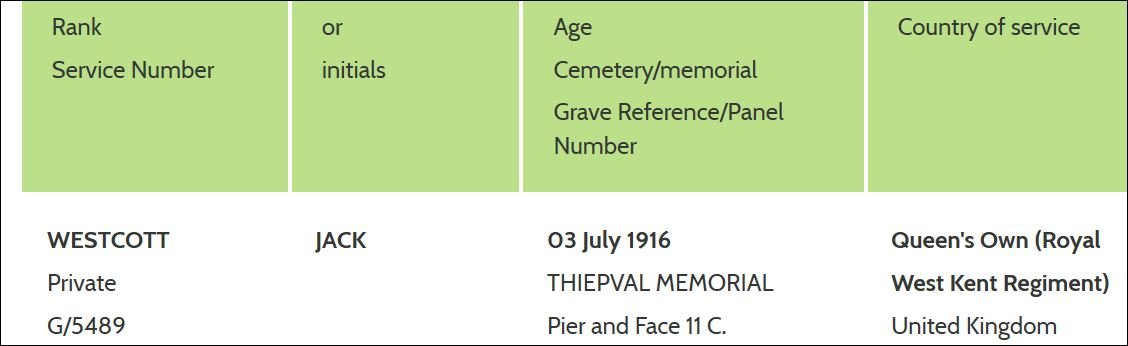
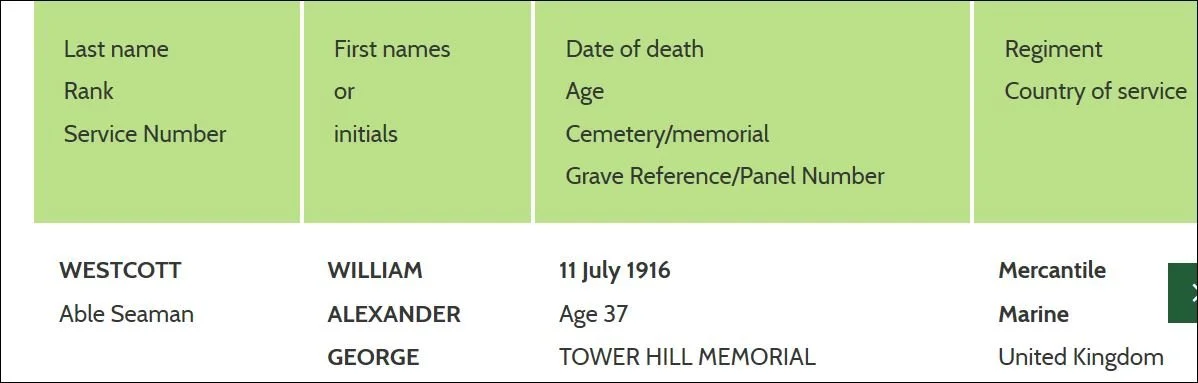
Register Commonwealth War Graves Commission
But then I was faced with a discrepancy. Either the War Graves Commission had their deaths wrong, or my mother didn't have the facts. I will never know where she got hers, but they were wrong. Though just by one month.
My great-uncles, unbeknown to each other, died within eight days of each other, William aboard the S.S. Calypso, lying now on the bottom of the North Sea, 15 miles west of Listafjorden, Norway and Jack near Ovillers, in hilly northern France. The Westcott family lost its eldest and youngest son and brother in a matter of days.
Private Jack Westcott
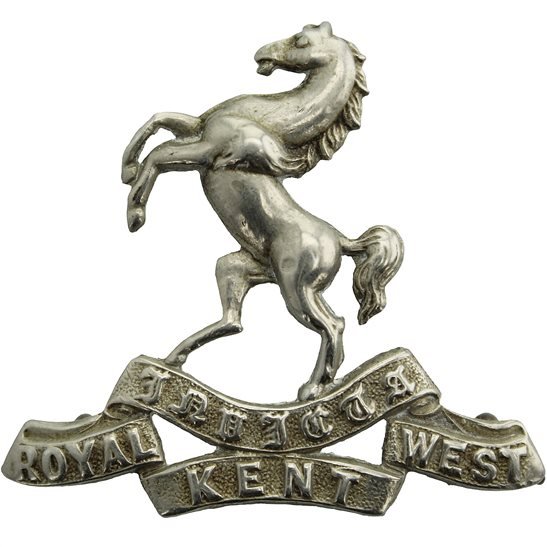
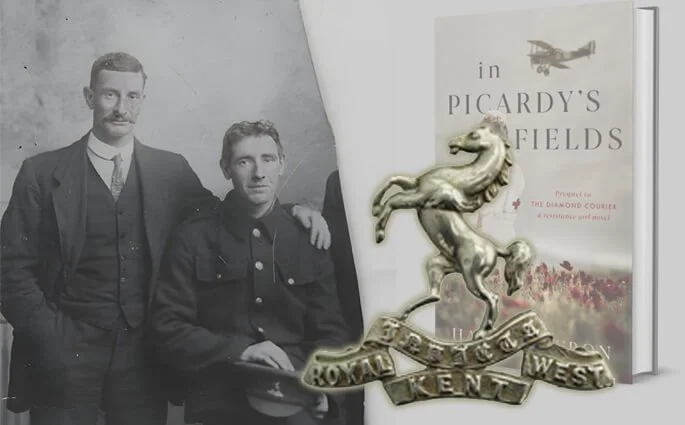
Emblem Royal West Kent Regiment
For the French connection I concentrated my research on Jack Westcott. I was able to trace his path, and more is known about him than about William. It starts with the cap resting on his knee in the photograph. The emblem is of the Queen's Own (Royal West Kent Regiment).
But it took a while to find that out. I enlarged the vague, 110-year-old photograph until I could see more clearly the jumping horse and started down a rabbit hole on the Internet until I found his regiment. They still sport that same emblem today!
With his name, his regiment, his number and approximately his whereabouts, it was time for me to take action. This was in late August 2019, just months before COVID disrupted all our plans. I could still freely travel from Holland to the North of France.
In the Field: Picardy and the Battle of the Somme
And so I went. I stood at the Thiepval Memorial, among the names of the missing of the Somme, and found Jack's name carved in stone. Even now, years later, those images are still vivid and emotional for me.
Jack and William never came home. But they are no longer anonymous men in an archive. Their story — and that of the women who stayed behind — lives on in In Picardy's Fields, the novel I dedicated to my great-uncles.
Step into Jack and William's world →

My great-uncles Jack & William Westcott and In Picardy’s Fields
One of the men shown in the 1916 Battle of the Somme footage could well have been my great-uncle, Private Jack Westcott. He never came home. Neither did his brother William. Here is how I found them — and why I had to write their story.
June is the history and personal month behind my first historical fiction novel, In Picardy’s Fields — a story rooted in my own WW1 family history. If you’ve read my June newsletter, you’ll know why this month matters so much to me personally. Here is where it all began.
In the description of this film — the 1916 Battle of the Somme footage, one of the earliest documentary films ever made — I mentioned my great-uncle, Private Jack Westcott. One of the men shown in that footage could well have been him. Here is his story, and that of his brother William and my ancestry.
How my WW1 family history began
Helen as a young boarding school teacher, 1950, age 22 [Byron Archives]
Two things struck me about this photo. Firstly she wrote on the back that she’s wearing an expensive suit bought at Harrods for her first job at Battle Abbey Girls’ School. It would start off her life-long career as a teacher of French and English in 3 different countries (England, France and Holland). Secondly, how is she sitting in this chair?
Anyway.
My late mother, Helen Ferguson was a keen amateur genealogist of both her own British/Irish ancestry and of the Dutch branch of my father’s family.
At first, I did not share my mum’s fascination for stuffy archives and bone-dry Internet sites, but I inherited the yellow envelopes with all her scribbles and earmarked photographs on her passing in 2017. Moving the envelopes one day – I had cautiously marked them ‘Hannah’s retirement project’- this photo fell out.
Standing left: William Alexander Westcott, sitting Jack Westcott (photo Jan 1915) [Byron Archives]
Written note on back of photo
Now this was intriguing. First someone other than my mother had tried to identify the two relatives who had apparently died in WW1 (see different handwriting in middle of backside note). Then my mother had done some more research and found out they were her uncles William Alexander Westcott and Jack Westcott, brothers to my maternal grandmother.
The WW1 story of my family
A 1915 photograph of family members who have died in the Great War triggered something deeper in me than my mother’s envelopes with her notes. These men were my blood relations, men who had given their lives for our freedom.
And with their ultimate sacrifice, young and childless, they had since my discovery become as forgotten and untraceable as their bodies were, as I was to find out. As both brothers are MIA, they have become anonymous men, listed in archives and on memorials.
Unless I change their fate and write about them, in a small attempt to honour their legacy.
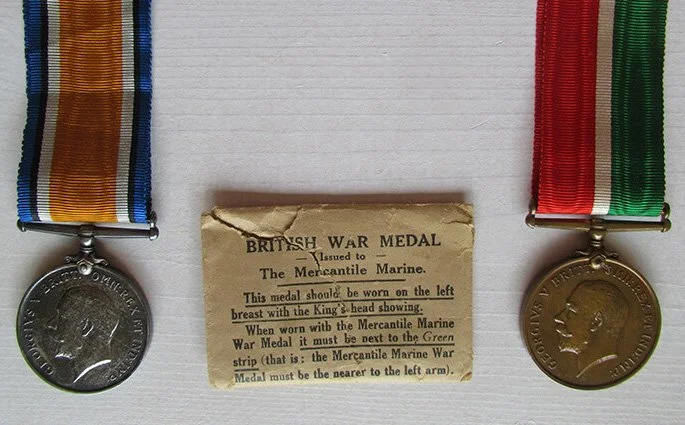
It saddens me that my great-uncles never knew they were war heroes, awarded these medals, let alone pin them proudly on their lapels. So I made it my duty to clean and polish them and iron the worn ribbons. As I was doing this, it struck me that no one today can even publicly wear these medals anymore. They are really history now. Publicly and privately.
William and Jack’s WW1 war medal [Byron Archives]
But something else happened as I took care of the photograph and the medals. I wanted to do more, to also pay homage to the women who stayed behind and suffered the losses. Their silent grief. Jack and William’s mother, my Irish great-grandmother Mary-Ann Meehan, and my grandmother, their sister, only 22 at the time.
And I would write a historical fiction novel about the Battle of the Somme, in which I would sneak in my family’s personal history. It was to become In Picardy’s Fields, dedicated to my great-uncles.
My great-grandmother Mary-Ann Meehan
My grandmother Gertrude at age 20

In the Field: Picardy and the Battle of the Somme
So this month I will take you with me on that trip to the Thiepval Memorial in Picardy and all the other places around it. Even now, years later, all these images are still so vivid and emotional for me. I hope you will find it interesting to know more about the background of In Picardy’s Fields, my very first historical fiction novel.
I’ve started a Pinterest board called “In the Field”. Several times a week throughout June a new pin will drop with a short background story, so make sure you go there regularly, or follow me: Hannah Byron on Pinterest and search the board.
There are YouTube videos to watch here: Hannah Byron on Youtube
Please subscribe!
And, of course, my Patreon, which I hope you will join for an in-depth look into the Making of In Picardy’s Fields, the foundation of my Resistance Girl Series and much more to come: Hannah Byron on Patreon
In the Shadows of Trust
In the world of the SOE, trust was not optional. It was the system itself. And when that system failed — or was believed to have failed — the consequences were not abstract. They were measured in names. And in those who did not come back.
In the end, the question is not only what Henri Déricourt did, or did not do…
Henri Déricourt and the Fragile World of the SOE
Henri Déricourt
Introduction
In The Color of Courage, he appears under his code name: Agent Gilbert.
He crosses paths with Lise de Baissac several times, organizing drops, receiving agents, managing the fragile choreography of arrivals and departures that kept her ARTIST network alive. In the world of the novel, he is part of the machinery. Necessary. And, at the time, not yet under suspicion.
Agent Gilbert’s real name was Henri Déricourt, a man whose role remains one of the most contested in the history of SOE’s French Section.
Long before I wrote The Color of Courage, I had come across his name. Historians still debate his loyalties. For the families of those arrested in 1943 — many of whom never returned — that uncertainty has never entirely lifted.
Lise de Baissac and her brother Claude were among the agents who survived.
This is the story of Henri Déricourt.
Background
Before the war, Déricourt was already a man moving between worlds. Born in 1909 in Aisne, he trained as a pilot and later flew mail routes across France. By the late 1930s, he had begun to intersect with intelligence circles, and, notably, with German contacts in Paris, including SD officer Karl Boemelburg.
He was known as charming, persuasive, and self-assured. Hugh Verity, one of the RAF pilots who flew many clandestine Lysander missions into France, later described him as a man who believed he could outsmart anyone, unscrupulous enough to take risks, and confident he would come out ahead.
His personal life reflected that same fluidity. Married, but not faithful, he maintained overlapping relationships. Among them was Juliette Aisner, who would later work with him inside the SOE network.
Nothing here proves anything. But it forms a pattern that is difficult to ignore.
The FARRIER Network — Paris
In January 1943, Déricourt was parachuted into France near Orléans. From there, he made his way to Paris.
His role was clear, and critical: air movements officer for SOE’s French Section. Under the codename “Gilbert,” he became responsible for organizing clandestine landings and departures for RAF Lysander aircraft operating out of Tempsford in England. His network was called FARRIER.
He identified landing fields across occupied France. Coordinated reception teams, managed signals, timings, movements. Over the following months, he organized dozens of those operations, bringing agents into France and taking others back to London and organising droppings.
But his role extended further as Déricourt also acted as courier. Letters, reports, and operational details passed through his hands, often written in clear language. In a system where wireless communication was dangerous and slow, this made him indispensable.
It also placed him at the intersection of multiple networks, including the PROSPER circuit led by Francis Suttill. In theory, these networks were meant to remain separate for security reasons. In practice, Déricourt connected them.
First Doubts
By the summer of 1943, concerns began to surface. For example, wireless operator to the PROSPER network, Jack Agazarian, raised alarms about security. Others followed. Messages were sent to London. The concerns were not always clear or consistent, but they were raised… and ignored.
At the same time, Déricourt maintained contact with German SD officers in Paris, including Karl Boemelburg. London was aware of at least some of these contacts, yet the Head of Section F, Colonel Buckmaster, trusted Déricourt blind. So no decisive action followed.
The Collapse of PROSPER
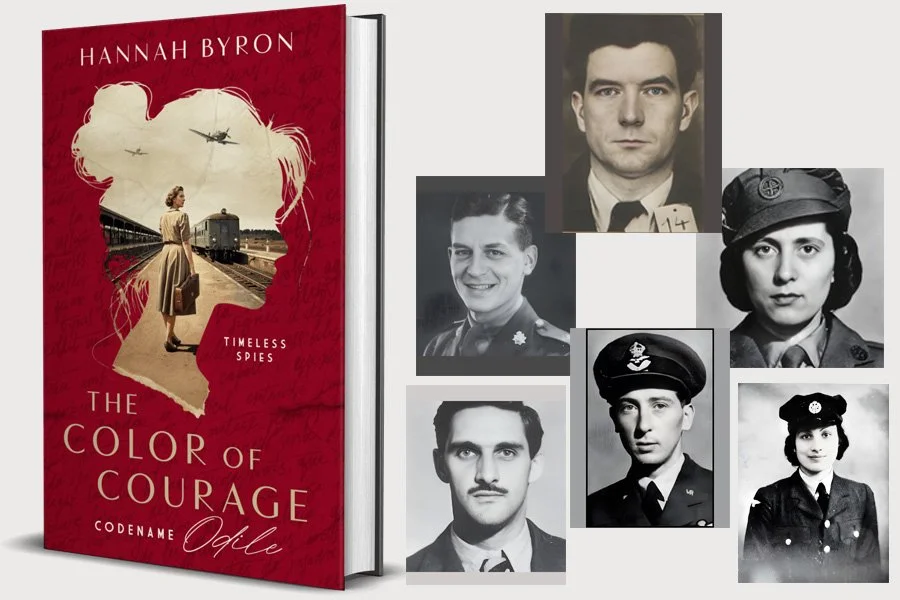
In June and July 1943, the PROSPER network began to collapse. Arrests spread rapidly across Paris. Key figures were taken, including Francis Suttill, Jack Agazarian and Gilbert Norman. Others followed. Among them two women: Andrée Borrel and Noor Inayat Khan. None of them survived.
Francis Suttill
Gilbert Norman
Jack Agazarian
Andrée Borrel
Noor Inayat Khan
At the time, no one in the field could see the full picture. That communications were compromised, and that German forces used captured radios to send false messages to London. Trust — already fragile — became almost impossible to navigate. And still, operations continued. Flights were organized. Messages carried. And Déricourt remained at the heart of it all.
After the War
Only after the war did the accusations against him take a clearer shape. German officers testified that information had reached them through an SOE contact. Documents had been copied. Messages intercepted. Déricourt’s name appeared repeatedly. He was arrested in 1946. Tried in Paris. And finally … acquitted. Not enough evidence.
An Unsettled Legacy
So despite the fact that Déricourt found an early death in Laos in 1962 flying for 'Air Opium', an international drug trade— which is again shady to say the least — there is no final verdict on his war escapades.
Some historians consider him a German agent. Others argue the evidence remains inconclusive. There are even theories — highly contested — that he may have been part of a larger intelligence strategy led by MI6.
What remains certain is the outcome. One of the most important, and skilfully led SOE networks in France, the PROSPER network, was destroyed. Hundreds were arrested. Many did not return. And at the centre of that system — trusted, necessary, and never fully investigated — was Henri Déricourt.
Conclusion
In the world of the SOE, trust was not optional. It was the system itself. And when that system failed — or was believed to have failed — the consequences were not abstract. They were measured in names. And in those who did not come back.
In the end, the question is not only what Henri Déricourt did — or did not do — but how much could ever be known in a world built on such secrecy, where the margin for doubt was as narrow as the strip of land on which a plane might land in the dark.
All agent photos, courtesy of Special Forces Roll of Honour.
Further reading
Robert Marshall, All the King's Men.
Jean Overton Fuller, Dericourt: The Chequered Spy
(in French), Bob Maloubier and Jean Lartéguy, Triple jeu. L'espion Déricourt,
Anthony Cave Brown, Bodyguard of Lies

On Rations, Recovery, and Real Food
My pottering about in the kitchen with only the bare minimals took me back to the cooks of the Second World War, to the ingenuity required under rationing, the necessity of making do with what was at hand. It reminded me of the wartime recipe book I created last year, a project that resonated far more widely than ever expected.
The empty nest syndrome works in unexpected ways. For me, once the house fell suddenly childless after decades of juggling single motherhood with a demanding job and household obligations, I let one thing go. I stopped cooking.
It didn’t happen overnight. It happened slowly, steadily. I didn’t enjoy cooking for one and eating alone, and I became adept at organising my meals so the cooker and oven could remain silent. For over a decade I lived on green juices, salads, protein bars, fruit, yoghurt, cheese, low-carb bread, and occasionally a bit of fish. Oh — and high doses of the very best supplements, carefully chosen for my age and my meat-free diet.
It worked. For me.
It saved time. It saved cleaning kitchens. It saved me from staring at a plate that had lost its attraction the moment it was served.
Mind you, I used to be quite a cook. In my twenties I even ran a restaurant with friends in Amsterdam — no Michelin star, admittedly — but the satisfied nods around the table after a Hannah-cooked meal were proof enough that I had the skill. I simply no longer had the juju.
And now, in 2026, I’ve started cooking again.
Not as a New Year’s resolution, but almost out of necessity. I fell ill with pneumonia, and while illness has many causes, I know I was overworked and, in a quiet way, starving my body. The overwork showed itself as apathy; the starvation was almost literal.
When I finally abandoned my regime and heated up an Indian dahl with rice, frozen leftovers from the last time the children came to dinner, it tasted astonishing. I was ravenous. It felt as if my palate, my stomach, my intestines were all singing hallelujah at once.
There was only one complication: I couldn’t go to the shops.
My eyes roamed the kitchen shelves, past rows of protein powder and a dwindling supply of bottled vegetable juices in the fridge. But hunger — or rather, the return of appetite — makes us resourceful. After rummaging through freezer, fridge, and cupboards, I managed to produce one comforting meal after another: green peas with mashed potato and a bit of mackerel; a real pancake (not the tasteless protein kind) with defrosted forest fruits and ice cream; mac and cheese with leftover leek and onion.
It helps to have been a cook. You learn to improvise.
My pottering about in the kitchen with only the bare minimals took me back to the cooks of the Second World War, to the ingenuity required under rationing, the necessity of making do with what was at hand.
What struck me most was not the scarcity of my provision cupboard, but how quickly appetite becomes specific. It isn’t long-shelf-life food we crave when access disappears, but warmth, softness, something familiar. The wartime cooks understood this instinctively. They didn’t just plan to survive; they planned for morale. Puddings mattered. Bread mattered. So did the small luxuries that made an ordinary day feel human.
It reminded me of the wartime recipe book I created last year, a project that resonated far more widely than ever expected. For those who haven’t downloaded it yet, I’ll share the link below. And I will now start planning the promised book 2, perhaps with some of my own contributions.
Here’s my favourite recipe from that first collection. These days I’m well enough to shop again, and I confess I now add fresh herbs — parsley, chives, anything green. Once your appetite returns, it turns out you don’t want to give up on your greens either.

📡 The Courage to Transmit – Danger in Salbris
By late April 1944, Muriel Byck — now operating under the field name Violette — had settled into the small town of Salbris. There, she was housed by Antoine Vincent, a local garage owner and long-standing Résistance contact. His garage — unremarkable, open to the public, and frequented by German soldiers — was the perfect cover. And it was also incredibly dangerous.
This was her reality: staying invisible in plain sight.

Behind an unassuming garage facade, a young woman defied an empire.
By late April 1944, Muriel Byck — now operating under the field name Violette, and sending messages to London under the codename Benefactress — had settled into her first real SOE base: the small town of Salbris, in the Loir-et-Cher.
There, she was housed by Antoine Vincent, a local garage owner and long-standing Résistance contact. His garage — unremarkable, open to the public, and frequented by German soldiers — was the perfect cover. And it was also incredibly dangerous.
Muriel established four radio transmitting sites, rotating between them by bicycle. One of those transmitters was hidden in a shed behind Vincent’s garage — only meters from where German troops came daily to have their bicycles repaired.
This was her reality: staying invisible in plain sight.
🧳 Arrival in Salbris
Muriel arrived with her organiser, Baron Philippe de Vomécourt — codename Antoine — who took a personal, almost paternal interest in her safety. On her first day, they lunched in a local restaurant — only for Muriel to discover it was packed with German soldiers.
The point, Vincent later explained, was to prepare her. To teach her how to function under pressure. To learn to breathe through danger.
Muriel didn’t flinch. Not even when it counted most. But the meal didn’t taste very well.
📸 Above: Vincent’s garage in Salbris, photographed after the war, now under a different name. A humble place that hid tremendous courage. Photo - Michel Septseault via Tony Lark
👁️ The Day She Was Seen
One day, while transmitting from the shed, Muriel looked up — and froze. An eye was watching her through a knothole in the wooden wall.
A German soldier.
She was mid-transmission. But instinct kicked in. She sent a danger signal, signed off, and packed up her set. The guard meant to be posted outside had vanished. There was no protection.
Muriel left no trace behind. She quietly returned to the main garage, where Vincent was elbow-deep in a gearbox. He read her face instantly.
Within minutes, he had called de Vomécourt, who arrived in his Citroën and spirited her away.
Hours later, 40 to 50 German soldiers arrived to raid the garage.
They found nothing. The soldier who’d spotted her was humiliated and punished.
Muriel’s composure — and the Resistance’s quick coordination — had saved her life.
📖 From The Call of Destiny
She was halfway through encoding the coordinates when she felt it — a shift, a stillness. Not a sound. A presence. There — on the opposite wall — a crack in the wood where a sliver of light shone through. And within it: an eye.
Perfectly framed in a knot-hole of warped timber.
It blinked once. Then vanished…
🧠 Intelligence in Motion
Muriel continued her work, cycling between alternate locations and transmitting under tight precautions. The Vincent family adored her. To them, she was more than a guest — she was one of their own.
To the SOE, she was a vital link to London.
To the Germans, she remained a ghost. Almost caught, but never quite found.
📸 Above: Antoine Vincent and his Résistance group in Salbris. Photo - De Vomécourt collection
💭 Reflection
The incident in Salbris — when Muriel was nearly discovered — is the best-known episode in the short, intense life of this otherwise little-known SOE agent.
It was a combination of swift judgment, good luck, and the tightly run Resistance network around her. But it was also a testament to her courage — and to the deep, almost psychic connection her organiser, de Vomécourt, had with her wellbeing. I’ve come across no other organiser so invested in his wireless operator’s safety, and so utterly devastated when she later died in his arms in th hospital.
Muriel’s meticulous actions in the shed — sweeping, covering her tracks, walking instead of running — speak volumes. By 1944, wireless operators in France had a life expectancy of less than six weeks. She knew the odds. She knew what had happened to the others.
Her sangfroid is astonishing. It’s one of the clearest reasons why she truly was cut out to be an SOE agent in occupied France. That day in Salbris, she earned her stripes.

The Call of Destiny
Codename Violette
Timeless Spies is both a literary endeavor and a passion project, dedicated to immortalizing the legacy of the 40 female secret agents of the SOE in France during WWII.
Release date 15 July 2025🗓 Next Week
➡️ The Final Message – Illness, Collapse, and Legacy
📖 The Call of Destiny: Codename Violette launches 15 July.
📬 Subscribe to follow Muriel’s full journey.
Note: This article draws on the work of SOE historian Paul McCue (HS9/1539/5 de V file), used with permission.

🪂 The Parachute Drop – First Steps in Occupied France
On Easter Sunday 1944, a young woman stepped into the dark above France… and into history.
By April 1944, Muriel Byck was just 25 years old — but had already survived SOE training, fallen in love, and committed to a mission that would take her deep into Nazi-occupied France. Though she hadn’t completed her final training phase, the need for wireless operators was too urgent. D-Day was imminent, and the flurry of messages flying back and forth over the English Channel grew by the day. Muriel agreed to go.

Though of poor quality, these photographs are from a false ID card issued to Muriel in France. Photo – via Tony Lark.
On Easter Sunday 1944, a young woman stepped into the dark above France… and into history.
By April 1944, Muriel Byck was just 25 years old — but had already survived SOE training, fallen in love, and committed to a mission that would take her deep into Nazi-occupied France. Though she hadn’t completed her final training phase, the need for wireless operators was too urgent. D-Day was imminent, and the flurry of messages flying back and forth over the English Channel grew by the day. Muriel agreed to go.
Her cover identity: Michèle Bernier, a governess from Paris.
Her field name: Violette.
Her assignment: to support veteran agent and organiser of the VENTRILOQUIST Network, Philippe de Vomécourt, in the Loir-et-Cher area.
🌒 Easter Sunday at Tempsford
Muriel’s departure was delayed by bad weather for two nights. On the third — Easter Sunday, 9 April 1944 — she finally boarded a Hudson aircraft with Major Sydney Hudson and Captain George Jones.
The plan had been for them to land at a Resistance-organized drop zone near Issoudun. But due to scheduling conflicts, the drop had to be blind — no reception party, no welcoming faces, no margin for error.
Muriel jumped into a forest in central France, in the pitch of night.
🌲 Landing in the Dark
The descent went smoothly, but the drop site — a wooded area instead of a clearing — added instant risk. Miraculously, Muriel’s parachute didn’t snag in the trees. She regrouped with Hudson and Jones, and the three worked by lamplight to retrieve their scattered supply containers, including Muriel’s wireless set.
As dawn broke, they left the trees and walked into the unknown.
By 8 a.m., they reached the town of Issoudun. Muriel and Jones stayed in a café while Hudson made contact with local ally Jacques Trommelschlager — the first link in the hidden network that would sustain them.
Muriel, now Michèle, was officially behind enemy lines.
🏡 Shelter in Chédigny
A few days later, Muriel was driven — via backroads and Resistance contacts — to a safe house in the village of Chédigny, in the Indre-et-Loire. There, she stayed with Madame Marthe Dauprat-Sevenet, the mother of another SOE agent, Captain Henri Sevenet.
Despite exhaustion from the journey and an early episode of illness en route, Muriel began to recover in this quiet, flower-filled village. She helped around the house, charmed her host, and won the trust of the household. Madame Sevenet later described her as “full of charm, full of courage, full of life.”
To outsiders, she was simply a young woman, resting in the countryside.
To the Resistance, she was Violette, preparing to transmit Allied intelligence from the heart of occupied France.

Le Breuil, the house of Madame Marthe Dauprat-Sevenet in Chédigny, where Muriel first stayed in France. Photo – Paul McCue’s collection.
📖 Snippet From The Call of Destiny
Whatever it was—exhaustion from the three tense nights, or Heaven granting her a small mercy—Muriel closed her eyes before takeoff and, somehow, slept. Soundly. Deeply. Until a hand shook her shoulder.
“Violette! We’re almost there.”
The engines roared in her ears. The smell of oil and metal filled her nose. She blinked. Outside the tiny window: darkness—and then, the glow of the full moon. A smattering of stars. France.
The signal light turned green. Albin slid down the chute first. She followed, as if in a dream. Isidore came last. The wind tore the thoughts from her head. And then—silence.
A bloom of white above her. The eerie hush of descent. A world stilled under moonlight. Three parachutes. Three agents. She wasn’t alone.
Below: France.
She hit the ground hard. Rolled. Coughed once. Lay still, her heart pounding, waiting for the signal. Footsteps. She held her breath.
Then—Albin appeared, grinning like a wolf. “You made it.”
“I did.” Her voice trembled, then steadied. “Where’s Isidore?”
“Safe. Bloody trees. Bit of a miracle we didn’t all end up dangling in one.”
“True.”
There was no time to reflect. Just movement. The three of them stripped off their harnesses and jumpsuits. Buried their parachutes in silence. Found their sets. One by one, they shrugged on civilian jackets and French identities.
What remained were three British agents—French in name only—armed with false papers and a trembling kind of hope.
🔐 Layers of Cover
Muriel’s cover was carefully constructed. She was to be passed off as the fiancée of Henri Sevenet. Her forged papers, her new name, her memorized background — everything had to hold up under German scrutiny. Any slip could mean arrest, torture, or worse.
Yet even amid danger, she never lost her warmth. She made tea, she listened, she joked with those around her. One small detail stands out: she insisted on taking Maurice Martin’s powder compact into the field — aged with ammonia to look worn. A tiny token of love, carried through the fire.
💭 Reflection
While writing Muriel’s story and “living” with her for the months I did, she came to life for me as an extraordinary mix: quiet and self-possessed on the outside, fearless and determined on the inside.
Her sudden, deep-felt love affair with fellow agent Maurice Martin is somewhat of an enigma to me. Perhaps it was the intensity of being thrown together in the unfamiliar Scottish Highlands, training like modern-day commandos. Perhaps she needed his support. Perhaps she needed to be in love — to be engaged — in order to dare enter France knowing someone would be waiting for her when the war was over. Maybe it truly was love at first sight.
We’ll never know. It may have been all these things.
But they separated, and Muriel went to France. From the beginning, she struggled with the stress and the physical demands of constant movement under harsh conditions. The signs of illness appeared early on, yet she soldiered on.
I’m absolutely certain she would not have wanted to miss one second of the hardship and terror that filled those six weeks of her mission.
Muriel was where she belonged — fighting for the freedom of France.

📅 Next Week
➡️ Signals in the Shadows – Muriel’s First Transmissions and the Day the Enemy Saw Her🗓 The Call of Destiny: Codename Violette launches 15 July
Note: This series of blog posts—and most of the accompanying photographs—are based on SOE historian Paul McCue’s research on Section Officer Muriel Tamara Byck (HS9/1539/5 de V file). Used with permission.

💥 Becoming Violette – Muriel’s SOE Training and Love Story
Just before she left, Maurice gave Muriel a leather powder compact—a farewell token, personal and cherished. They were engaged. De Vomécourt thought it looked suspiciously new and nearly forbade her from taking it. But Muriel insisted. With a little help from ammonia to age its surface, the compact was allowed to travel with her into occupied France.
We don’t know if it went with her into her grave, or whether it was returned to England—a small, silent witness to a brief but powerful wartime love.
Bombed house in Torquay of Muriel Byck’s family (clickable)
History rarely shows us the quiet before the storm. But in this photo, taken in 1943 after a German air raid on Torquay, we glimpse a moment of devastation that changed one woman’s path forever. The man standing amid the rubble is George Leslie, Muriel Byck’s stepfather. The house behind him was theirs. It was a wonder the family survived. Elsewhere in Torquay that day, dozens of Sunday school children and their teachers weren’t as lucky.
The walls that crumbled around Muriel may have shattered more than bricks.
Just a month later, she made a decision that would lead her deep into the shadows of occupied France: she volunteered for the Special Operations Executive as a secret agent—fully aware of the danger that awaited her.
This blog post traces the beginning of that journey—from a battered home in Devon to the secret training grounds of the SOE—and the unexpected love that blossomed along the way. Before she became “Violette,” Muriel was a young woman caught between duty, heartbreak over her parents’ divorce, and an unshakable desire to do more. Despite her delicate health and quiet nature, she pressed forward.
📝 First Impressions
Muriel’s initial assessment at SOE’s Winterfold screening center paints the picture of a young woman who stood out not through bravado, but through character:
“A quiet, bright, attractive girl, keen, enthusiastic and intelligent… She is self-possessed and persistent, and warm in her feeling for others.”
The examiners noted she lacked guile and foresight—qualities prized in undercover work—and would need extensive training. But they also saw potential. Enough, at least, to send her forward.
Muriel was selected for Group A training—paramilitary basics—and dispatched to one of SOE’s most remote centers: Meoble Lodge, in the Scottish Highlands.
🏔️ Meoble Lodge: Rain, Rifles, and Revelation
At Meoble, Muriel endured grueling hikes, weapons handling, and survival exercises in freezing rain. Though never physically robust, she kept pace, earning the admiration of her instructors. Lieutenant Oliver, her conducting officer, wrote of her charm, strength of character, and surprising depth.
But Oliver’s admiration remained one-sided.
It was there, in the remote wilds of Scotland, that Muriel quietly fell in love—not with the landscape, but with Second Lieutenant Maurice Martin, a French OSS trainee operating under the alias Maurice Morange. A fellow outsider. A kindred spirit. I’ve come to think of them as le couple français.
Together, they learned to decode, to disarm, to disappear.
Their connection grew not from stolen moments, but from shared silences—glances in the mess hall, trust forged under tension. In the middle of war, they found something tender—and real.
📡 Promise and Pressure
By the end of training, Muriel had proven herself exceptionally capable in Morse and technical skills, but physically fragile. She was given a rare double grading: C (fit to serve with conditions) and F (fail).
And yet, such was the urgency of the moment that she was moved forward—first to Thame Park for W/T (wireless transmission) training, then parachute training at Ringway. Maurice remained close by her side. They were inseparable.

Philippe de Vomécourt
Muriel’s final phase of training—the vital “Finishing School” at Beaulieu—was waived. SOE needed a wireless operator immediately. Philippe de Vomécourt, one of SOE’s most experienced agents, was preparing to return to France.
Muriel was offered the assignment. She accepted.
Her codename in London: BENEFACTRESS
Her name in the field: Violette
Her false identity: Michèle Bernier, a governess from Paris
💌 A Final Gift
Just before she left, Maurice gave Muriel a leather powder compact—a farewell token, personal and cherished. They were engaged. De Vomécourt thought it looked suspiciously new and nearly forbade her from taking it. But Muriel insisted. With a little help from ammonia to age its surface, the compact was allowed to travel with her into occupied France.
We don’t know if it went with her into her grave, or whether it was returned to England—a small, silent witness to a brief but powerful wartime love.
📖 From The Call of Destiny
Outside, the lamps of London flickered against war-darkened skies. Inside Le Régent, two lovers held on to a moment suspended in time—before the occupied land of their beloved France would call them home.
Later that night, as they walked back through the blackout streets, they said little. There was no need. They’d said it all. At the door of the apartment SOE had rented for Muriel, he tucked a curl behind her ear and kissed her again.
“Reviens vers moi,” he repeated.
“I will,” she whispered. “And you, Maurice Martin… you’d better come back to me as well.”
They didn’t know then that it would be their last kiss. But perhaps some part of them did.

Muriel Byck in uniform
💭 Reflection – How I see Muriel in this stage
Muriel’s path to becoming Violette must have been gruesome for the well-educated, soft, lovely girl she really was. But Muriel had one trait that overshadows all fallibility: she had an iron will. She bit off more than she could chew. Maybe she knew that. Maybe she didn’t. But she was prepared to die for France. To die for freedom.
I believe that drive is what carried her through the grueling training. Her strength wasn’t the kind that screamed. It was the kind that endured.
And through it all, she carried with her a quiet love—not a distraction from duty, but a reason to be brave. How she must have welcomed Maurice’s warmth in those icy months, knowing full well that they would be parachuted into France separately, and the chances of seeing each other again were heartbreakingly slim.
📅 Next Week
➡️ Into the Shadows – Muriel’s Parachute Drop and Arrival in Occupied France
🗓 The Call of Destiny: Codename Violette launches 15 July
📬 Subscribe to follow the rest of Muriel’s extraordinary journey.
Note: This series of blog posts—and most of the accompanying photographs—are based on SOE historian Paul McCue’s research on Section Officer Muriel Tamara Byck (HS9/1539/5 de V file). Used with permission.

June's Fire: Honoring the SOE Women Born This Month
June’s daughters of the SOE remind us of the breadth—and the cost—of courage. Muriel Byck, Pearl Witherington and Violette Szabo. Each of them carved a legacy in their own way: through loyalty, leadership, or the ultimate sacrifice. Their stories remind us that resistance is not a single act, but a way of living—even when the odds are against you.
As a fellow June girl, I carry a quiet connection to these women. And each year, as their birthdays return, I’m reminded that history doesn’t rest—it waits to be remembered.
June brings us three extraordinary women from the Special Operations Executive’s Section F—each of them fierce, resilient, and unforgettable. Muriel Byck, Pearl Witherington, and Violette Szabo didn’t just support the Resistance—they were the Resistance. Their courage, loyalty, and sheer determination lit fires behind enemy lines and left legacies that still burn bright today.
And June feels especially close to my heart—because it’s also the month I was born. Every time I write these tributes, I feel a deep connection to the women I honor, but this month, perhaps even more so. These three agents, in their unique ways, reflect so much of what I admire: compassion, clarity of purpose, and bold, quiet power.
In this month’s trio, we find a fragile wireless operator whose spirit never faltered, a battle-tested leader who defied male hierarchy, and a young widow-turned-heroine whose courage became legend. Two did not live to see the peace they fought for. One demanded to be remembered not just as a woman spy—but as a commanding officer.
Each of these women features—or will feature—in my Timeless Agents series. But here, as always, we strip the fiction away and let their real stories shine.

Muriel Byck – Codename Violette
Muriel Byck’s life was marked by quiet strength and deep conviction. Born in London in 1918 to Russian Jewish émigré parents, she spoke fluent French and had a passion for service that led her first to the WAAF and eventually to the SOE. Trained as a wireless operator—a role with one of the shortest survival rates—Muriel was deployed to France in April 1944, just weeks before D-Day. Her cover identity, Michèle Bernier, was a governess from Paris. Her real task: transmitting coded messages in support of the VENTRILOQUIST circuit.
Despite struggling with poor health, she carried out her mission with unwavering dedication until she suddenly collapsed with meningitis. She died on 23 May 1944, just days before her 26th birthday. Her fellow agent, the hardened resistance leader Philippe de Vomécourt wept at her funeral.
Muriel’s grave first lay in the town of Romorantin, later she was reinterred at the Military Cemetery in Pornic, France. Her story features in The Call of Destiny, my third book in my Timeless Agents series—a tribute to the power of courage that burns quietly, but brightly.

Pearl Witherington – Codenames Marie / Pauline
Few SOE agents fought harder—not just in the field, but for recognition—than Pearl Witherington. Born in Paris to British parents, Pearl grew up fluent in French and fiercely independent. When the Germans invaded France, she fled to Britain and joined the SOE, determined to return and fight. Parachuted into central France in 1943, she initially worked as a courier but quickly rose to lead the Wrestler circuit after her superior was arrested. Under her command, more than 1,500 Resistance fighters sabotaged German rail lines, blew up supply depots, and disrupted troop movements during the lead-up to D-Day.
Despite her achievements, Pearl was initially offered only a civilian MBE. She returned it in protest, stating that she had been a soldier—and should be recognized as such. Years later, she was finally awarded the military MBE and honored as a Chevalier de la Légion d’Honneur in France. After the war, she settled in the Loire Valley with her SOE radio operator and husband Henri Cornioley.
Pearl’s story is a sharp reminder that women were not only vital to the Resistance—but also often overlooked. She didn’t accept that. And thanks to her refusal to stay silent, neither do we.
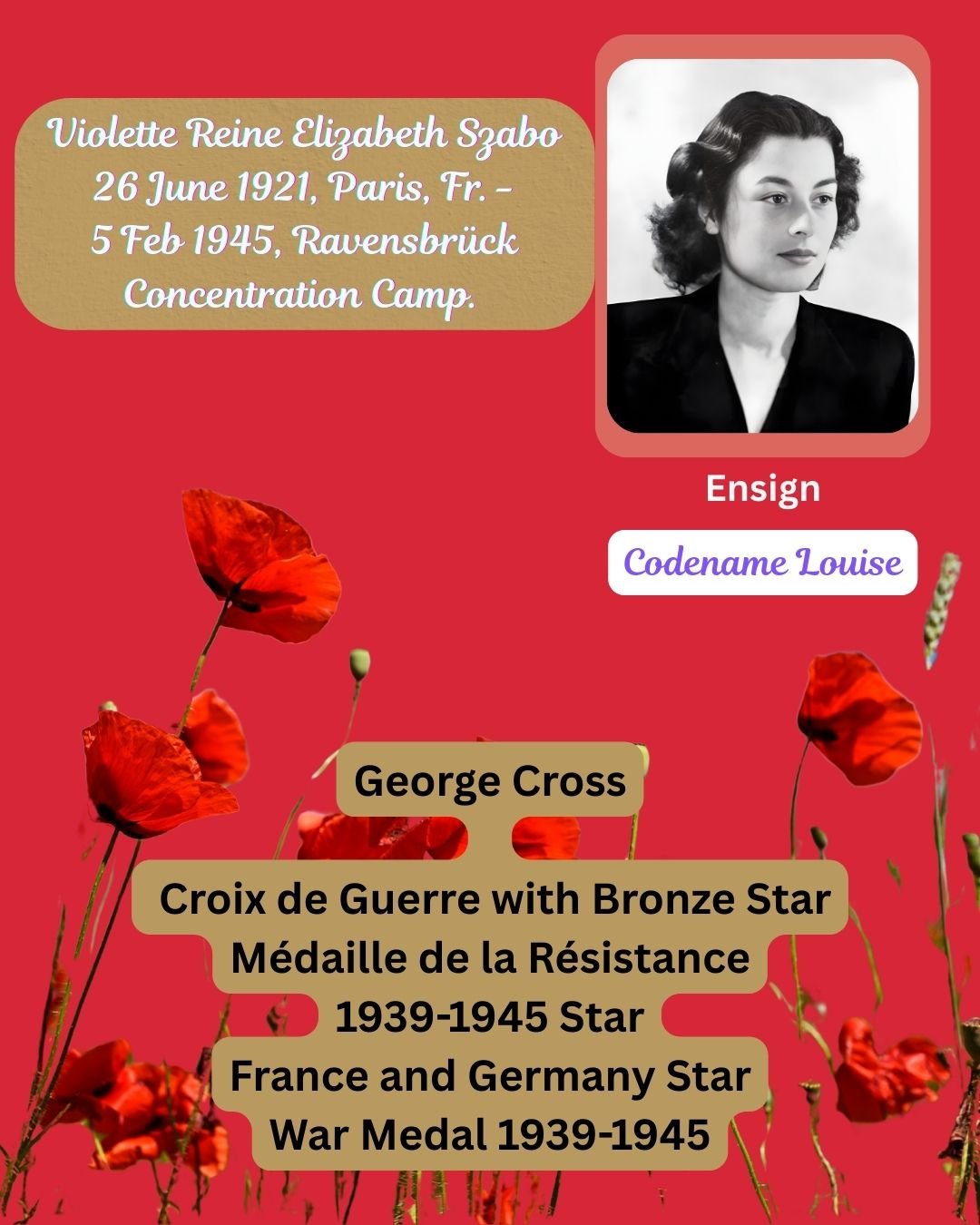
Violette Szabo – Codename Louise
If there is one name from the SOE that echoes like poetry and thunder, it’s Violette Szabo. Born in Paris to a French mother and British father, Violette was widowed at 22 when her French Foreign Legion husband was killed in North Africa. Grieving but resolute, she volunteered for the SOE, determined to fight back. She was parachuted into France twice, serving as a courier and saboteur with fearless resolve.
On her second mission in June 1944, Violette was captured after an intense gun battle near Salon-la-Tour. Despite brutal interrogation and torture, she never revealed her secrets. Deported to Ravensbrück concentration camp, she continued to show solidarity, compassion, and bravery until her execution in February 1945 at the age of 23.
Posthumously awarded the George Cross, Croix de Guerre, and Médaille de la Résistance, Violette became a symbol of resistance, sacrifice, and unwavering spirit. Her life inspired poems, books, and a 1958 film—but perhaps most moving of all is the small museum dedicated to her in Herefordshire, created by her devoted aunt.
Conclusion: June’s Legacy of Light and Fire
June’s daughters of the SOE remind us of the breadth—and the cost—of courage. Muriel Byck, whose frail body belied her strength of will. Pearl Witherington, who led Resistance fighters through sabotage and strategy with military precision. And Violette Szabo, who died without betraying her comrades and with her dignity unbroken.
Each of them carved a legacy in their own way: through loyalty, leadership, or the ultimate sacrifice. Their stories remind us that resistance is not a single act, but a way of living—even when the odds are against you.
As a fellow June girl, I carry a quiet connection to these women. And each year, as their birthdays return, I’m reminded that history doesn’t rest—it waits to be remembered.
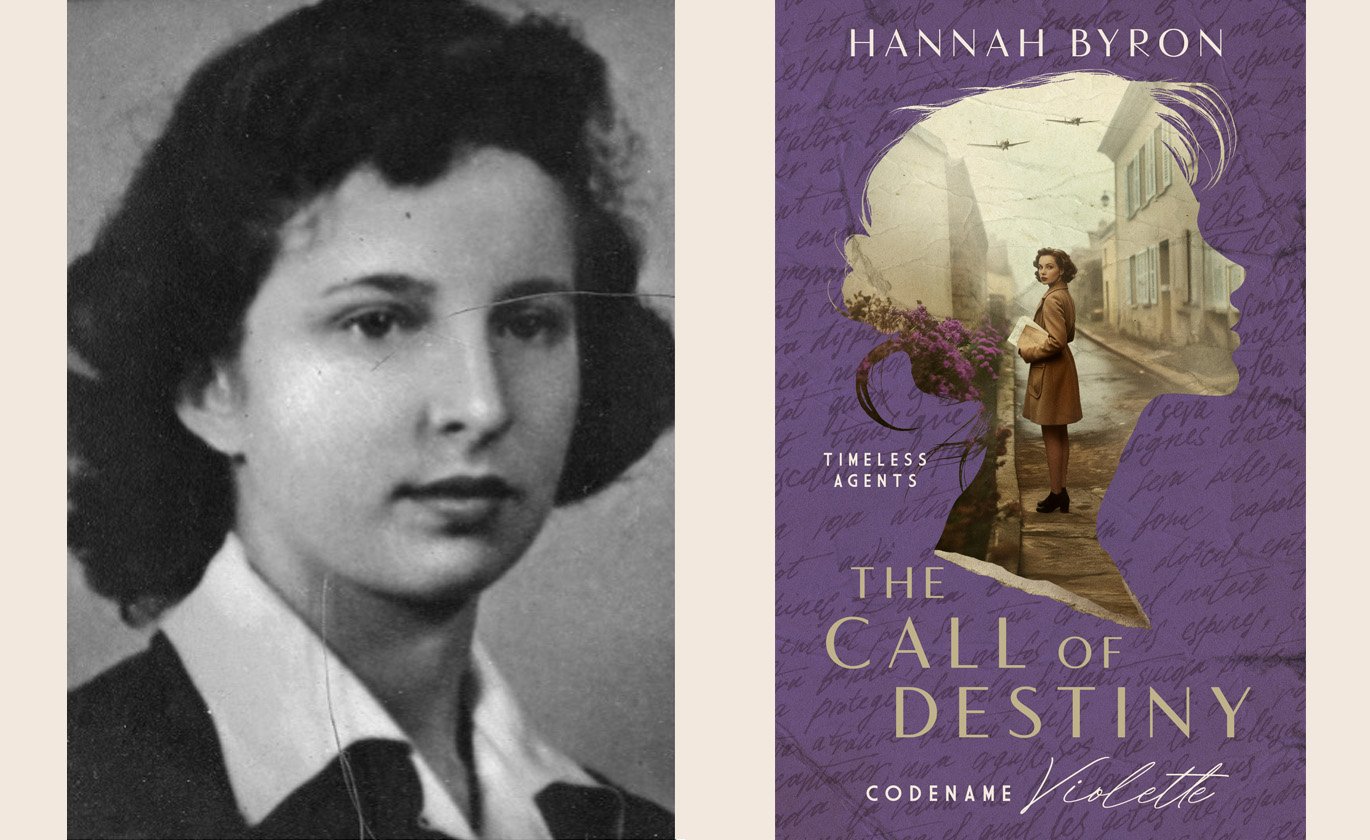
A Voice Across Borders – Muriel Byck’s Unlikely Path to War Heroine
When I first discovered Muriel Byck’s story, I was struck not just by her bravery—and her tragic six-week mission as an SOE agent in occupied France—but also by her cosmopolitan, Jewish beginnings: a rich mix of languages, cultures, and a youth spent across Europe.
Before this well-educated, quiet young woman became the fearless wireless operator codenamed Violette, she had already crossed many borders.

Introduction
When I first discovered Muriel Byck’s story, I was struck not just by her bravery—and her tragic six-week mission as an SOE agent in occupied France—but also by her cosmopolitan, Jewish beginnings: a rich mix of languages, cultures, and a youth spent across Europe.
Before this well-educated, quiet young woman became the fearless wireless operator codenamed Violette, she had already crossed many borders. She spoke perfect French, loved the theatre, and carried a deep empathy that defied the turbulent world around her.
Background
Muriel Tamara Byck was born in 1918 in west London, the daughter of Jewish refugees originally from what is now Ukraine. Her early life was anything but ordinary. As a child, she lived in Wiesbaden, Germany, and later spent four formative years in France, attending the Lycée de Jeunes Filles in Saint-Germain-en-Laye.
When the family returned to England, Muriel continued her French education at the Lycée Français in South Kensington, where she passed her Baccalauréat in 1935 — a distinction then reserved for only privileged British girls.
Muriel was fluent in French and Russian and spoke English without a trace of an accent. At eighteen, she seemed destined for an academic or artistic path. She pursued further studies at the Université de Lille and, upon returning to London, worked first as a secretary and then in theatre, including a stint as assistant stage manager at the Gate Theatre in Charing Cross. Stage management became her world — lights, scripts, cues — until the war called her elsewhere.
Like many young women of her generation, Muriel’s life changed dramatically with the outbreak of WWII. She joined the Women’s Voluntary Service and later worked with the Children’s Overseas Reception Board, helping evacuate children away from the Blitz. She also served as an ARP warden and a Red Cross librarian — all before enlisting in the Women’s Auxiliary Air Force (WAAF) in 1942.
But it wasn’t enough. Perhaps it was the air raid that damaged her mother’s home in Torquay in 1943, or perhaps it was always in her nature — Muriel volunteered for SOE and stepped into the annals of history.
Quote from the Source
“A quiet, bright, attractive girl, keen, enthusiastic and intelligent… warm in her feeling for others.” — SOE assessment, 1943
Snippet from The Call of Destiny
She had known. She had seen it coming. And yet—some part of her had still hoped. Hoped that war might be avoided. War was definitive. War was black and white. No one could hide in neutrality anymore.
And that included her.
Closing Reflection
Muriel’s early life reminds us that resistance often begins not with weapons, but with empathy, education, and an unshakable sense of purpose.
In the weeks to come, I’ll be sharing more about Muriel’s life and her courageous mission behind enemy lines — and how her legacy inspired my upcoming novel, The Call of Destiny: Codename Violette.
How I, as an author, see Muriel
“I think of her — the girl with a quiet voice, a coy smile, and an iron will. She crossed mental and physical borders long before she parachuted into France in 1944 to become de Vomécourt’s W/T operator in the Sologne.”
✨ The Call of Destiny launches on 15 July 2025. Stay tuned for next week’s post: “Becoming Violette – Muriel’s SOE Training and Love Story.”
🔗 Preorder here mybook.to/CallOfDestiny

Note: This series of blog posts—and most of the accompanying photographs—are based on SOE historian Paul McCue’s research on Section Officer Muriel Tamara Byck (HS9/1539/5 de V file). Used with permission.
May’s Silent Warriors: Honoring the SOE Women Born This Month
As the month of May unfolds, we turn the page on another chapter of remembrance—this time for the five brave women of the Special Operations Executive (SOE), Section F, who were born during this spring month.
Among all the months we honor, May stands apart for a rare and remarkable reason. May’s daughters remind us that courage sometimes means not only fighting, but surviving when the guns fell silent.
As the month of May unfolds, we turn the page on another chapter of remembrance—this time for the five brave women of the Special Operations Executive (SOE), Section F, who were born during this spring month.
From Christine Granville, the legendary Polish countess with nerves of steel, to Francine Agazarian, the radio operator who vanished back into everyday life, these women carried secrets, messages, and hope across enemy lines. All of them left an imprint on the war—and on history—that must never be erased.
May’s list brings together not only familiar names like Lise de Baissac, who parachuted into France as part of the earliest SOE landings, but also quieter heroines like Sonya Butt and Blanche Charlet, whose courage played out in quiet fields, coded messages, and midnight missions.
As with every monthly tribute, these posts are part of my effort to spotlight the women who inspire my Timeless Agents series—fiction rooted in real-life bravery. Through this blog, and across my social media, I hope to keep their memory vivid and enduring.
You can explore more about each woman through the links below each post, and I invite you to join me in honoring May’s Silent Warriors.

Christine Granville – Codename Pauline
Known as one of the most daring women to serve in the SOE, Christine Granville—born Krystyna Skarbek—was a Polish aristocrat who became Britain’s first and longest-serving female spy during WWII. Fluent in multiple languages and fearless in the field, Christine served in Poland, Hungary, North Africa, and France, showing extraordinary resourcefulness and resolve.
Her charm and cunning saved lives, including her own, as she bluffed her way past Gestapo officers and bribed her way into prisons to free captured comrades. She once skied across the Tatra Mountains in winter to deliver intelligence and, in another mission, reportedly pulled a knife on a Nazi officer.
Christine was described by one fellow agent as “a flaming sword of freedom”—a woman of instinct, grit, and sheer will. Tragically, she survived the war only to be murdered in London in 1952. Her legacy is immense, and her story is still told as one of the most compelling in the SOE’s history.

Francine Agazarian – Codename Marguerite
Francine Agazarian, born Françoise Isabella, was one of the many quietly heroic figures of the SOE. She served as a courier for the PROSPER network, working alongside her husband André Agazarian, who was a wireless operator. Together, they took enormous risks, delivering messages, coordinating arms drops, and maintaining vital communication lines for the Resistance in and around Paris.
In 1943, as German counter-intelligence closed in, Francine was recalled to London for her safety. Tragically, André was arrested shortly afterward and executed at Sachsenhausen concentration camp in 1944.
The war left Francine a widow, and though she survived, her life was forever marked by the immense losses she endured, as she was the only one of her network to survive. Francine rarely spoke publicly about her experiences, quietly carrying the weight of memory.
She was later awarded the Croix de Guerre and the King’s Medal for Courage in the Cause of Freedom for her bravery. Her story stands as a reminder that even among the survivors, the scars of war ran deep.

Lise de Baissac – Codename Odile
Few SOE agents embodied quiet determination like Lise de Baissac. Born into a French-Mauritian family, Lise was among the first women to parachute into occupied France in September 1942—an extraordinary feat for the time.
Operating under the codename Odile, and later Marguerite, she established safe houses, gathered intelligence, and coordinated Resistance activities around Poitiers, often cycling dozens of miles under the enemy’s nose. Known for her sangfroid, Lise approached each mission with steely calm and meticulous preparation.
During her second mission she joind her brother’s network SCIENTIST network work that supported the D-Day landings and helped destabilize German communication lines.
After the war, she was awarded the Croix de Guerre and the MBE, yet remained strikingly humble about her wartime contributions. Lise’s life and spirit inspired my novel The Color of Courage: Codename Odile, where I had the privilege of bringing her extraordinary story to a new generation of readers.

Sonya Butt – Codename Blanche
At just 20 years old, Sonya Butt became one of the youngest female agents to serve with the SOE. Trained as a courier and wireless operator, she parachuted into occupied France in 1944, working with extraordinary courage to maintain communications between Resistance groups and London.
Despite the immense dangers—constant surveillance, the threat of betrayal, and brutal punishment if captured—Sonya moved through her missions with resilience and quiet bravery.
After the liberation of France, Sonya did what few of the other female agents managed: she built a joyful, lasting life. She married fellow SOE agent Guy d’Artois, moved to Canada, and together they raised six children.
Her post-war life was filled with the very things so many fought to protect: family, freedom, and peace. Sonya’s story stands as a testament to hope and new beginnings after unimaginable risk.

Blanche Charlet – Codename Christiane
Before the war, Blanche Charlet lived a vibrant life as an art dealer, running a gallery specializing in modern art in Brussels. But when Germany invaded Belgium in 1940, Blanche fled to Britain—only to return to danger voluntarily. Recruited by the SOE, she parachuted into occupied France in August 1942 under the codename Christiane. As a courier for the VENTRILOQUIST network, she transported vital intelligence under constant threat. Captured by the Germans, she endured harsh imprisonment but staged a daring escape in November 1942, making her way across France before returning to England via Brittany in April 1944.
Awarded the MBE for her bravery, Blanche lived the remainder of her life more quietly, a survivor of extraordinary times. Her journey from art galleries to underground resistance operations is a testament to how courage can bloom from the most unexpected places.
Conclusion: May’s Survivors
Among all the months we honor, May stands apart for a rare and remarkable reason: every single SOE woman born this month survived the war. Christine Granville, Francine Agazarian, Lise de Baissac, Sonya Butt, and Blanche Charlet—all faced imprisonment, betrayal, near capture, and unimaginable danger. And yet, through adaptability, endurance, and sheer will, they returned.
Their lives after the war took many forms—quiet anonymity, joyful family life, continuing service—but their survival itself stands as a defiant victory. May’s daughters remind us that courage sometimes means not only fighting, but surviving when the guns fell silent.
April's Daughters: Honoring the SOE Women Born This Month
April is the most remarkable month in our calendar of remembrance, with eight female agents of the Special Operations Executive (SOE), Section F born during this time. These women came from all walks of life and across continents, united by a singular mission: to serve behind enemy lines in France and resist Nazi occupation during WWII.
Their courage echoes through time. Some survived the war and returned to quiet lives. Others paid the ultimate price, executed in camps or lost in the field. Some left behind photographs and medals. Others left behind only a name and codename—but all left their mark on history.
April is the most remarkable month in our calendar of remembrance, with eight female agents of the Special Operations Executive (SOE), Section F born during this time. These women came from all walks of life and across continents, united by a singular mission: to serve behind enemy lines in France and resist Nazi occupation during WWII.
Their courage echoes through time. Some survived the war and returned to quiet lives. Others paid the ultimate price, executed in camps or lost in the field. Some left behind photographs and medals. Others left behind only a name and codename—but all left their mark on history.
This monthly tribute is part of my broader effort to honor these women through the Timeless Agents series—historical novels that blend dual timelines to preserve their legacy for a new generation. But this space is just for them. A quiet corner to remember their birthdays, their bravery, and their stories.
April has the highest number of SOE birthdays, followed closely by January with seven agents. Let us now turn to these eight extraordinary women—April’s daughters—who dared to stand in the shadows and fight for freedom.
1. Virginia Hall Or The Limping Lady Who Terrified the Gestapo
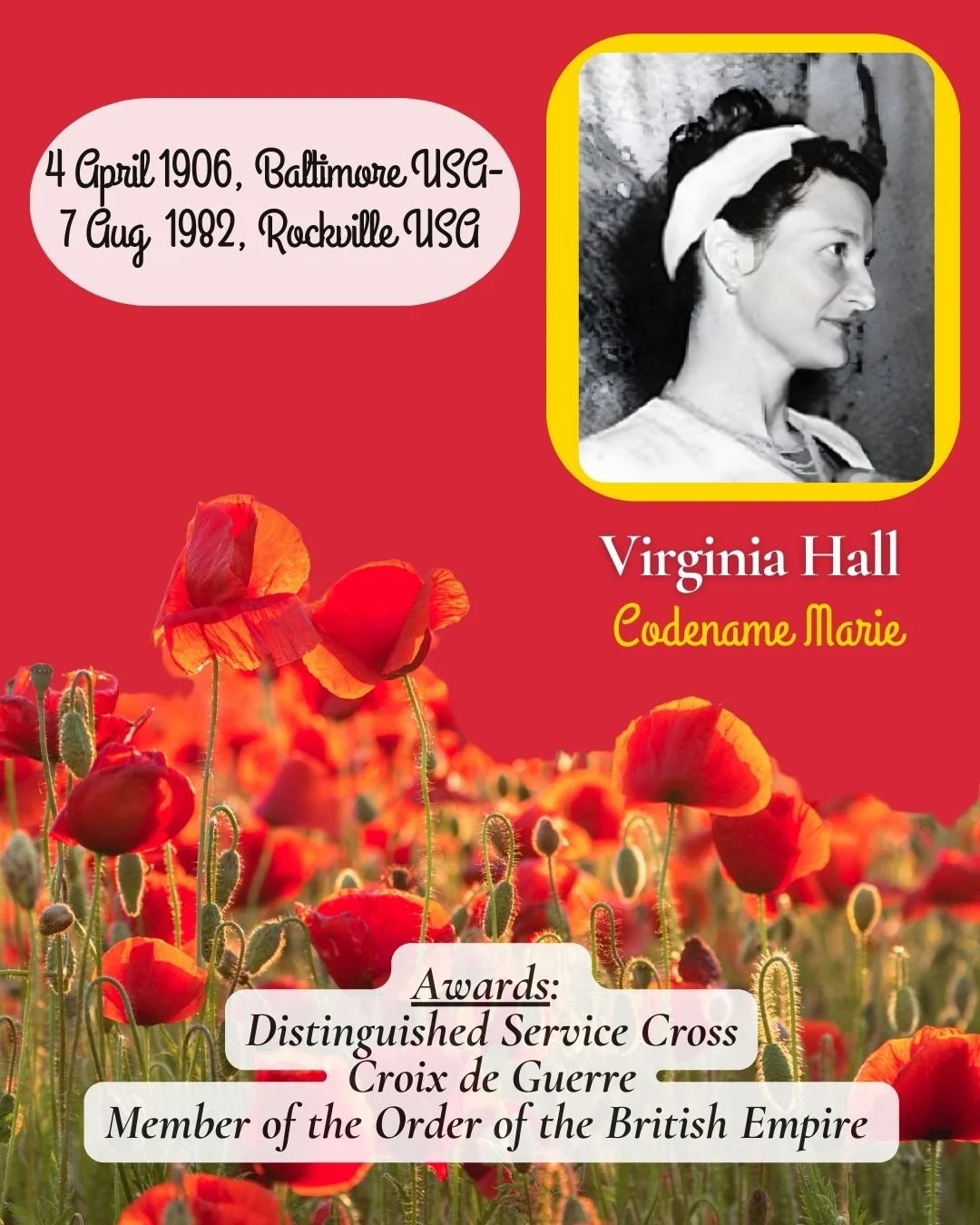
Few agents in the Second World War struck as much fear into the Gestapo as Virginia Hall. Known to them as “the most dangerous of all Allied spies,” she was—remarkably—an American woman with a wooden leg. That didn’t stop her from serving first with the British SOE and later with the American OSS, coordinating resistance networks, organizing sabotage, and guiding escaped prisoners over the Pyrenees.
Nicknamed "La Dame qui Boîte", or "The Limping Lady," Virginia’s prosthetic leg, which she nicknamed “Cuthbert,” became legendary in its own right. After being rejected by the U.S. Foreign Service due to her disability, she found her calling in the shadows—serving fearlessly behind enemy lines.
Virginia Hall’s story is one of sheer defiance. She operated in Vichy France under constant threat of capture, often disguising herself as a peasant woman and filing her teeth to appear older. Even after being forced to flee over the mountains into Spain, she returned to occupied France in 1944 to assist the Resistance ahead of the D-Day landings.
For her service, she was awarded the Distinguished Service Cross, the Croix de Guerre, and made a Member of the Order of the British Empire—the only civilian woman to receive the DSC during WWII.
Her legacy continues to inspire generations of intelligence officers, and her story is now widely taught and celebrated, including by the CIA, where she later worked. You can read more about Virginia Hall’s extraordinary life in this article by the CIA:
👉 Virginia Hall: The Courage and Daring of the Limping Lady
2. Phyllis “Pippa” Latour – The Last Agent Standing

In October 2023, the world lost the last surviving female agent of SOE’s Section F—Phyllis “Pippa” Latour. Born in South Africa, raised in French-speaking environments, and trained for some of the most perilous missions behind enemy lines, Pippa lived to the remarkable age of 102. Her story, like so many of her comrades, remained largely unknown for decades.
Phyllis joined the Women’s Auxiliary Air Force (WAAF) before being recruited into the SOE. At just 23 years old, she parachuted into Normandy in May 1944, working undercover as a teenage girl riding a bicycle through the French countryside. Her mission: gather intelligence and relay it to the Allies in preparation for D-Day. To protect her messages, she encrypted them in microscopic code hidden on silk, disguised as clothing repairs or hair ribbons.
Despite the enormous danger—being caught with a radio transmitter was punishable by death—she operated successfully until France’s liberation. She later said she joined to avenge the death of her godmother, who had been killed by the Nazis.
For her service, Pippa received numerous awards, including the Legion of Honour, the Croix de Guerre, and was made a Member of the Order of the British Empire.
She rarely spoke of her wartime work until much later in life, when she finally received public recognition. The BBC published a moving tribute after her passing, which you can read here:
👉 BBC: Phyllis Latour, the last female SOE agent, dies at 102
Phyllis Latour was the last link to a sisterhood of secret agents whose courage changed the course of the war. Now, she joins them in memory. The last agent has passed—but their stories live on.
For those of you who read The Color of Courage, you may remember that “Geneviève“ was the young W/T Operator who Lise de Baissac took under her wing in Normandy before and after D-Day.
3. Peggy Knight – The Leyton Typist with Nerves of Steel

Marguerite Diana Frances “Peggy” Knight may have started her career as a humble typist in Leyton, but her wartime path led her deep into the heart of Nazi-occupied France. Recruited into the SOE for her fluent French and remarkable calm under pressure, she parachuted into the Auvergne in 1944 and served as a courier for the DONKEYMAN Network.
With a bicycle, a fierce sense of duty, and nerves of steel, Peggy delivered secret messages between Resistance groups, often riding for miles under the constant threat of arrest or execution. Her courage, professionalism, and ability to maintain her cover made her an invaluable part of the underground effort to destabilize the German war machine.
Her wartime heroism earned her numerous honors, including the Croix de Guerre, US Medal of Freedom, and appointment as a Member of the Order of the British Empire.
After the war, Peggy lived a quiet life in Cornwall. Her story, like many of her comrades, was nearly lost to time—but thanks to dedicated local historians, her legacy now lives on.
You can read more about her in this article by the Leyton History Society:
👉 The Leyton Typist with Nerves of Steel
4. Marie-Thérèse Le Chêne – The Oldest Female SOE Agent

At 52, Marie-Thérèse Le Chêne became the oldest female agent sent by the Special Operations Executive (SOE) into occupied France during World War II. Serving from 31 October 1942 until 19 August 1943, she worked as a courier under the codename Adèle, operating primarily in the Lyon area alongside her husband, Henri Le Chêne, and brother-in-law, Pierre Le Chêne.
Due to her age, Marie-Thérèse did not parachute into France; instead, she arrived by boat. Her assignments involved transporting messages and coordinating with various resistance networks—a perilous role that required constant vigilance and courage.
Despite the significant risks, she successfully evaded capture and continued her operations until her extraction by the SOE on 19 August 1943. For her bravery and contributions to the resistance, she was awarded the Croix de Guerre and appointed a Member of the Order of the British Empire (MBE).
Unfortunately, much of Marie-Thérèse's life after the war remains shrouded in mystery, with no known photographs or detailed records of her later years. Her story stands as a testament to the countless unsung heroes whose valor and sacrifices were instrumental in the fight against oppression.
Learn more about the Le Chêne family's involvement with the SOE here:
👉 The Le Chêne Family and the Special Operations Executive
5. Odette Wilen – The Survivor Who Disappeared into the Shadows

Odette Wilen is one of the more enigmatic SOE heroines. Born in London to a Finnish mother and a French father, she joined the war effort after the death of her husband, an RAF pilot. Trained in the SOE’s rigorous program, she was parachuted into occupied France in April 1944 to serve as a courier under the codename Sophie.
Tragically, her first contact in the field was missing—arrested days earlier in what would unravel into the betrayal of the entire PROSPER circuit, one of the SOE's largest and most successful networks. Odette found herself stranded in France, surrounded by danger and unsure whom to trust.
Amazingly, she survived. With help from sympathetic locals and extraordinary courage, she evaded capture and returned safely to England—a fate not shared by many of her comrades. After the war, she quietly left public life and eventually emigrated to Argentina, where she died in 2015 at the age of 96.
She received the Croix de Guerre, the Parachute Badge of Wings, and was made a Member of the Order of the British Empire—a testament to her bravery and resilience.
You can read more about Odette and the haunting fate of the SOE's PROSPER agents in this BBC feature:
👉 BBC: The British spies who lied, loved—and were betrayed
6. Lilian Vera Rolfe – “Beyond Courage”

Born to a French mother and British father, Lilian Vera Rolfe was raised in Paris and educated in both languages—making her a perfect candidate for the Special Operations Executive. After fleeing Nazi-occupied France, she worked in the British Ministry of Information before joining the SOE.
Parachuted into the Loiret region in April 1944 under the codename Nadine, Lilian served as a wireless operator for the HISTORIAN network. Her work was perilous: transmitting from occupied territory, constantly on the move, with the risk of capture ever-present. But she continued her missions with remarkable courage and calm.
In July 1944, her network collapsed. Lilian was captured by the Gestapo, tortured, and imprisoned in Ravensbrück concentration camp. Witnesses later recalled her bravery and kindness even in the most horrific conditions. On 5 February 1945, she was executed alongside fellow agents Denise Bloch and Violette Szabo.
Lilian was posthumously awarded the Croix de Guerre, the MBE, and was Mentioned in Despatches. She was just 30 years old.
Her story is one of steadfast spirit in the face of unimaginable cruelty—a life taken far too soon, but never forgotten.
You can read more about her in this moving profile by historian Paul McCue:
👉 Lilian Vera Rolfe: Beyond Courage – Paul McCue for ICMGLT
7. Odette Sansom – The Most Decorated Woman of WWII

Few names are as synonymous with female wartime heroism as Odette Sansom. A French mother of three living in Britain, she volunteered for SOE and was parachuted into occupied France in 1942. Operating under the codename Lise, she worked closely with fellow agent Peter Churchill, posing as his wife to mask their activities.
Odette was eventually captured, tortured at Fresnes Prison, and deported to Ravensbrück concentration camp. Despite brutal interrogations and the threat of execution, she gave nothing away—protecting her comrades and inventing the story that Churchill was related to Prime Minister Winston Churchill, a clever ploy that may have saved both their lives.
Her bravery, resistance, and sheer endurance became legendary. After the war, Odette received the George Cross—Britain’s highest civilian award for gallantry—and became the most decorated female agent of the SOE. Her honors also included the Croix de Guerre, Légion d’Honneur, and multiple British campaign and jubilee medals.
Odette’s story was dramatized in the 1950 film Odette, and she later became a prominent speaker and advocate for remembering the sacrifices of the Resistance.
You can read more about her astonishing life here:
👉 How a Housewife Became One of WWII’s Most Highly Decorated Spies – HistoryNet
8. Cicely Lefort – A Tragic End in Ravensbrück

Cicely Marie Lefort had been living a quiet life in France with her French doctor husband when the world fell into chaos. Bilingual and determined, she volunteered for the Special Operations Executive (SOE) in 1943. Trained as a courier under the codename Alice, she was sent to France to serve the JOCKEY network in southeastern regions.
Unfortunately, her mission was cut tragically short. In September 1943, Cicely was arrested by the Gestapo while carrying compromising materials. She endured torture and was eventually deported to Ravensbrück concentration camp. In February 1945, with the war nearing its end, she was executed by gas chamber.
Cicely’s story might have vanished into the silence of history, but her courage was never forgotten. She was awarded the Croix de Guerre and Mentioned in Despatches. In recent years, her American great-niece embarked on a journey to uncover her legacy—piecing together family letters, records, and resistance archives to give Cicely’s sacrifice the recognition it deserves.
Her life and death are reminders of how easily the stories of brave women can be buried—and how essential it is to bring them to light.
You can read the full article about Cicely’s rediscovery here:
👉 Moscow author pieces together puzzle of relative executed as a WWII secret agent
Honoring the March SOE Women: A Legacy of Courage
As the year progresses, I continue my tribute to the extraordinary women of the Special Operations Executive (SOE) Section F by remembering those born in March. Each of these brave agents answered the call to resist tyranny, risking their lives to support the Allied cause. This month, we honor the women whose birthdays fall in March, sharing their stories so they are never forgotten.
As the year progresses, I continue my tribute to the extraordinary women of the Special Operations Executive (SOE) Section F by remembering those born in March. Each of these brave agents answered the call to resist tyranny, risking their lives to support the Allied cause.
Through their courage, resilience, and ultimate sacrifices, they became integral to the fight against Nazi occupation in France. Their missions were perilous, their endurance remarkable, and their contributions invaluable.
This month, we honor the women whose birthdays fall in March, sharing their stories so they are never forgotten.
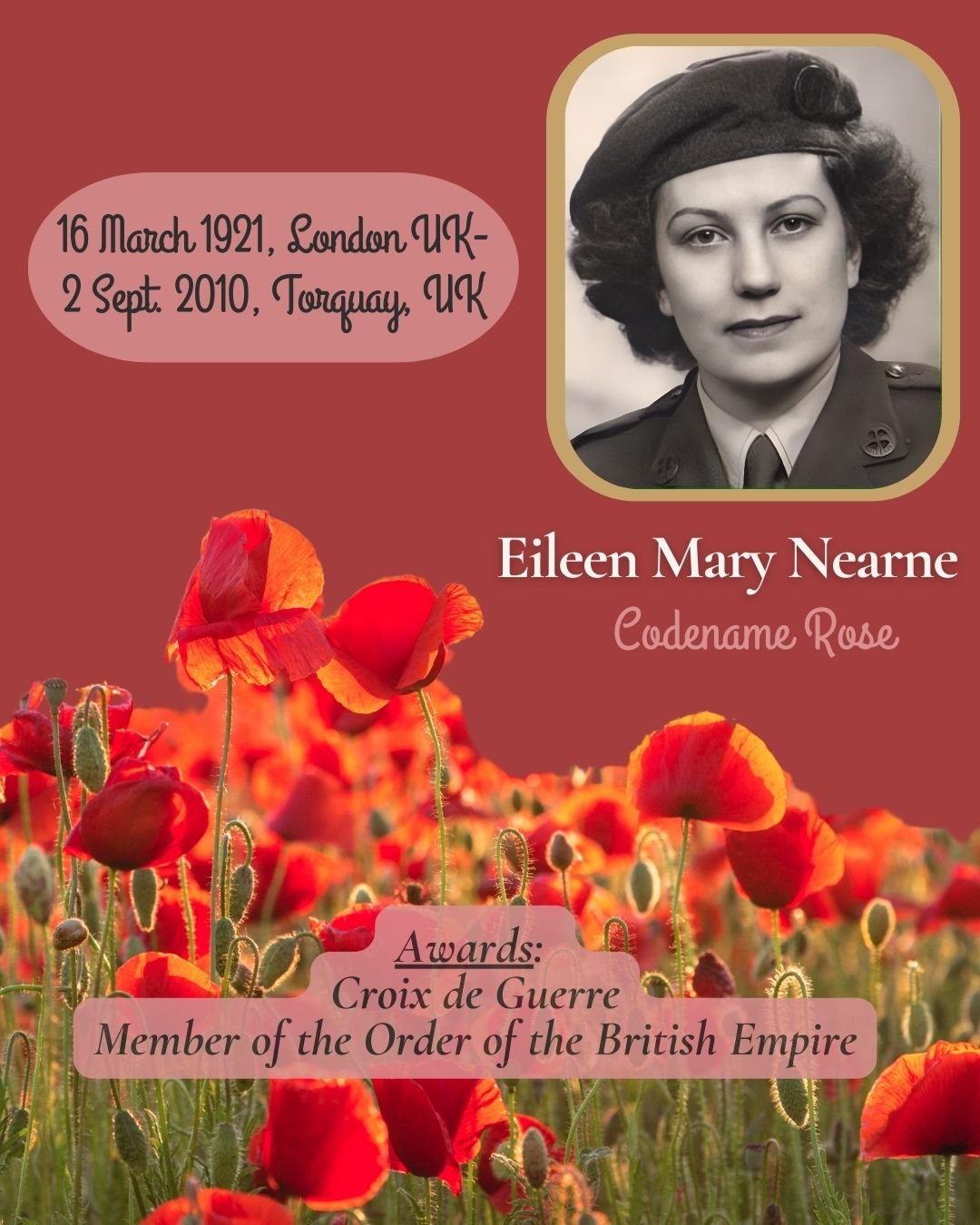
Eileen Nearne: The Unbreakable Spirit Behind Codename "Rose"
Eileen Nearne, born on March 16, 1921, in London, was one of the most resilient female agents of the SOE. After spending much of her childhood in France, she returned to Britain during the war and was soon recruited into the SOE’s clandestine operations. Fluent in French and fiercely determined, she trained as a wireless operator—one of the most dangerous roles an agent could take on.
In March 1944, under the codename Rose, Eileen was parachuted into occupied France to work as a radio operator for the Wizard network. For months, she transmitted critical messages between the French Resistance and London, facilitating supply drops, coordinating sabotage missions, and relaying vital intelligence. Despite the constant threat of detection, she remained steadfast, sending over a hundred transmissions—each one a potential death sentence if intercepted.
Her luck ran out in July 1944 when the Gestapo captured her. Despite brutal interrogation and torture, she refused to break, insisting she was an innocent civilian who knew nothing of espionage. Deported to Ravensbrück concentration camp, she endured forced labor and starvation but never lost her resolve. In early 1945, she escaped during a prison transfer and was eventually liberated by American troops.
After the war, Eileen was honored with the Croix de Guerre by France and appointed a Member of the Order of the British Empire (MBE) for her extraordinary bravery. However, she lived out her later years in quiet solitude, her incredible wartime efforts largely unknown to the world until after her passing in 2010.
Her story, though once hidden, stands today as a powerful testament to the unwavering spirit of the SOE women. She was, and will always be, a symbol of resilience, courage, and quiet heroism.
You can read my version of Eileen’s life and mission is the recently released The Echo of Valor, Codename Rose.

Anne-Marie Walters: The Young Courier of the Wheelwright Network
Born on March 16, 1923, in Geneva, Switzerland, Anne-Marie Walters was the daughter of an English father and a French mother. Fluent in both languages, she joined the Women's Auxiliary Air Force (WAAF) in 1941. In 1943, recognizing her potential, the Special Operations Executive (SOE) recruited her as a field agent. At just 20 years old, she became one of the youngest female agents in the SOE, operating under the codename "Colette."
In January 1944, Anne-Marie was parachuted into southwestern France to serve as a courier for the Wheelwright network, led by George Starr. Her role involved transporting messages, coordinating supply drops, and liaising between resistance groups—a perilous task that required constant movement and discretion. She often traveled by bicycle or train, adopting various disguises to evade German forces. Her missions took her across regions such as Auch, Tarbes, and Montréjeau, where she delivered vital information and resources to support sabotage operations against the occupying forces.
In August 1944, as Allied forces advanced, Anne-Marie and her comrades faced intense combat during the Battle of Castelnau. Despite the dangers, she continued her work until the liberation of the area. For her bravery and contributions, she was appointed a Member of the Order of the British Empire (MBE) and awarded the Croix de Guerre and the Médaille de la Reconnaissance Française by the French government.
After the war, Anne-Marie documented her experiences in her memoir, "Moondrop to Gascony," providing a vivid account of her time with the French Resistance. She later settled in France, where she lived until her passing in 1998. Her story stands as a testament to the courage and determination of the young women who risked their lives to fight against oppression.

Vera Leigh: The Overlooked Heroine of the SOE
Born on March 17, 1903, in Leeds, England, Vera Leigh was adopted by an American racehorse trainer and raised in France. She became a successful figure in Parisian haute couture, co-founding the fashion house Rose Valois in 1927. With the onset of World War II and the fall of Paris in 1940, Vera joined the French Resistance, assisting in the escape of Allied servicemen from occupied France. In 1942, she made her way to England and was recruited by the Special Operations Executive (SOE). Operating under the codename "Simone," she was parachuted back into France in May 1943 to serve as a courier for the Donkeyman circuit. Her work involved perilous missions, including delivering messages and coordinating resistance activities. Tragically, she was arrested by the Gestapo in October 1943, endured harsh imprisonment, and was executed at the Natzweiler-Struthof concentration camp in July 1944. Despite her extraordinary bravery and sacrifice, Vera Leigh received only the King's Commendation for Brave Conduct posthumously. Her story is a poignant reminder of the many unsung heroes of the SOE whose contributions have not been fully recognized.
Note: Vera Leigh's life and service will be further explored in the upcoming book, "The Gift of Grace: Codename Simone," as part of the Timeless Agents series.

Women of the Resistance: Forgotten and Famous Heroines
This month, in honor of Women's History Month, we shine a light on the famous and forgotten heroines of WWII’s resistance movements—women who fought, spied, sabotaged, and sacrificed. Some became legends, like Violette Szabo, whose bravery inspired books and films. Others, like Muriel Byck, Hannie Schaft, and Wanda Gertz, remain lesser known despite their extraordinary courage. Their stories deserve to be remembered.
Throughout history, countless women have risked everything to resist oppression, fight for freedom, and aid the war effort from the shadows. Some became legends, like Violette Szabo, whose bravery inspired books and films. Others, like Muriel Byck, Hannie Schaft, and Wanda Gertz, remain lesser known despite their extraordinary courage. This month, in honor of Women's History Month, we shine a light on the famous and forgotten heroines of WWII’s resistance movements—women who fought, spied, sabotaged, and sacrificed. Their stories deserve to be remembered. Here are some for Women History month. Join me in the Facebook Reader Group as we uncover the incredible lives of these fearless women.
📜 Remembering Violette Szabo – 80 Years On

On 5 February 1945, Violette Reine Szabo, a courageous SOE agent, was executed at Ravensbrück concentration camp. She was only 23 years old, but her bravery and resilience left a lasting mark on history.
Born to a British mother and a French father, Violette risked everything to fight for France’s freedom. Twice parachuted into occupied France, she carried out vital intelligence work and led resistance efforts with unwavering determination. Despite being captured in June 1944, she endured brutal interrogations without breaking, protecting her comrades to the very end.
On 2 February 2025, a commemoration was held in her honor, marking 80 years since her execution. Her legacy remains alive through books, films, and the continued admiration of those who recognize her sacrifice.
My own book in the Timeless Agents series about Violette, The Heartbeat of Freedom, Codename Louise, will be written in due time.
Read more about Violette’s story in this recent tribute:
📖 Her story of the Month – Violette Szabo
🕯 Lest we forget.
#VioletteSzabo #SOE #WWIIWomen #WomenOfTheResistance
📜 Remembering Muriel Byck – The SOE Agent Who Never Got to See Victory

Muriel Tamara Byck was a young Jewish woman who risked everything for the cause of freedom. Born in France but raised in Britain, she was recruited into the Special Operations Executive (SOE) and parachuted into occupied France in 1944 as a radio operator—a role with one of the highest mortality rates in the Resistance.
Working under constant danger, Muriel transmitted vital intelligence for the French Resistance, helping coordinate sabotage operations. Tragically, she fell ill with meningitis in May 1944 and died in a makeshift hospital, never living to see the Liberation of France.
Despite her sacrifice, Muriel’s story remains little known. This July, her legacy will be honored in my upcoming novel, The Call of Destiny: Codename Violette, which is now available for preorder:
📖 The Call of Destiny – Preorder Here
For more about Muriel and other Jewish heroines of the SOE, visit:
🌍 Daughters of Yael: Jewish Heroines of the SOE
🕯 Gone but not forgotten.
#MurielByck #SOE #WWIIWomen #WomenOfTheResistance #JewishHeroines
📜 Remembering Hannie Schaft – The Girl with the Red Hair

Hannie Schaft was a Dutch resistance fighter who struck fear into the hearts of Nazi occupiers. A university student turned resistance operative, she helped Jewish children escape, sabotaged enemy operations, and executed Nazi collaborators—earning her a place on the Gestapo’s most-wanted list.
In April 1945, just weeks before the Netherlands was liberated, Hannie was captured and executed. Her final words before being shot: “I shoot better than you.” Even in death, she remained defiant.
Having lived in the Netherlands for many years, I’ve always admired her courage and relentless spirit. Her story has stayed with me, and I’m honored to share it here.
For more on Hannie’s overlooked legacy, read this New York Times tribute:
📖 Hannie Schaft – Overlooked No More
🕯 Lest we forget.
#HannieSchaft #DutchResistance #WWIIWomen #WomenOfTheResistance
📜 Honoring Wanda Gertz – The Woman Who Became a Soldier

Wanda Gertz was a Polish patriot whose determination knew no bounds. Born in 1896 in Warsaw, she was inspired by her father's tales of the January Uprising. At a time when women were barred from combat, Wanda cut her hair, donned male attire, and enlisted in the Polish Legion during World War I under the alias Kazimierz "Kazik" Żuchowicz. Her courage and skill led her to serve in various capacities, including commanding an all-female sabotage unit during World War II. Despite facing imprisonment and numerous challenges, her spirit remained unbroken.
For a comprehensive look into her life and legacy, this article offers detailed insights:
📖 Wanda Gertz – The Symbol of Female Courage in World War II
🕯 Remembering a true heroine.
#WandaGertz #PolishResistance #WWIIWomen #WomenOfTheResistance
📜 Honoring Andrée de Jongh – The Architect of the Comet Line

Andrée de Jongh, affectionately known as "Dédée," was a Belgian resistance heroine who, during World War II, established the Comet Line, a clandestine network that rescued Allied airmen shot down over occupied Europe. Born in 1916 in Schaerbeek, Belgium, she was inspired by the bravery of Edith Cavell, a British nurse executed in World War I for aiding soldiers' escapes. Dédée's unwavering courage led her to personally escort numerous airmen across treacherous terrains, including the Pyrenees, guiding them to safety in neutral Spain. Her relentless efforts saved countless lives, and even after being captured and enduring imprisonment in concentration camps, her spirit remained unbroken.
For a comprehensive look into her life and legacy, this article offers detailed insights:
📖 Andrée de Jongh: Faster Than a Comet
🕯 Remembering a true heroine.
#AndréeDeJongh #CometLine #BelgianResistance #WWIIWomen #WomenOfTheResistance

Revolutionary Roles: Women’s Military Uniforms in WWII
World War II marked a turning point in history—not just on the battlefield but in how societies redefined roles for women. For the first time, women donned official military uniforms, stepping into roles that challenged traditional gender norms and showcased their courage, skill, and resilience. Join me as we explore the stories behind these iconic uniforms, the brave women who wore them, and the revolutionary shift they represented in military and social history.
World War II marked a turning point in history—not just on the battlefield but in how societies redefined roles for women. For the first time, women donned official military uniforms, stepping into roles that challenged traditional gender norms and showcased their courage, skill, and resilience. From the Women’s Auxiliary Air Force (WAAF) to the First Aid Nursing Yeomanry (FANY), these uniforms symbolized a blend of functionality and groundbreaking progress.
Each of the uniforms featured in this blog post—WAAF, FANY, ATS, CWAC, AWAS, and WAC—represents women’s invaluable contributions to the war effort. While this blog focuses on these specific groups, countless others, including nurses and pilots, also wore uniforms that made history.
It’s important to recognize that this blogpost highlights only a few of the many roles women played in WWII. Their contributions spanned far beyond these groups, with numerous unsung heroines working tirelessly behind the scenes and in active service.
Join me as we explore the stories behind these iconic uniforms, the brave women who wore them, and the revolutionary shift they represented in military and social history.
Click image for larger size
FANY Uniforms: A Story of Service and Secrecy
The First Aid Nursing Yeomanry (FANY) played a crucial role during World War II, with its members serving in communications, intelligence, and field operations. Many women agents, including Lise de Baissac and Eileen Nearne, operated under the guise of being part of the FANY. This "cover" provided a layer of official protection while they carried out their daring missions behind enemy lines. The FANY uniform, distinguished by its practical design and smart tailoring, embodied the resilience and courage of the women who wore it.
While the FANY began as a nursing organization, by WWII, its members took on far more diverse and dangerous roles, from radio operators to drivers in active war zones. The uniform was not just a symbol of their service but also a part of the secrecy that made their contributions possible.
Learn more about the FANY and the women who made history in these uniforms here https://www.fany.org.uk/History
Click image for larger size
WAAF Uniforms: Service in the Skies and Beyond
The Women’s Auxiliary Air Force (WAAF) was established during World War II, and its uniform symbolized a new era of women's active involvement in the military. Unlike some other organizations, WAAF members were given official ranks, marking their roles as integral and not just voluntary. Women like Muriel Byck and Noor Inayat Khan, both SOE agents, wore the WAAF uniform as a form of protection and cover for their clandestine missions.
The uniform itself was practical yet smartly designed, consisting of a blue-grey jacket, skirt, and cap, reflecting its connection to the Royal Air Force. Women in the WAAF served in a variety of roles, from clerks and drivers to wireless operators and radar mechanics. For agents like Muriel and Noor, the uniform provided a semblance of legitimacy as they carried out dangerous operations behind enemy lines.
While Noor Inayat Khan tragically lost her life in service, her story, alongside Muriel’s, underscores the immense courage and sacrifice of WAAF members who shaped the war effort in both visible and hidden ways.
Dive deeper into the history of the WAAF and the women who served with bravery here https://rafhornchurch.com/history/waaf/
Click image for larger size
ATS Uniforms: Service on the Home Front
The Auxiliary Territorial Service (ATS), the women’s branch of the British Army during World War II, was a vital part of the military effort. Its uniform, consisting of a khaki jacket, skirt, and cap, mirrored that of their male counterparts while being tailored to women. The ATS uniform symbolized the expanding roles of women, from clerks and cooks to mechanics, drivers, and anti-aircraft gunners.
Among the many women who wore the ATS uniform was Princess Elizabeth, the late-Queen Elizabeth II, who joined the ATS in 1945 as a second subaltern. She trained as a driver and mechanic, becoming the first female member of the royal family to serve in the armed forces. Her service in the ATS not only reflected her dedication but also served as a powerful symbol of solidarity with the people during the war.
The ATS uniform showcased practicality and professionalism, blending the need for functionality with military decorum. For the women who wore it, including Princess Elizabeth, it represented a sense of duty and pride in their contribution to the war effort.
Explore the stories of the ATS and its extraordinary members here https://www.nam.ac.uk/explore/war-glamour
Click image for larger size
WAC Uniforms: Pioneering Roles in the U.S. Military
The Women’s Army Corps (WAC), established in 1943, marked a significant shift in the U.S. military, allowing women to serve in non-combat roles with official military status. The WAC uniform, designed with practicality and professionalism in mind, included a tailored olive-drab jacket, skirt, and hat, reflecting the military standards of the time.
One of the most notable figures of the WAC was Oveta Culp Hobby, the Corps’ first director. A trailblazing leader, she guided the WAC through its formative years, ensuring women’s roles were respected and impactful. Under her leadership, WAC members served in over 200 job roles, including clerks, radio operators, mechanics, and cryptographers, freeing up men for combat roles and proving the invaluable contributions of women in the armed forces.
The WAC uniform became a symbol of progress and determination, as women stepped into roles traditionally held by men, breaking barriers and reshaping the perception of women in the military.
Learn more about the Women’s Army Corps and its pioneering members here https://unwritten-record.blogs.archives.gov/2013/06/03/dont-walk-like-a-man-be-the-best-wac-that-you-can-be/
Click image for larger size
CWAC Uniforms: Canadian Women’s Contributions to the War Effort
The Canadian Women’s Army Corps (CWAC) was formed in 1941, allowing women to officially enlist in the Canadian Army for the first time. The CWAC uniform, a smartly tailored khaki jacket and skirt paired with a peaked cap, represented professionalism and pride in service. It was designed to provide women with practicality and a sense of equality within the military.
Among the many women who served in the CWAC, Joan Kennedy stands out as a trailblazer. As one of the first officers in the Corps, she was instrumental in recruiting and organizing women for military roles. Under her leadership, CWAC members served in critical support positions, such as clerks, typists, drivers, and medical aides, enabling male soldiers to focus on combat duties.
The CWAC uniform became a powerful symbol of Canadian women’s vital role in the war effort. These women not only contributed to the Allied victory but also paved the way for future generations of women in the armed forces.
Discover the inspiring stories of the CWAC and the women who shaped history here https://www.thecanadianencyclopedia.ca/en/article/canadian-womens-army-corps
Click image for larger size
AWAS Uniforms: Australian Women Supporting the War Effort
The Australian Women’s Army Service (AWAS), formed in 1941, was the first time Australian women were allowed to serve in the army. The AWAS uniform, featuring a khaki jacket, skirt, and slouch hat, reflected the unique identity of Australian servicewomen. Designed for practicality and function, it became a symbol of their commitment and dedication.
One of the most notable figures in the AWAS was Sybil Irving, its founder and controller. A visionary leader, Irving worked tirelessly to organize and expand the AWAS, ensuring women were prepared and equipped to serve in roles such as clerks, drivers, signal operators, and even anti-aircraft personnel. Under her guidance, the AWAS became a vital part of Australia’s war effort, allowing men to be deployed to combat roles.
The AWAS uniform represented more than just military service; it embodied the pioneering spirit of Australian women who stepped forward to serve their country during its time of need.
Explore the history of the AWAS and the incredible women who wore the uniform here https://vwma.org.au/explore/units/3423