I’ve been fascinated by dance and dancers all my life, but that doesn’t mean my own experience of ballroom dancing has been either successful or glamorous. On the contrary. Like other fourteen- and fifteen-year-old girls in Holland, I took ballroom-dancing lessons on Friday nights. For most girls, the biggest challenge was finding a partner at all, as there were far fewer boys than girls at the dance school. That wasn’t my greatest worry, although I wasn’t one of the popular girls and would have ranked among the Eloise Bridgertons on the dance floor. No, I was in absolute terror of the dance master, Mr Janvier.
At the end of the 1960s, the fashion was slingbacks with a small heel. As I was struggling to get a grip on the foxtrot with an equally clumsy partner, I suddenly felt a sharp, stinging pain in my heel. I yelped, and maybe even let out a badly restrained curse. When I looked to see what had attacked me, I found the very pointy toe of Dancemaster Janvier’s patent-leather shoe. And why? Because I was on the wrong footing. It goes without saying that he was on the wrong footing with me from then on, and whenever I could feign a headache on a Friday night, I skipped the ballroom class.
I never became an accomplished dancer, but I am still a fervent spectator of anything ballroom and glamour.
Like everyone who has enjoyed series such as Bridgerton and Downton Abbey, I’m fascinated by the debutante balls of the nineteenth and early twentieth centuries, while understanding very well that they were mostly a marriage market for young girls. And we most enjoy the girls who at least tried to escape the net, like the bookish, sharp Eloise.
Of course, my dance classes had nothing to do with getting married, but they did have a lot to do with that first, awkward discovery of touch with the opposite sex. Though not enough to stop me skipping the classes.
My own ballroom failure is a sideways introduction to my new heroine, Rosamond, who also had no intention whatsoever of getting married when she attended Charlotte’s Ball in 1912.
A machine with one purpose
We see the Season now through a gauze of romance, but the girls of 1912 knew exactly what it was for. First came the presentation at Court: a white gown, a train, three ostrich feathers in your hair, and one deep curtsy to the King and Queen. Then a whole summer of balls, dance cards, calling cards and chaperoned visits. At the end of it, a girl was expected to have turned her single season of glory into a husband.
Rosamond is seventeen, and she does her best. She dances with a great many young men with whom she has nothing to talk about, and smiles until her face aches. All the while she longs for her notebooks, because what she really wants is to write. Her grandmother, the formidable GG, whispers the only advice she can bear:
“Sell your wonderful head only to the highest bidder, ma petite Rose. Look at their teeth and their conversation, and say no. For as long as it takes.”
The question mid-waltz
And then, at Charlotte’s Ball, in the middle of a Viennese waltz, an old friend from her Cornish summers bends to her ear and asks:
“Do you have a special beau, Rose?”
And Rosamond, who has never been able to hold her tongue, answers: “No, I don’t particularly like young men.”
In that moment, mid-waltz, she understands what the Season has been trying to tell her all summer: that a girl like her is expected to marry within the year, and that her only assets are her youth and her womb. It’s the gilded cage in a single dance, and Rosamond has no intention of staying in it.
What happens next, and who that young man turns out to be, you’ll find in the book.
A small confession
I have taken one liberty with history. Queen Charlotte’s Ball, named for the queen whose birthday ball began the tradition in 1780, only became the great debutante event of the Season in the 1920s. I let Rosamond dance at it a few years early. I hope you’ll forgive me; she needed a ballroom, and I couldn’t resist.
Rosamond’s was also one of the last Seasons of the old world. Two summers later the war swept the whole glittering business away. The Season crept back in the twenties, but it was never the same again, and the curtsy to the sovereign survived only until 1958.
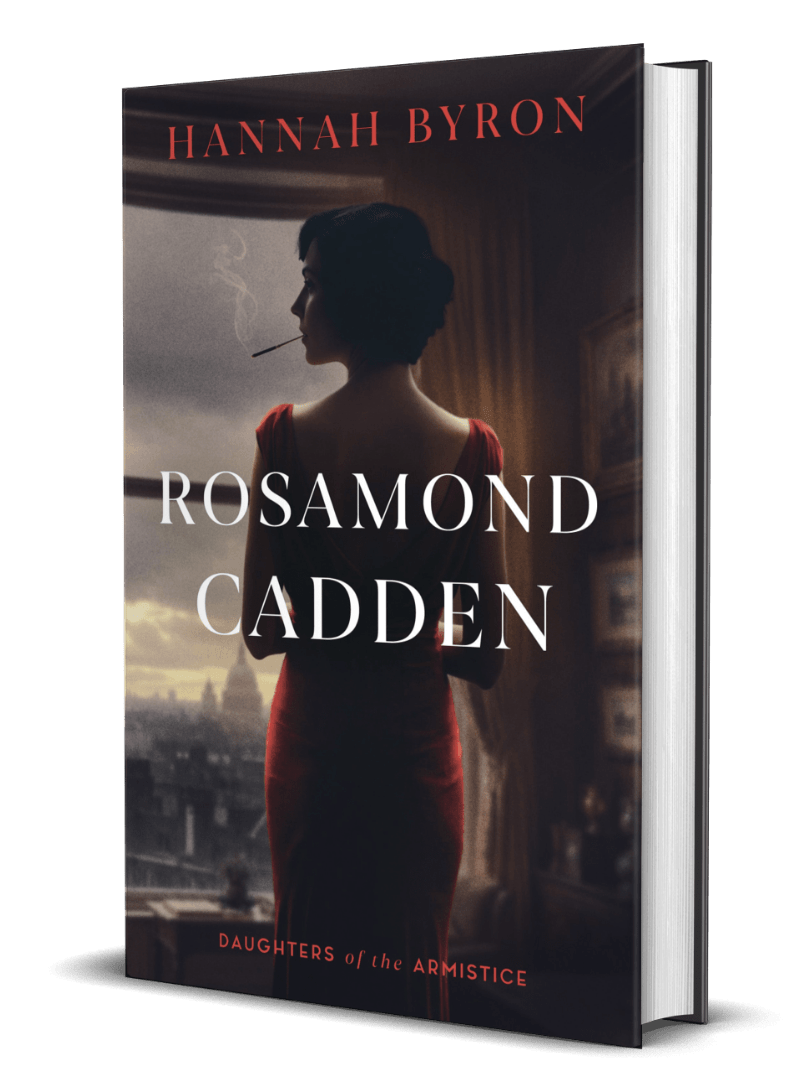
Rosamond Cadden, the first book in Daughters of the Armistice, is out now.