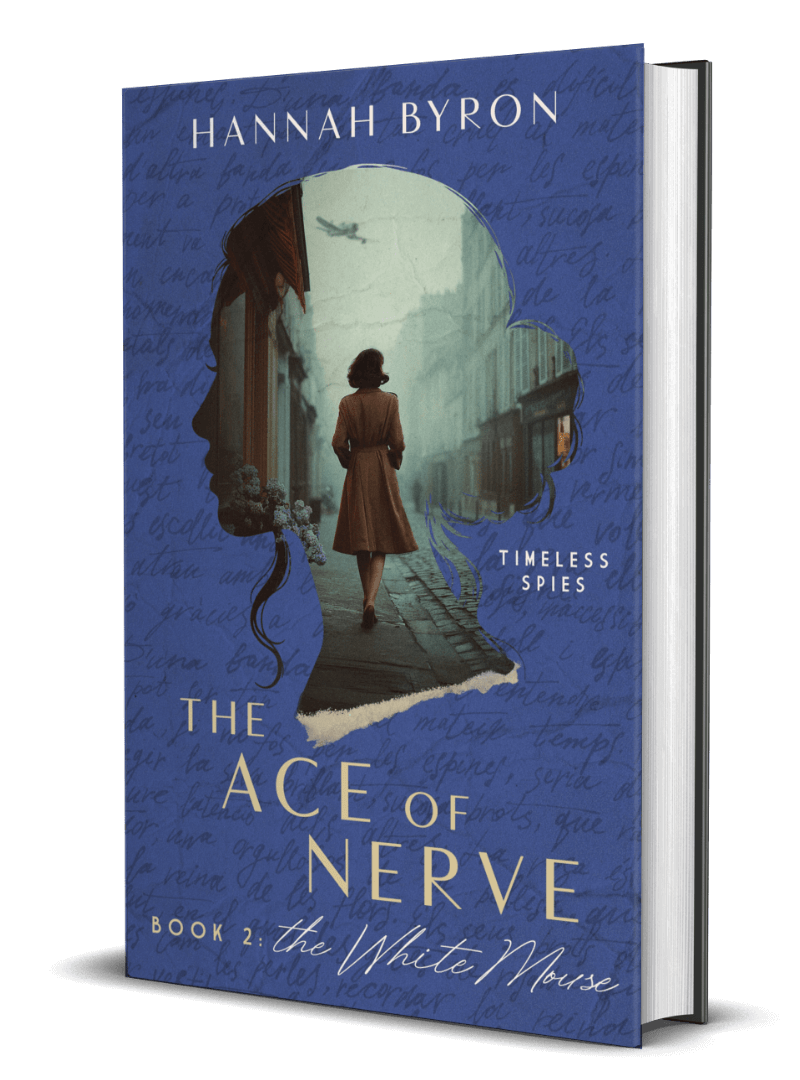
Out now: The Ace of Nerve, Book 2: The White Mouse
The Journey Continues
When Codename Hélène was published in late December 2025, it marked the beginning of my journey with one of the Second World War’s most remarkable women. Nancy Wake entered my life through months of research: reading biographies and her own autobiography and speaking with historians who had known her during the last decade of her life in London.
Even before I had finished writing that first book, I knew there was another chapter of her story I wanted to tell.
Those of you who have read Codename Hélène will know that I chose not to tell Nancy’s story chronologically. Perhaps I should have, but I allowed myself a little artistic freedom. The White Mouse therefore returns to an earlier period in her life, focusing on her years in Marseille as Madame Fiocca and the events that would eventually earn her the Gestapo nickname ‘The White Mouse’.
Alongside Nancy’s story, Aroha Tui, the young Māori nurse and companion introduced in the first novel, also returns as her own journey continues to unfold.
Following in Their Footsteps
Over the past few years, I've travelled to many of the places where these events unfolded. I visited Beaulieu in Hampshire, where SOE agents underwent part of their training, walked the streets of Paris and Marseille, stood outside the homes where Nancy and Henri Fiocca once lived, and corresponded with historians who have devoted years to researching the men and women of the SOE.
Every journey, every conversation and every new discovery added another layer to the story and reminded me that history is rarely as straightforward as it first appears.
The People Around the Legend
What stayed with me most, however, wasn't simply Nancy's extraordinary courage. It was the people around her.
Those who risked everything without expecting recognition: Henri Tardivat, Ian Garrow, Denis Rake, Albert Guérisse (Pat O’ Leary), Georges and Fanny Rodocanachi, and so many others whose names are less familiar today. But above all, Henri Fiocca, whose quiet loyalty and tragic fate became one of the moments in Nancy's story that touched me most deeply while writing the novel.
The longer I write historical fiction, the more I find myself drawn not only to the famous names, but to the people who quietly stood beside them. Historical fiction allows us to celebrate those whose stories are well known, but it also gives us the opportunity to remember those who rarely appear in the history books. For me, it is one of the greatest privileges of writing these novels.
Two Journeys, One Story
Alongside Nancy's wartime journey, Aroha's own search for identity and belonging becomes increasingly intertwined with the past she is uncovering. While history tells us how Nancy's life unfolded, Aroha's future remains unwritten, and I hope readers will find themselves caring just as deeply about her quest.
Why I Write These Novels
As a fiction author, it is never my goal to simply teach readers about history. That is the role of historians and biographers. I try to shed light on what lies beyond the facts: the hopes, dreams, failures and lessons that lived in the hearts of these people. Imagined, of course, but hopefully relatable.
Today, I invite you to continue the journey. Whether you have already travelled with Nancy in Codename Hélène or are meeting her for the first time, I hope The White Mouse reminds you that around every legendary name stood real people who laughed, loved, sacrificed, and quietly changed the course of history with them.