
Blog categories
The Forgotten Years in Britain Between Two World Wars
We call them the interwar years, but nobody living in 1919 knew that a second war was coming. All they knew was that the first one had ended. In my new series, Daughters of the Armistice, I have become fascinated by those twenty years — and by what they meant for the women who had to build a future out of them.
For my next historical fiction series I’m moving away from the Second World War to the interwar period.
In the history books we have been taught to call them the interwar years and, from our perspective, this sounds like a convenient label for twenty years of human life squeezed “in between.”
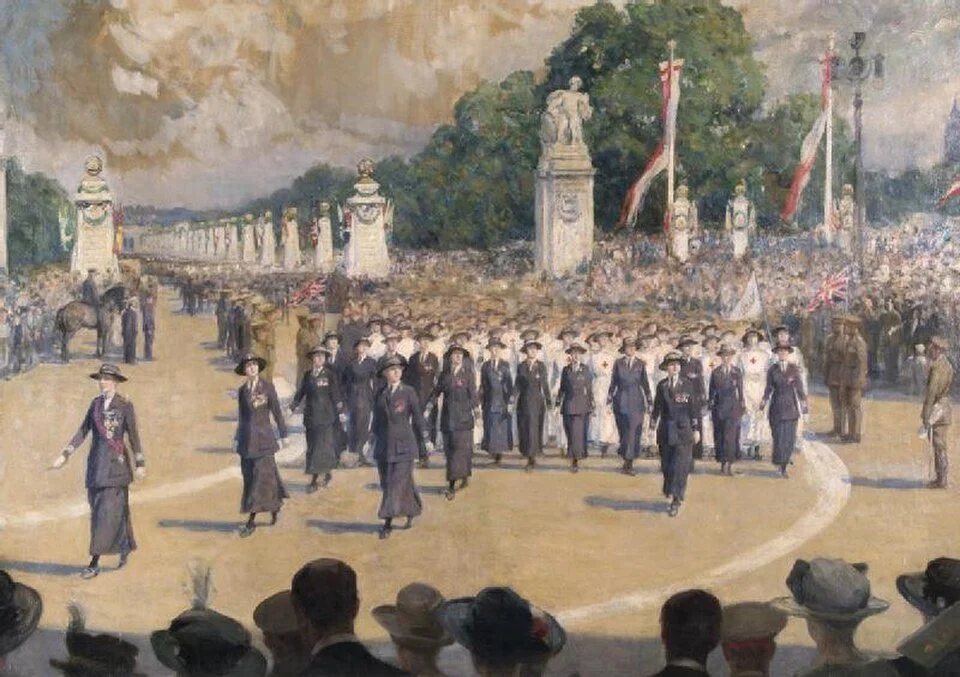
George Harcourt - The Voluntary Aid Detachments, Peace Procession, 19 July 1919
The First World War ended in November 1918. The Second began in September 1939. Two decades contained by two wars, as though those two terrible events were the bookends that gave the intervening years their meaning.
But nobody woke up on the morning of 1 January 1919 and thought: Gosh, now I am living in the first year of the interwar period. Let’s enjoy it while it lasts.
All people knew was that one war had ended. They didn’t know another one was waiting for them. And this difference in perspective is one of the reasons I’ve become increasingly fascinated by these “interbellum” years. Of course, people always lived “between wars”, perhaps we are doing so right now but only that generation lived between two world wars.
They didn’t — We do
We know about Hitler and Mussolini, the Depression, appeasement and the road that — almost inevitably — led to the next global conflict. We recognise the writing on the wall because we already know where they led. The people living in the 1920s and 1930s could not. And I’d say, thank God for that.
In fact, there was genuine hope that the hell they’d just survived might result in a better world order. Already during the war H. G. Wells had written of a conflict the scale of which could end war itself. In Britain, the Ministry of Reconstruction had been established before the fighting was even over, charged with rebuilding national life on what it called “a better and more durable foundation.”
In August 1919, British government planning even worked on the assumption that the British Empire “would not be engaged in any great war during the next ten years”. Smaller conflicts were not ruled out — only another war on that scale.
But optimism was never the whole story. As early as September 1918, two months before the Armistice, the British military correspondent Charles à Court Repington recorded that he and an American historian had agreed that the conflict should be called The First World War.
Repington was not predicting a second world war. His reasoning was more sombre: he believed people shouldn’t forget that the history of humanity had repeatedly been a history of war. When was humanity ever “war free”? Well, we can still ask that question today.
So hope and apprehension existed side by side. And in the meantime ordinary people tried to rebuild their lives while still carrying the physical and emotional wreckage of the old one.
From the Second World War to the Interwar Period
The ‘historical’ part of historical fiction holds almost as much fascination for me as the ‘fiction’ part. That’s why I write it. I love researching the period my novels are set in, and I suppose every historical fiction author will tell you the same. We get ‘obsessed’ with the period itself, as if it is just another character.
Of the eighteen historical novels I’ve brought out so far, only one was set in 1918. All the others were set between 1939 and 1945. The second war offered me a bigger canvas and a rich tapestry of different European countries where my resistance women moved, lived, loved and fought.
But those of you who know my books know they start before the war even breaks out because I’m interested in why and how my heroines decide to join the resistance and not stay home and be wives and mothers. And that leads me to the years in between.
Who decides what becomes history?
And that brings me to women’s lives as gender is important to me.
Alas, history books never tell everything that happened to everyone. What is handed down to us depends on what was recorded, preserved, studied and considered important enough to pass on.
For centuries in the Western world, the institutions making those decisions were controlled by educated and socially powerful (white) men. Inevitably, that influenced where the historical spotlight fell.
We know about governments and generals, elections and treaties, battles and political crises. And perhaps we should, because they matter.
But I’m not a historian. I’m also not a socially powerful man, although one could argue that I’m educated. And I’ve chosen to shed a light on the women in history.
British women filling munitions in a factory during WW1
Why Wealthy Women
As a novelist and a woman, I’m interested in how those enormous events impacted individual life. And, particularly, what they meant for women.
‘My women’ tend to belong largely to the educated middle and upper classes. That is the window through which I look at this period. And I’m quite aware that isn’t the whole picture, either. But that choice has more to do with the fiction part than the historical one. I want to add glamour, travel, a ‘Downton Abbey feel’ to my books, so the women have more opportunities than their sisters from the working classes.
But of course you’ll find working-class characters in my books because all lives were intertwined, so also those who worked in the grand houses, in hospitals and in factories. Class radically altered a woman’s choices and opportunities in the 1920s anyway.
There is another reason I write women who were raised with a clear idea of what their future would look like, shaped by the expectations of their class. It gives them something to rebel against. My women change their future because the gilded cage no longer fits. I call that Downton with steel.
So let’s have a look at my first heroine in the series, the novelist Rosamond Cadden. She writes in her diary on Armistice Day, 11 November 1918:
“Before all this, before the war and the devastation, I had a family, Reggie, Mummy, little one. And I had my work. It was a future.”
The question behind those words was very real for all women who came out of the war widowed or without sons.
What happened to these women when the future she was raised to expect disappeared?
Before the war, Rosamond’s successful debut novel had made a name for her, and her publisher was waiting for her second book. Writing had become more than something she loved to do. It offered her a career and, potentially, an independent future.
Then her husband went missing in the war. Her financial future became uncertain and, just when her work might have offered her another way forward, grief robbed her of the ability to write.
That is the contradiction that interests me. A woman could appear privileged and protected and still discover how precarious her independence really was. And Rosamond was far from alone in facing an uncertain future after the war.
The women left behind
Despite a generally held belief, the First World War didn’t create Britain’s imbalance between the sexes, although it made it considerably worse. The 1911 census already recorded around 1.18 million more females than males in England and Wales. By 1921, that difference had grown to roughly 1.72 million.
As early as 1917, a teacher at Bournemouth High School for Girls reportedly told a class of sixteen- and seventeen-year-olds that only one in ten of them could ever hope to marry.
Her arithmetic could certainly be questioned, but that’s almost beside the point. It tells us something about the atmosphere in which girls were contemplating their futures, at a time when marriage was still regarded as the expected — and often the most secure — future for a woman of their class.
And it raised an important question. What were these unmarriageable women supposed to do instead?
Valve Testing - the Signal School, Royal Navy Barracks, Portsmouth
Freedom — followed by a step backwards
The war had also disrupted assumptions about what women were capable of doing. With the men away to the front, women had entered occupations previously closed to them. They worked in factories and offices, on farms, in transport, hospitals and countless other areas of national life.
But when the men came home, Britain produced an odd mixture of progress and retreat until the mid-1920s.
Some women received the parliamentary vote in 1918, but not all. A twenty-five-year-old woman who’d spent the war doing dangerous munitions work could still not vote. Equal voting rights with men wouldn’t arrive until 1928.
The Sex Disqualification (Removal) Act of 1919 declared that a person should not be disqualified by sex or marriage from exercising a public function. Slowly but certainly, women began entering professions that had previously excluded them.
Yet marriage bars survived. Usually, women lost their employment upon marriage. And the women who’d taken men’s places during the war were generally expected to relinquish them when the servicemen returned.
Conclusion
For women the interwar period opened doors. Some stayed open. Others were quietly pushed shut again.
And this is where these forgotten years become most interesting to me. They were neither simply an age of female emancipation nor a return to the world that existed before 1914. They were something much messier: a period in which old expectations and new possibilities existed side by side.
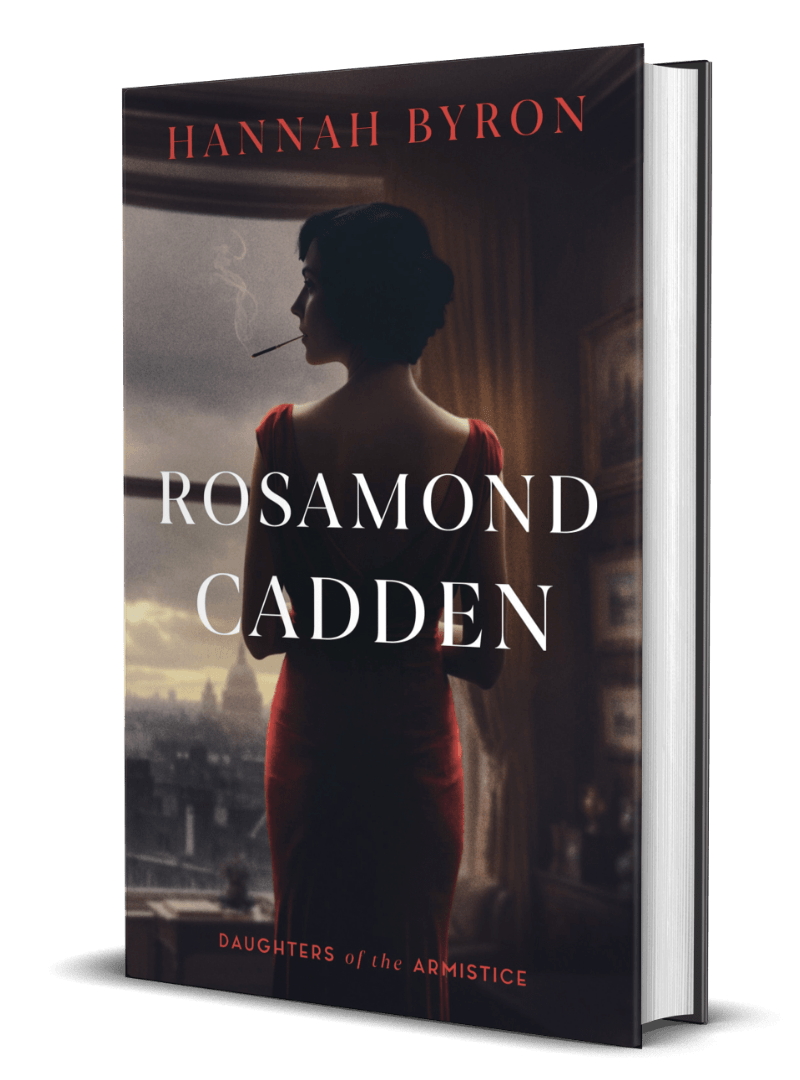
Rosamond Cadden is the first of the women through whom I will be exploring that world in my new series, Daughters of the Armistice. Over the coming months, here on the blog, I want to step beyond their fictional lives too — into the real history that shaped them, the choices women actually faced, and the extraordinary changes taking place behind the familiar headlines of the 1920s and 1930s.
Because the wars may give these twenty years their name. But the women who lived between them had stories of their own.
Sources & further reading
1911 Census of England and Wales, General Report — population figures for the pre-war imbalance between women and men.
1921 Census of England and Wales / Office for National Statistics, “Census unearthed: population, widows and orphans in 1921” (2022) — population and sex-ratio figures for post-war England and Wales.
Charles à Court Repington, The First World War 1914–1918 (Constable, 1920) — including his diary entry of 10 September 1918 on the choice of the term “First World War.”
H. G. Wells, The War That Will End War (1914) — contemporary expression of the hope that the conflict might lead to lasting peace.
Ministry of Reconstruction, 1917–1919 — established to consider post-war reconstruction of British national life, including employment, housing and the position of women.
British Cabinet decision, August 1919 — the “Ten Year Rule,” under which defence estimates were prepared on the assumption that the British Empire would not be engaged in a great war during the following ten years.
Virginia Nicholson, Singled Out: How Two Million Women Survived Without Men After the First World War (Penguin, 2007) — including Rosamund Essex’s recollection of being told at Bournemouth High School for Girls that only one girl in ten could expect to marry.
Representation of the People Act 1918 — enfranchised women over thirty who met the relevant qualifications; equal parliamentary voting rights came with the Representation of the People (Equal Franchise) Act 1928.
Sex Disqualification (Removal) Act 1919 — removed a number of formal barriers preventing women from entering public functions and professions.